








Pantera Partners: Why the 2025 Crypto VC Landscape is Different from Previous Cycles?

 The wave of strategic mergers and acquisitions and IPOs will continue into the next cycle.
Original Title: The State of Crypto Venture Capital in 2025
Original Author: Paul Veradittakit, Partner at Pantera Capital
Original Translation: Luffy, Foresight News
Summary
Since the beginning of this year, cryptocurrency companies have raised over $16 billion, with more than 100 merger and acquisition deals. The industry is moving towards a record-breaking direction, with total transaction volume exceeding that of the entire year of 2024.
Driven by increased transparency in U.S. regulations and global growth momentum, the foundation of this cycle is more solid.
Strategic mergers and acquisitions and the IPO wave will continue into the next cycle.
In 2025, record-breaking M&A and IPO activities are reshaping and driving the upgrade of the crypto industry, attracting new capital, institutions, developers, and users, injecting momentum into blockchain innovation and application implementation. This pattern has also appeared in other major technological transformations: after decades of infrastructure development, explosive growth often follows. The rise of artificial intelligence benefited from decades of infrastructure investment, while the crypto industry is maturing at a much faster pace, relying on a more advanced tech stack and leveraging higher-quality tools for compounded growth. For this reason, the intrinsic dynamics of the current market are fundamentally different from previous cycles: it is no longer dominated by speculative trading but is more reliant on strategic integration.
Accelerating Momentum: What Makes This Cycle Different
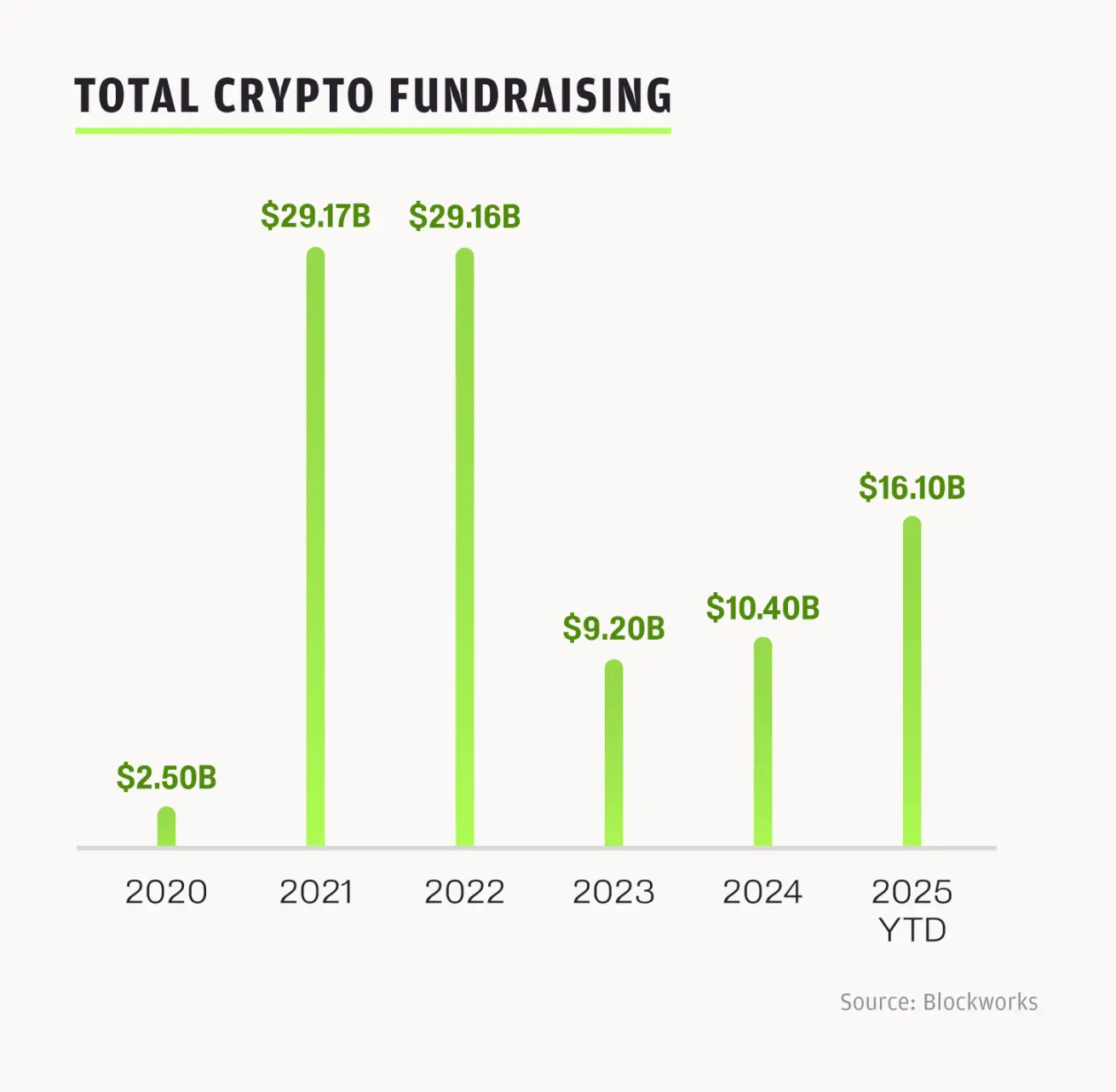
The crypto market exhibits sinusoidal fluctuations. Although the growth rate in the venture capital sector has slowed, factors such as favorable regulations, a government-friendly attitude towards crypto, active trading flows, increased investment from companies like Robinhood in crypto businesses, and deeper cross-integration between crypto and adjacent fields have led to a bullish trend in the industry's deeper activities.
After peaking in 2022, capital investment significantly declined in 2023, began to recover in 2024, and is expected to accelerate significantly in 2025: in just the second quarter of 2025, there were 31 transactions exceeding $50 million, with follow-on financing such as IPOs, mergers, and debt financing becoming the main drivers of growth. From the beginning of the year to now, the capital attracted by the crypto market has reached $16.1 billion, but crypto venture capital is mimicking the model of traditional venture capital: capital is concentrating in a few funds. Capital concentration typically leads to an increase in the amount of individual investments but a decrease in the total number of transactions, reflecting that many crypto companies are gradually moving towards the growth stage, and indicating that the current financing environment is more competitive than ever for both founders and investors.
Multiple factors are at play, making this cycle unique: the rebound in token prices, the continuous launch of new products, founders' increased confidence in the industry, and favorable regulations clarifying the development direction for stablecoins and digital assets have unlocked more capital for the industry. In recent years, regulatory ambiguity has created friction between innovators and the Web3 space due to concerns over potential punitive risks. The Trump administration's friendly attitude towards the crypto industry, through the "Genius Act" and the "Clarity Act," has laid a legislative foundation for on-chain applications. While we cannot determine the long-term impact of these acts, it is certain that these discussions and initiatives will reduce hesitations regarding crypto investments at both cognitive and funding levels. Additionally, the Federal Reserve is expected to lower interest rates in November, which may drive more capital into risk assets, while the Digital Asset Trading System (DATS) will lock capital into long-tail assets. Investors' risk aversion is gradually weakening, and the enthusiasm for capital inflow is continuously increasing.
Investment allocation is shifting: one-third of capital is flowing into "bottom-up" opportunities, such as perpetual contracts, token issuance platforms, prediction markets, and new DeFi foundational protocols; the remaining two-thirds focus on "top-down" areas, including DATS, real-world asset tokenization (RWAs), exchange-traded funds (ETFs), and companies preparing for IPOs. In this cycle, public market assets dominate, allowing a broader public to access crypto assets more easily. This is a very healthy signal for the industry. This balanced situation indicates that the market is gradually maturing, valuing both innovation and integration with traditional finance.
The window for establishing a crypto legislative blueprint is very short, and the current government's supportive attitude towards the crypto industry will last until the mid-term elections in 2026. The DeFi Education Fund is committed to protecting software developers: it has not only submitted feedback on the Senate Banking Committee's "Digital Asset Market Structure Information Request" but also recently released a discussion draft of the "2025 Responsible Financial Innovation Act." The Wyoming Blockchain Summit 2025 held last week focused on digital asset regulation, emphasizing the urgency of establishing a clear regulatory framework for crypto in the U.S. and the necessity of building a balanced market structure. Current government officials attended the summit, and the agenda included promoting forward-looking regulations. Looking ahead to the first quarter of 2026, we expect the regulatory foundation to be more solid than in any previous cycle, especially in the context of time constraints.
Token Listings and IPO Market Reopening
In 2025, the number of token listings has decreased, and fewer new tokens are able to maintain their gains, which has dragged down downstream trading flows. Projects relying on token issuance will find it more difficult to secure financing if they lack market appeal.
In contrast, the IPO window has reopened. By 2025, 95 companies have gone public on U.S. exchanges, with a total financing amount of $15.6 billion as of mid-June, a 30% increase from 2024. IPOs from crypto-related companies like Circle and BitGo are leading the trend, prompting a new shift where investors are beginning to allocate funds to crypto stocks rather than tokens. On June 5, 2025, Circle's IPO became a key milestone: its issue price was $31 per share, and by mid-July, it had risen to $233, yielding a return of over 5 times, with a market capitalization of $44.98 billion. Recently, Figure and Bullish also completed IPOs, with Bullish becoming the first company to raise $1.15 billion partially through stablecoins. BitGo plans to advance its IPO and had already raised $100 million during the 2023 bear market, highlighting investor interest. Now, crypto companies are focusing more on optimizing revenue and growth rather than pursuing speculative token issuance.
The surge in crypto IPOs and other "top-down" areas is attracting traditional investors through robust, revenue-oriented business models (rather than the highly volatile cryptocurrencies). The IPO wave has just begun, and more companies are expected to join in the coming months.
M&A Activity and Industry Maturity
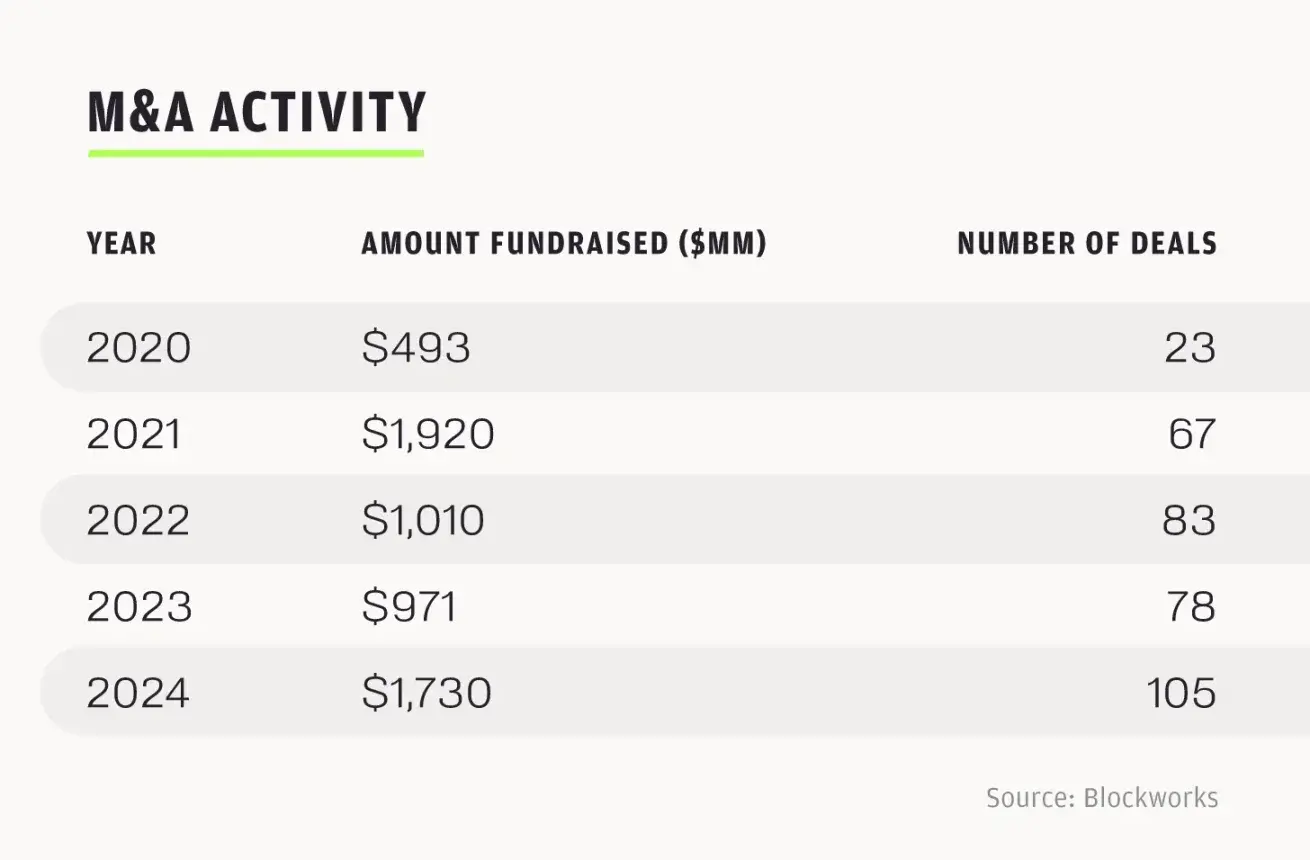
2024 was a record year for mergers and acquisitions, with over 100 deals totaling $1.73 billion; the number of transactions in 2025 is expected to surpass that of 2024. From January to July of this year alone, 76 transactions have been completed, totaling $6.23 billion, which is 3.6 times the total transaction volume for the entire year of 2024. At the current pace, the total number of M&A transactions in 2025 is expected to reach 130.
The momentum of M&A in 2025 reflects more of a natural maturation signal of the industry rather than a release of pent-up demand. Strategic acquisitions, such as Robinhood's acquisition of Bitstamp, indicate that mature companies are focused on building integrated platforms. Robinhood's multi-billion dollar bet on the future of crypto adds more credibility to the ecosystem. In the second quarter of 2025, Robinhood's crypto business revenue surged 98% year-on-year to $160 million; the company's total revenue grew 45% to $989 million, with a profit of $386 million. As a stock trading platform centered on retail users, Robinhood's acceptance of blockchain infrastructure highlights the trend of the industry transitioning towards mainstream and compliant infrastructure.
Similarly, later-stage financing transactions also reflect a focus on "revenue-oriented, compliant models." For example, in the second quarter of 2025, Securitize raised $400 million from Mantle for RWA tokenization; the prediction market platform Kalshi raised $185 million, achieving a valuation of $2 billion. These initiatives indicate that the focus of the crypto industry has shifted towards collaborating with traditional financial institutions rather than merely chasing speculative opportunities.
Cross-Integration of the Crypto Industry with Other Fields
The crypto industry is no longer isolated but is deeply integrating with today's cutting-edge technologies and the global financial system.
In the field of artificial intelligence, OpenMind's OM1 + FABRIC tech stack fills the "missing layer" in the robotics industry, enabling decentralized collaboration among different robots; Worldcoin's iris scanning identity verification system relies on a blockchain identity layer, allowing AI agents to achieve autonomous authentication and transactions, addressing the critical issue of secure interactions for AI agents in the crypto space; decentralized AI platforms like Sahara AI (decentralized version of Scale AI) and Sentient (decentralized version of Hugging Face) are disrupting traditional AI infrastructure. Currently, the application layer of crypto AI is still in its infancy, but its potential may give rise to a new market structure through on-chain agents and trading systems.
In the payment sector, stablecoins (especially Circle's USDC) have become an important part of the global payment system, and the "Genius Act" has further accelerated the adoption of USDC. In the first quarter of 2025, Circle's revenue grew by 58.6% to $579 million. Analysts predict that the daily trading volume of stablecoins could reach $250 billion within the next three years; if the growth momentum continues, it may even surpass traditional payment systems like Visa in the next decade. Companies like PayPal and Visa are exploring the integration of stablecoins into mainstream payment channels. The collaboration between Robinhood and Arbitrum allows Robinhood users to trade USDC directly on Arbitrum, lowering the barrier for retail users to use stablecoins. This collaboration is just the beginning, as Arbitrum plays a key role in expanding the application of stablecoins, confirming the value of Layer 2 solutions in connecting cryptocurrencies with traditional finance.
The cross-integration of these key industries brings together experts from artificial intelligence, fintech, and consumer technology, blurring industry boundaries. The crypto industry, as the infrastructure of decentralized systems, is gradually becoming a critical layer in the global tech stack.
Looking Ahead
We expect that from the fourth quarter of 2025 to the first quarter of 2026, the market cycle will be structurally stronger. Unprecedented regulatory clarity, anticipated interest rate cuts, and significant capital inflows from strategic mergers and acquisitions and IPOs are collectively building a solid foundation for the industry. The current new momentum centered on "real application value" lays the groundwork for accelerated growth in the industry. Our strategy is to seize this opportunity and concentrate resources on high-certainty investments in Series A companies that are likely to define their fields.
From the beginning of 2025 to now, the U.S. IPO market has welcomed 224 IPOs. The number of IPOs in the first half of 2024 was 94, while in the first half of 2025, it reached 165, an increase of 76%. In just the first half of 2025, there were 185 crypto-related M&A transactions, expected to exceed the total of 248 transactions for the entire year of 2024. The successful IPOs of well-known companies like Circle and the acquisitions of crypto companies by traditional financial giants highlight the strength of the upcoming cycle.
The cross-integration of crypto with artificial intelligence, payments, and infrastructure, combined with favorable regulations and strong investor interest, will propel the industry into an era of accelerated growth. Seizing this opportunity, we will continue to solidify the position of the crypto industry as a pillar of global finance and technology.
 Risk warning
 Risk warning



Popular articles





