








HashWhale Crypto Weekly | Bitcoin Energy Accumulation Breakthrough; Market Structure Shifts to Bullish (9.06-9.12)

 In the past week, Bitcoin's overall performance has been characterized by "sideways consolidation → volatile ascent → sideways accumulation → upward breakout." Under the combined forces of macroeconomic easing expectations, continuous inflow of ETFs, and institutional accumulation, Bitcoin has transitioned from a phase of volatile consolidation to a breakout. The price has switched between the $110,000 – $116,000 range, accompanied by gradually increasing trading volume, and the market structure has shifted to a bullish bias.
Author & Editor: Monkey, HashWhale
1. Bitcoin Market
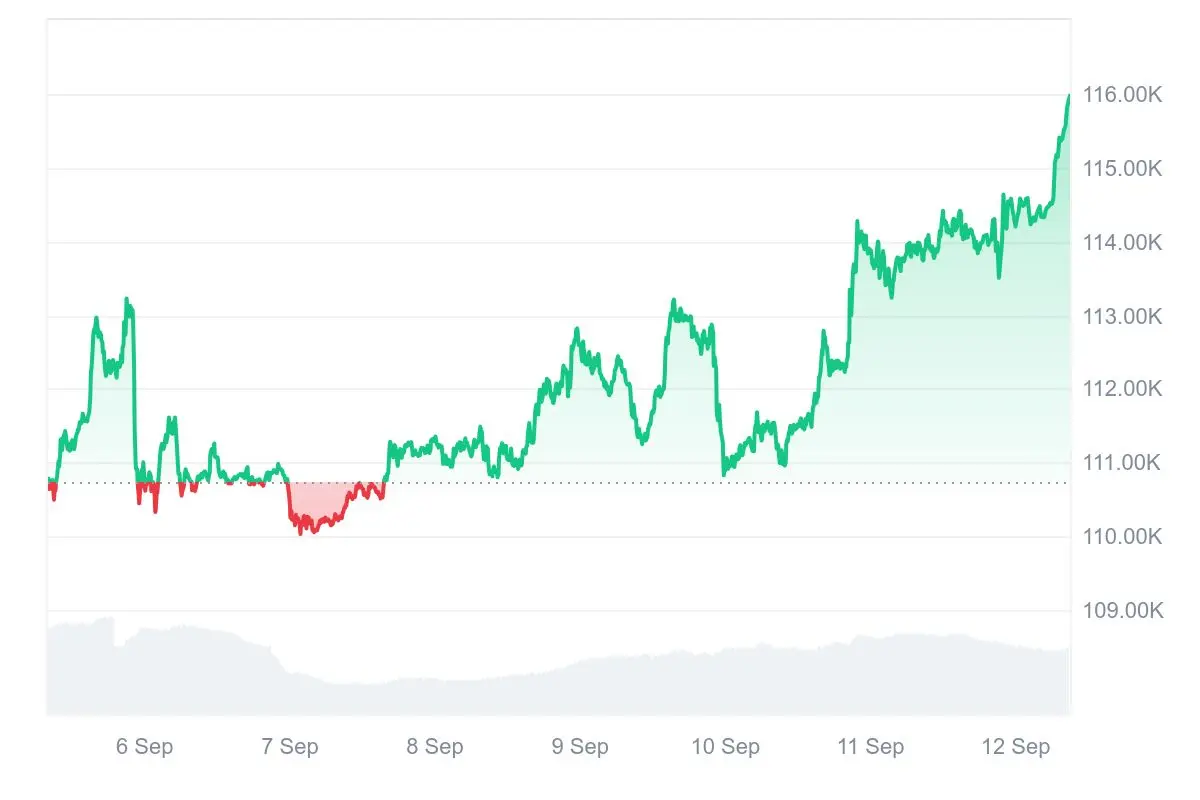
Bitcoin Price Trend (2025/09/06-2025/09/12)
In the past week, the overall rhythm of Bitcoin's operation has been characterized by "sideways consolidation → oscillating upward → sideways accumulation → upward breakout." Macroeconomic data, expectations of Federal Reserve policy, movements of spot ETF funds, institutional buying, and whale distribution have alternated as the core driving forces of the market. The price mainly operated within the range of $110,000 -- $116,000, with significant trading volume at key moments when macro data was released and funds concentrated.
Sideways Phase (September 6 to September 8)
On September 6, Bitcoin's price fluctuations narrowed, maintaining a sideways range around $110,820. On September 7, after a slight decline, the price rose again, briefly consolidating around $110,200, $110,600, and $111,200. On September 8, it continued the previous day's state, maintaining a sideways range around $111,200. Trading volume was significantly lower than before, presenting a typical accumulation pattern.
Causes of the Trend:
Interest rate policy expectations are not yet fully determined.
Although the market has begun to seriously consider the possibility of a rate cut by the Federal Reserve in September, doubts remain about the scale, timing, and whether it will be accompanied by hawkish rhetoric. This uncertainty makes it difficult for arbitrageurs/speculators to place significant directional bets.
Oscillating Upward Phase (September 8 to September 10)
Phase One of the Ascent
On the afternoon of September 8, the price oscillated upward from $110,912 to $112,818. On September 9, the price temporarily retraced to $111,294, then surged straight to $113,210, and after a brief consolidation, it retraced to $110,826.
Phase Two of the Ascent
On September 10, the price continued to oscillate upward, reaching $111,681, $112,738, and $114,273, climbing from $110,938 to $114,273, with an intraday increase of X%.
Driving Force Analysis:
1. Macroeconomic Data Expectations and Real Value Impact: After observing softening U.S. manufacturing/price data (PPI, some inflation indicators cooling), traders increased their bets on the Federal Reserve's future rate cuts, shifting short-term interest rate expectations towards easing, which boosted demand for risk assets, thereby driving Bitcoin's short-term surge. Such news had a noticeable impact on the market between September 9 and 10.
2. ETF and Institutional Buying: Some spot Bitcoin ETFs continued to attract fund inflows, while institutional/corporate treasuries continued to buy within the price range, providing upward elasticity; at the same time, a few "whales" exhibited distribution behavior within the range, causing rapid fluctuations after the surge (i.e., surge --- distribution --- retracement cycle).
Sideways Brewing Breakout Phase (September 11 to September 12)
On September 11, Bitcoin's price consolidated around $114,000, accumulating momentum and brewing a directional breakout, with fund flows indicating that buyers were gradually accumulating positions. On September 12, accompanied by resonance from macro data and fund inflows, the price achieved an effective breakout, reaching a high of nearly $116,000, completing a strong weekly close.
Breakout Driving Analysis:
1. Positive Macroeconomic Data: The U.S. PPI showed weakened inflationary pressures, leading the market to believe that the Federal Reserve is more likely to cut rates.
2. CPI is high but not fatal: Inflation data slightly exceeded expectations but remained within controllable limits, not completely dispelling rate cut expectations.
3. Institutional Fund Inflows: Increased ETF and large fund buying boosted Bitcoin demand.
4. Market Sentiment and Technicals: The price broke through a key range near $114,000, triggering follow-up buying, with sentiment leaning bullish.
Summary
This week, Bitcoin completed a transition from oscillating consolidation to breakout under the combined forces of macro easing expectations + continuous ETF inflows + institutional accumulation. The price switched between $110,000 -- $116,000, accompanied by gradually increasing trading volume, shifting the market structure towards a bullish bias.
2. Market Dynamics and Macroeconomic Background
Fund Flows
1. ETF Fund Dynamics
This week, Bitcoin spot ETFs continued the trend of fund inflows, although the inflow magnitude fluctuated, the overall trend remained positive:
- September 8: +$364.3 million
- September 9: +$23 million
- September 10: +$741.5 million
- September 11: +$186.5 million
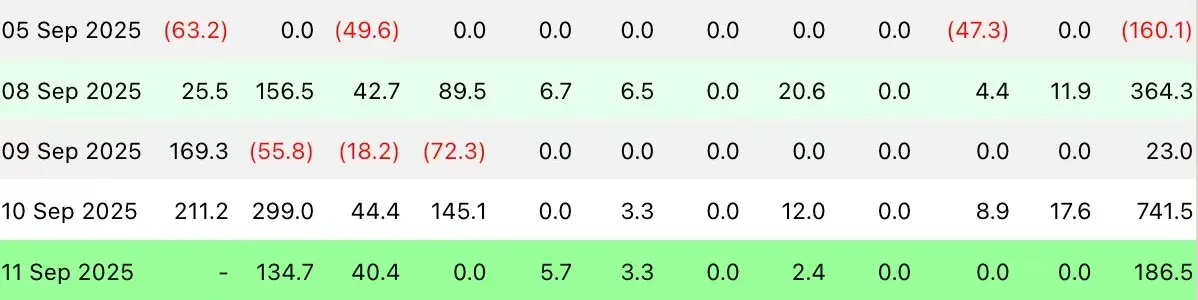
ETF Inflow/Outflow Data Image
With four consecutive days of fund inflows supporting it, ETF products continue to be an important channel for institutions and traditional investors to allocate Bitcoin. Especially the large-scale net inflow on September 10 shows that there is still strong buying power in the market despite high volatility.
2. Bitcoin Non-liquid Supply Hits All-time High
- As of late August, Bitcoin's non-liquid supply surpassed 14.3 million BTC, setting a new historical record.
- In the past 30 days, the non-liquid supply increased by about 20,000 BTC. Of the circulating 19.9 million BTC, 72% are in a non-liquid state, mainly controlled by long-term holders and cold storage investors.
- Notably, although Bitcoin fell about 15% after hitting a historical high of $124,000 in mid-August, the non-liquid supply continued to rise, indicating that long-term funds have not chosen to reduce positions due to short-term pullbacks.
The continuous increase in non-liquid supply highlights the trend of "reduced circulation" of Bitcoin. The firm stance of long-term holders has somewhat weakened selling pressure, providing support for potential price increases in the future.
3. Exchange Fund Flows: Withdrawal Slows, Net Inflows Increase
- On September 9, there was a total net inflow of 3,057.57 BTC in CEX over the past 24 hours.
Top Three Exchanges by Net Inflow:
- Kraken: +2,030.23 BTC
- Bitfinex: +730.35 BTC
- Coinbase Pro: +685.85 BTC
- Binance became the largest net outflow, with an outflow of 832.55 BTC.
Additionally, Ethereum also showed a similar trend, with a net inflow of 24,400 ETH in CEX over the past 24 hours.
Both BTC and ETH have recently shown signs of slowing withdrawals and increasing net inflows to exchanges, which may reflect that investors are choosing to consolidate funds after a short-term pullback or preparing for potential trading and hedging. This contrasts with the long-term accumulation trend of non-liquid supply, indicating a divergence between short-term and long-term fund behaviors in the market.
4. On-chain and Realized Profit Inflows Slow Down
- An on-chain data report shows that Bitcoin's "realized profit inflows" (i.e., the inflow of profits being realized or withdrawn to exchanges/markets) have decreased to about $1.17 billion per day, nearly 47% lower than the peak in June.
- Meanwhile, the average daily inflow of the US spot ETF (measured in BTC) has significantly decreased compared to July, currently around 980 BTC/day.
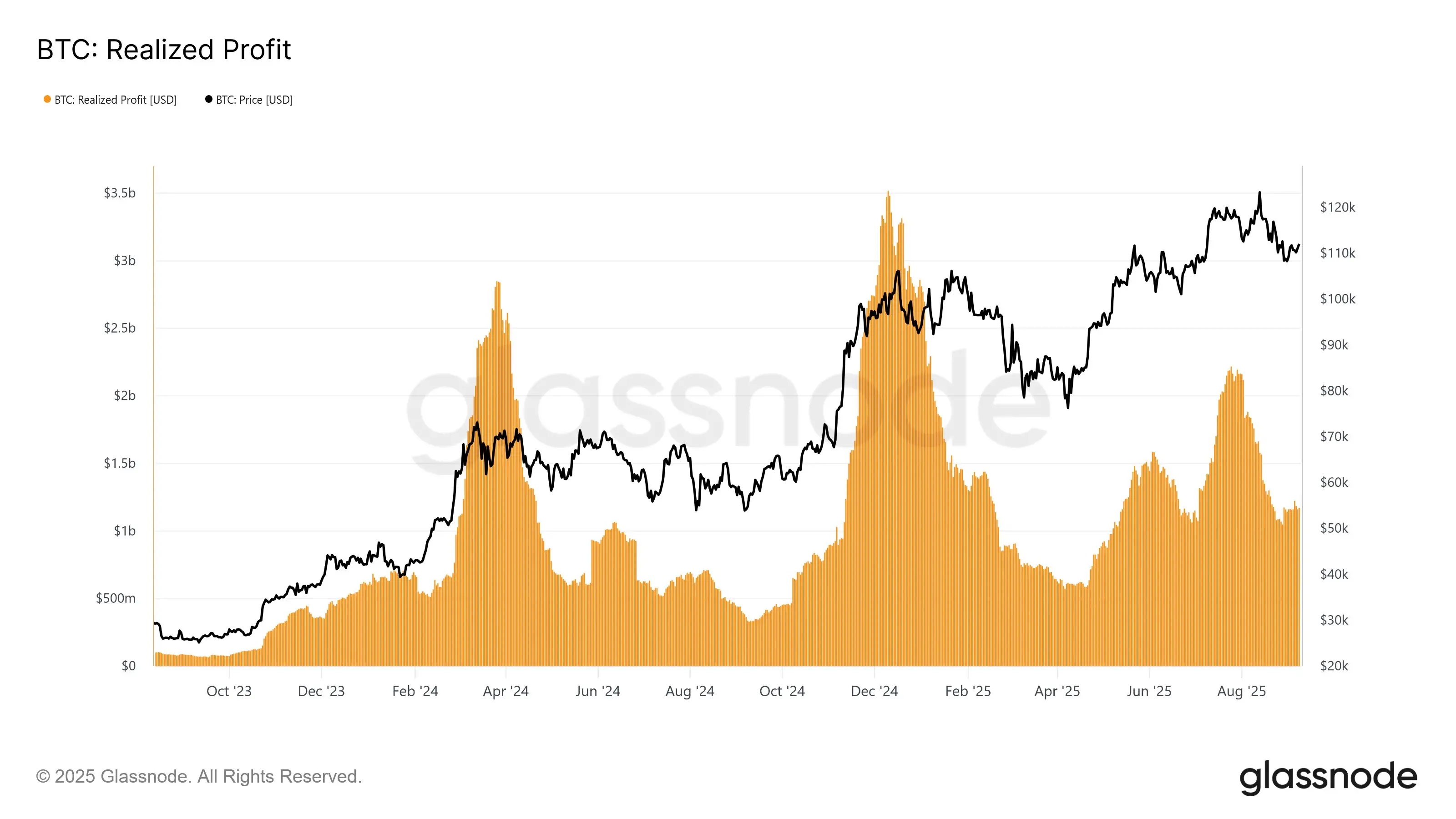
Related Image
5. Changes in Holding Structure: Significant Increase in Medium-sized Holders
On September 11, news from Glassnode indicated that entities holding 100 to 1,000 BTC have significantly increased their holdings in the past 7 days, adding about 65,000 BTC.
Currently, this group holds a total of 3.65 million BTC, a record high. This trend indicates that the medium-sized holding group has shown a clear bullish attitude amid recent fluctuations, further strengthening the market's concentration of chips.
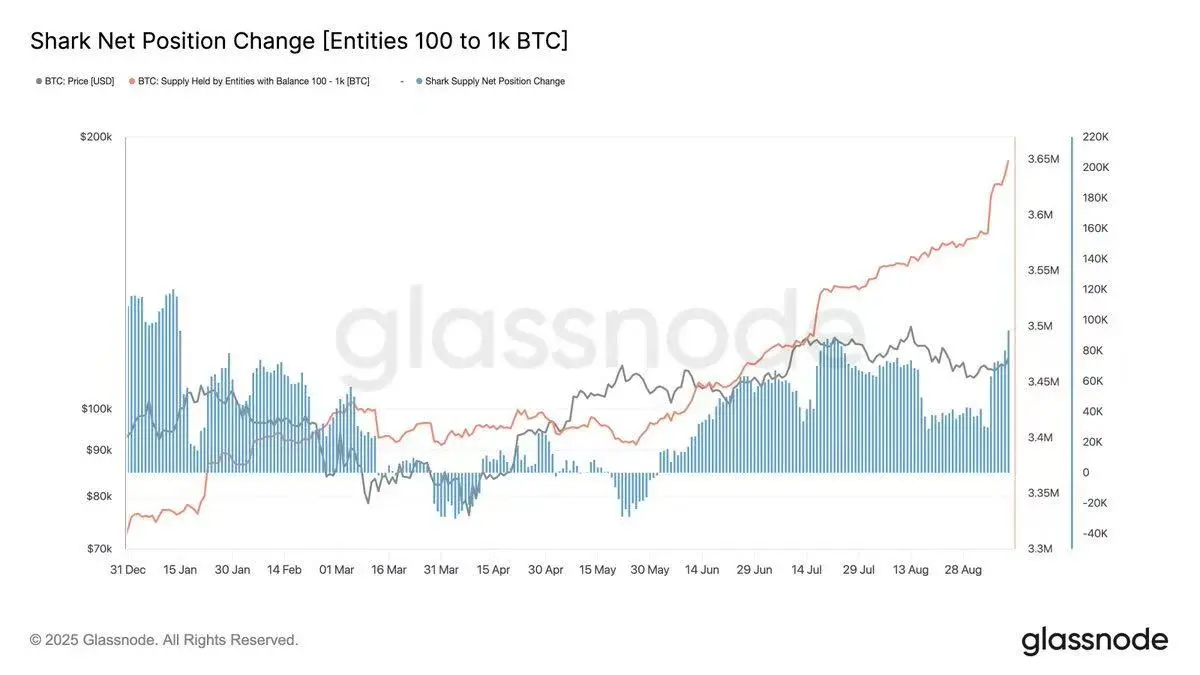
Related Image
Technical Indicator Analysis
1. Relative Strength Index (RSI 14)
According to Bitbo data, as of September 12, 2025, Bitcoin's 14-day RSI is 42.27. The RSI is in the 30-50 range, indicating that the market remains relatively weak in the short term but has not entered the oversold zone (<30), suggesting limited downside potential and a relatively balanced state between bulls and bears.
The RSI has shown a slow recovery trend over the past week, rising from last week's low of about 36-38 to the current 42, indicating that there is some support at lower levels, with bulls gradually absorbing positions on dips.
If the RSI continues to approach or break through 50, it may indicate a strengthening of short-term bullish momentum, with potential for a phase rebound in price.
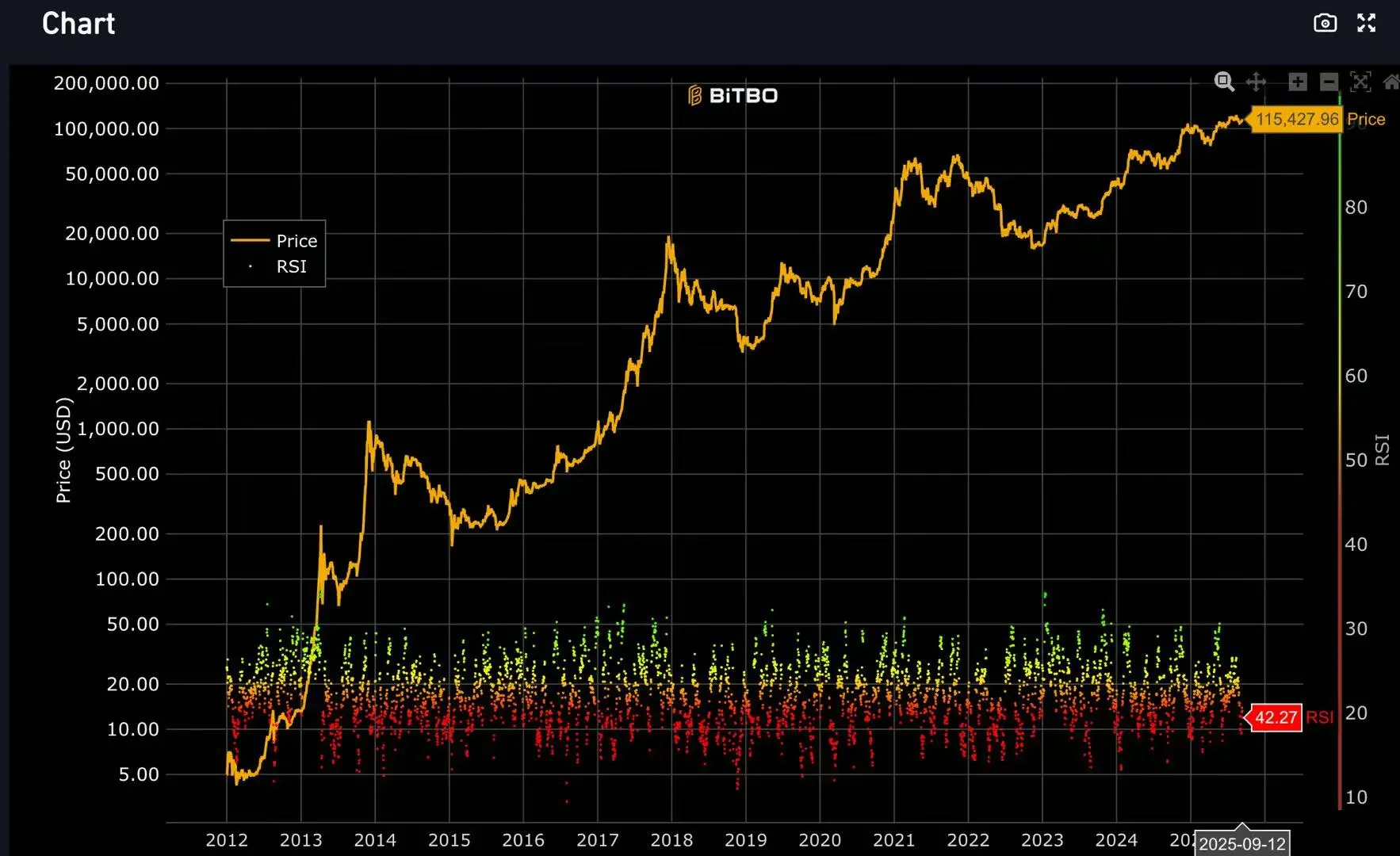
Bitcoin 14-day RSI Data Image
2. Moving Average (MA) Analysis
MA5 (5-day moving average): $113,911
MA20 (20-day moving average): $113,445
MA50 (50-day moving average): $116,182
MA100 (100-day moving average): $111,023
MA200 (200-day moving average): $104,657
Current Price: $115,568

MA5, MA20, MA50, MA100 Data Image
The current price is above MA5, MA20, MA100, and MA200, but slightly below MA50, indicating a mixed short-term moving average trend, with an overall bullish bias, but medium-term resistance still exists.
MA5 and MA20 show a slight golden cross trend, with short-term moving averages providing support in the $113,500 -- $114,000 range.
The gap between MA50 and MA100 is narrowing, indicating that medium-term upward momentum has not yet been fully confirmed, requiring the price to break through MA50 ($116,182) and stabilize to form a medium-term upward trend signal.
MA200 ($104,657) is far below the current price, indicating that the long-term bullish trend remains solid, providing strong support for long-term investors.
3. Key Support and Resistance Levels
Support Levels: The short-term key support areas are located at $110,000, $111,000, and $113,500. On September 7, Bitcoin's price consolidated around $110,000 without further declines, indicating that this area has become an important reference for a phase bottom, effectively suppressing short-term selling pressure. Subsequently, during the two pullbacks on September 9 and 10, the $111,000 support was once again validated, with downward momentum significantly curtailed, showing that buying power in this area is relatively active and has the capacity to absorb. By September 11, the price slightly retraced to around $113,500 and stabilized, gradually turning this position into a new short-term support point, likely becoming a future dividing line for bulls and bears, providing a support baseline for short-term bulls.
Resistance Levels: Short-term resistance is mainly concentrated around $116,000. The $114,000 level is an important pressure zone in the market's short-term structure, where the price consolidated after the previous two rounds of increases, indicating that market forces are accumulating here, waiting for a further breakout. On September 12, Bitcoin briefly touched a high of $116,287 but failed to stabilize, confirming that the area around $116,000 is a key short-term resistance level. If the price cannot effectively break through this level, bullish momentum may be suppressed, increasing the risk of a short-term pullback.
Comprehensive Analysis
Overall, Bitcoin's short-term trend presents a pattern of "gradually rising support and narrowing resistance," with the market in a phase of range oscillation and gradual convergence. Bottom buying shows resilience, indicating that bullish funds are still absorbing on dips, while the willingness to break above $116,000 becomes a key observation point for the short-term market. If bulls can successfully hold the $114,000 -- $115,000 range and maintain above it, the market is likely to continue its upward trend, and a breakout above resistance may trigger a new round of short-term bullish momentum. Conversely, if the breakout is blocked, the price may retest the $113,000 -- $114,000 range to test the buying power and support strength again. Overall, the short-term structure leans towards oscillating upward, but true trend confirmation still requires observation of trading volume, fund inflow conditions, and the stability of key resistance level breakouts.
Market Sentiment Analysis
As of September 12, the Fear & Greed Index reported 50 points, in the "neutral" range, indicating that overall market sentiment is relatively stable, with investor sentiment neither leaning towards fear nor showing significant greed.
Looking back at this week (September 6 -- September 12), the daily values of the Fear & Greed Index were: 41 (lower end of neutral), 40 (lower end of neutral), 42 (neutral), 44 (neutral), 43 (neutral), 47 (neutral), operating overall in the 40-50 point range, with small fluctuations in sentiment. In the early part of the week, market sentiment was cautious, with a strong wait-and-see atmosphere among investors, and fund flows were relatively conservative, indicating that the market had not formed a clear upward momentum. As the index gradually rose to the upper end of the neutral range mid-week, market sentiment showed signs of gradual recovery, with investor confidence slightly warming. If prices can stabilize effectively and trading volume increases, the Fear & Greed Index is expected to rise further, pushing market sentiment in a positive direction; conversely, if prices fall again, market sentiment may come under pressure again.
Overall, this week, Bitcoin market sentiment has shown a trend of gradually recovering from caution to neutrality, but the overall atmosphere remains cautious, and in the short term, attention still needs to be paid to the impact of price fluctuations on market sentiment and potential wait-and-see fund inflows/outflows.
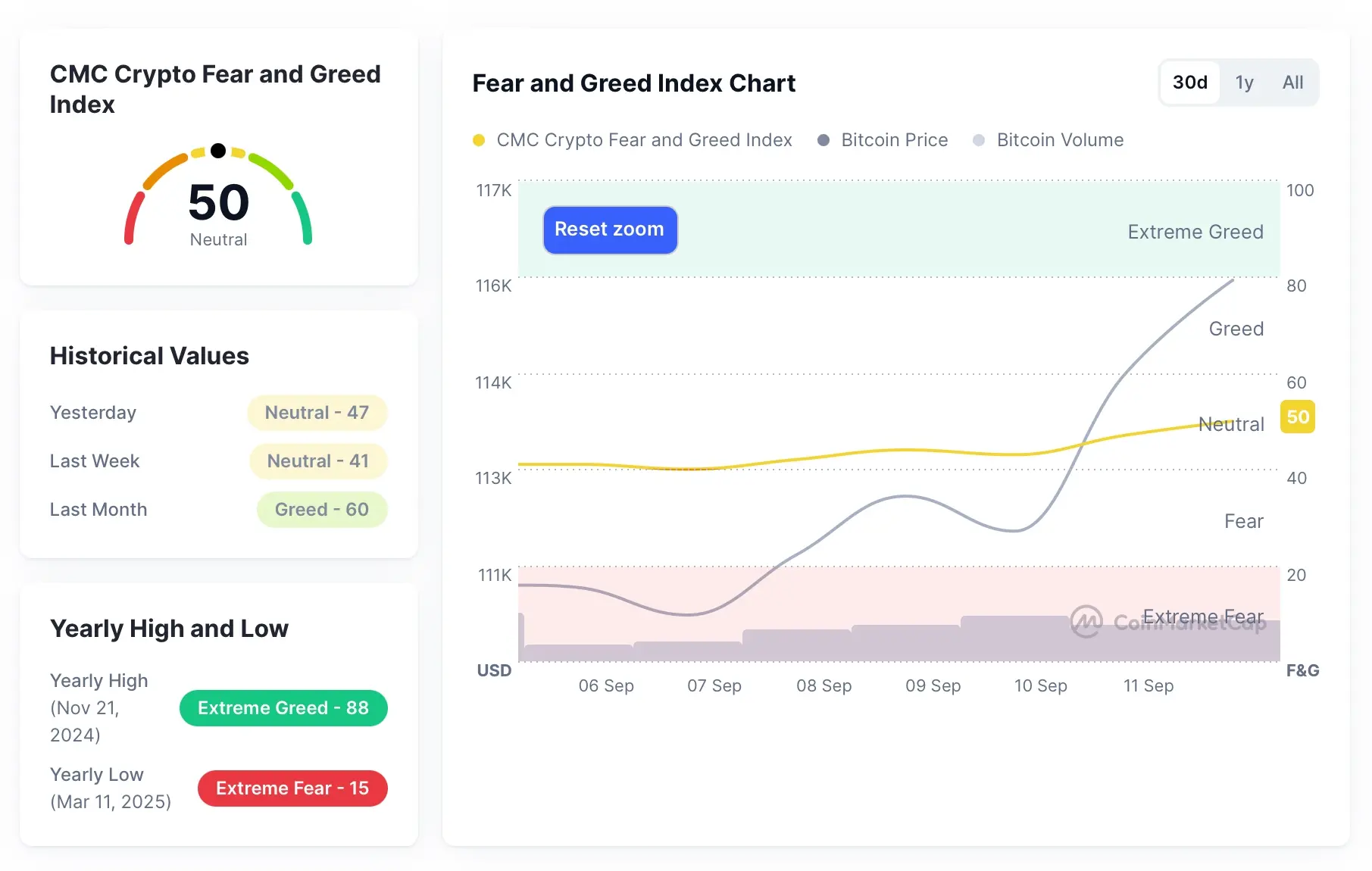
Fear & Greed Index Data Image
Macroeconomic Background
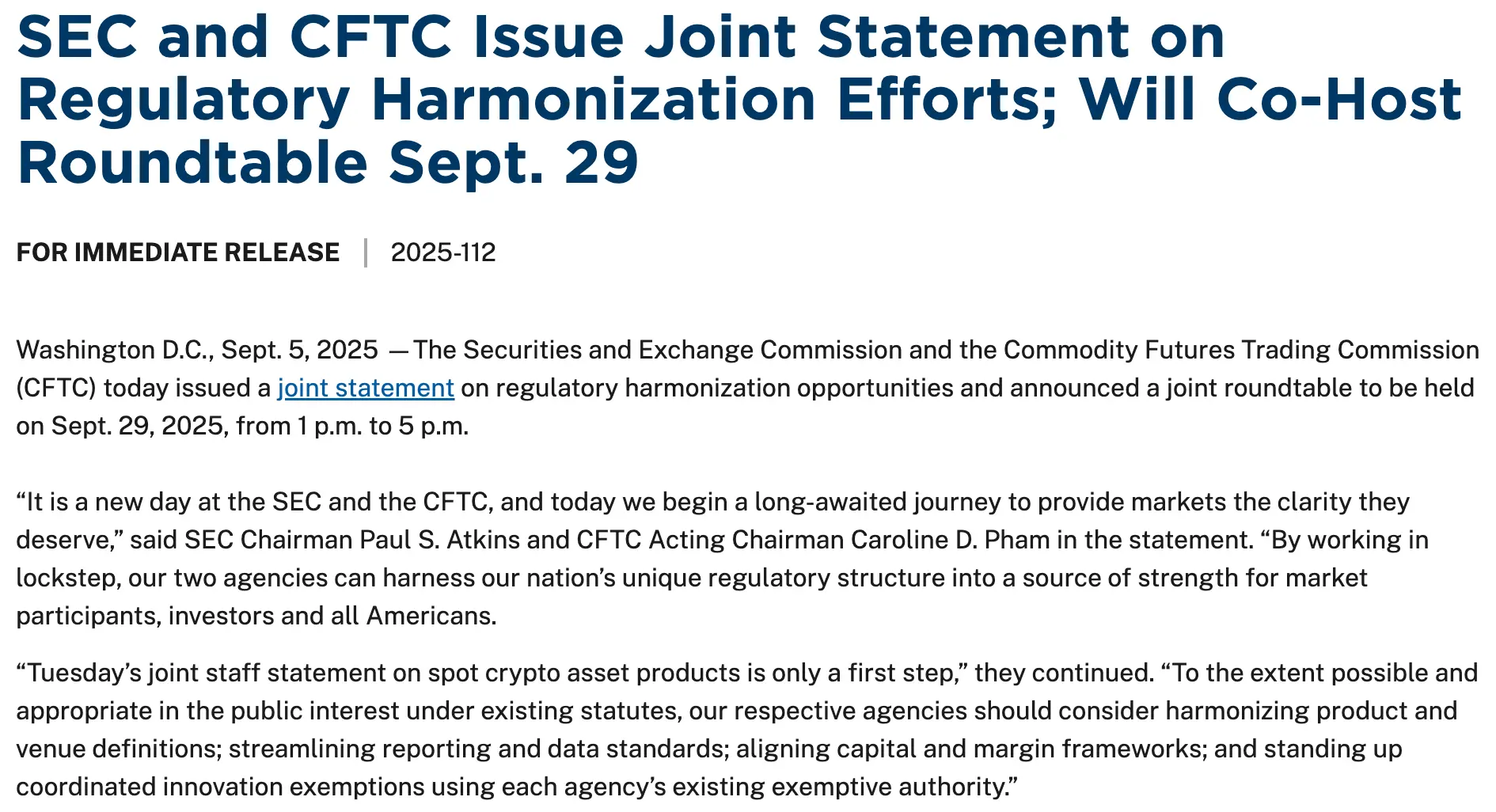
1. Rare Joint Statement by SEC and CFTC / Joint Roundtable (Regulatory Coordination Signal)
This week, the SEC and CFTC issued a joint statement and announced that they will jointly hold a regulatory coordination roundtable on September 29, explicitly stating that the two regulatory agencies are strengthening communication and cooperation in "digital asset regulatory coordination" and encouraging selective choices for trading venues.
This is a positive signal for institutional investors (long-term) ------ regulation is no longer completely disconnected, and if progress is smooth, it could enhance institutional confidence in spot/derivatives trading venues and potentially bring more stable fund inflows; the short-term impact on prices is neutral to positive, depending on subsequent regulatory details.
Related Image
2. U.S. Labor Market Data: Weak Non-farm Payrolls and Unemployment Rate in August (Employment Growth Slows)
Key Points: The U.S. added only +22,000 non-farm jobs in August, and the unemployment rate rose (see BLS report), showing clear signs of "cooling/stagnation" in the labor market. Meanwhile, media and regulators have intensified scrutiny of BLS data quality (the Labor Department's Inspector General has initiated a review of BLS collection issues and mentioned previous significant revisions).
Weak employment has strengthened market expectations for the Federal Reserve to initiate rate cuts (or a more accommodative stance) ------ typically a positive catalyst for risk assets (including Bitcoin), but if accompanied by doubts about data credibility, it may increase market volatility.
3. Producer Price Index (PPI) and Inflation Data Dynamics: PPI Unexpectedly Declines; CPI Year-on-Year Rises
PPI Data: The Producer Price Index (PPI) for August fell by 0.1% month-on-month, indicating some relief in wholesale inflation pressures.
CPI Data: The Consumer Price Index (CPI) rose 2.9% year-on-year in August and 0.4% month-on-month; core CPI rose 3.1% year-on-year and 0.3% month-on-month.
Overall, the decline in PPI may alleviate market concerns about rising inflation in the short term, enhancing expectations for the Federal Reserve to adopt accommodative monetary policy. However, the sustained high level of core CPI indicates that inflationary pressures remain, which may limit the Federal Reserve's room for significant rate cuts in the medium term. The market's overall reaction indicates that despite a slight rise in inflation data, the weak labor market leads investors to still expect the Federal Reserve to take a rate cut or maintain an accommodative stance at the upcoming meeting, thus providing some support for risk assets (including Bitcoin).

Related Image
4. Gold Prices Continue to Strengthen
Gold prices have surpassed $3,600 per ounce, repeatedly setting historical highs. The driving factors include weak employment, rising easing expectations, and increased demand for safe-haven assets.
Institutions (such as ANZ) have raised their year-end gold price expectations to around $3,800. Kitco analysis states that the weakening dollar and risks in the yield curve are key factors driving gold's rise.

Related Image
5. U.S. Treasury Yields Decline
Affected by rate cut expectations, U.S. Treasury yields have generally declined, with the 10-year yield reaching a five-month low. Reuters analysis states that under easing expectations, short-end yields are falling faster, leading to a steepening yield curve.
Lower yields reduce the opportunity cost of holding non-yielding assets (such as gold and Bitcoin), indirectly benefiting Bitcoin.
6. U.S. Dollar Weakness
The U.S. Dollar Index (DXY) is approaching a seven-week low, with the dollar under pressure against major currencies. The weakening dollar strengthens gold's appeal and enhances the valuation advantage of non-dollar assets like Bitcoin.
Overall, the combination of a weakening dollar + declining Treasury yields + strengthening gold forms a typical "easing trade" backdrop, providing supportive conditions for risk assets.
3. Hash Rate Changes
In the past seven days, the Bitcoin network hash rate has shown a gradual upward trend, with a decline at the end of the week.
On September 6, the hash rate fluctuated within the range of 840 EH/s - 1 ZH/s, at a relatively low level. On September 7, the network's computing power significantly increased, with the hash rate climbing to 1.1524 ZH/s, indicating that miners accelerated their computing power input at that point. Subsequently, from September 7 to 8, the hash rate remained around 1.05 ZH/s. From the evening of September 8 to September 9, the computing power further climbed to 1.2102 ZH/s. From September 9 to 11, the morning hash rate generally operated in the range of 1.05 ZH/s -- 1.2 ZH/s, while the afternoon hash rate fell to 959.21 EH/s. On September 12, the hash rate continued to decline, falling to around 930 EH/s at the time of writing.
Overall, the hash rate was low at the beginning of this cycle, then quickly rose and oscillated in a high range, with the amplitude gradually narrowing. This trend reflects that miners are continuously releasing computing power, maintaining a high level of network security, while the distribution of computing power is becoming more balanced. The decline in hash rate at the end of the week may be related to short-term adjustments in computing power, miners' profit expectations, or electricity costs, but the overall network operation remains robust, and network security is still at a high level in the short term.
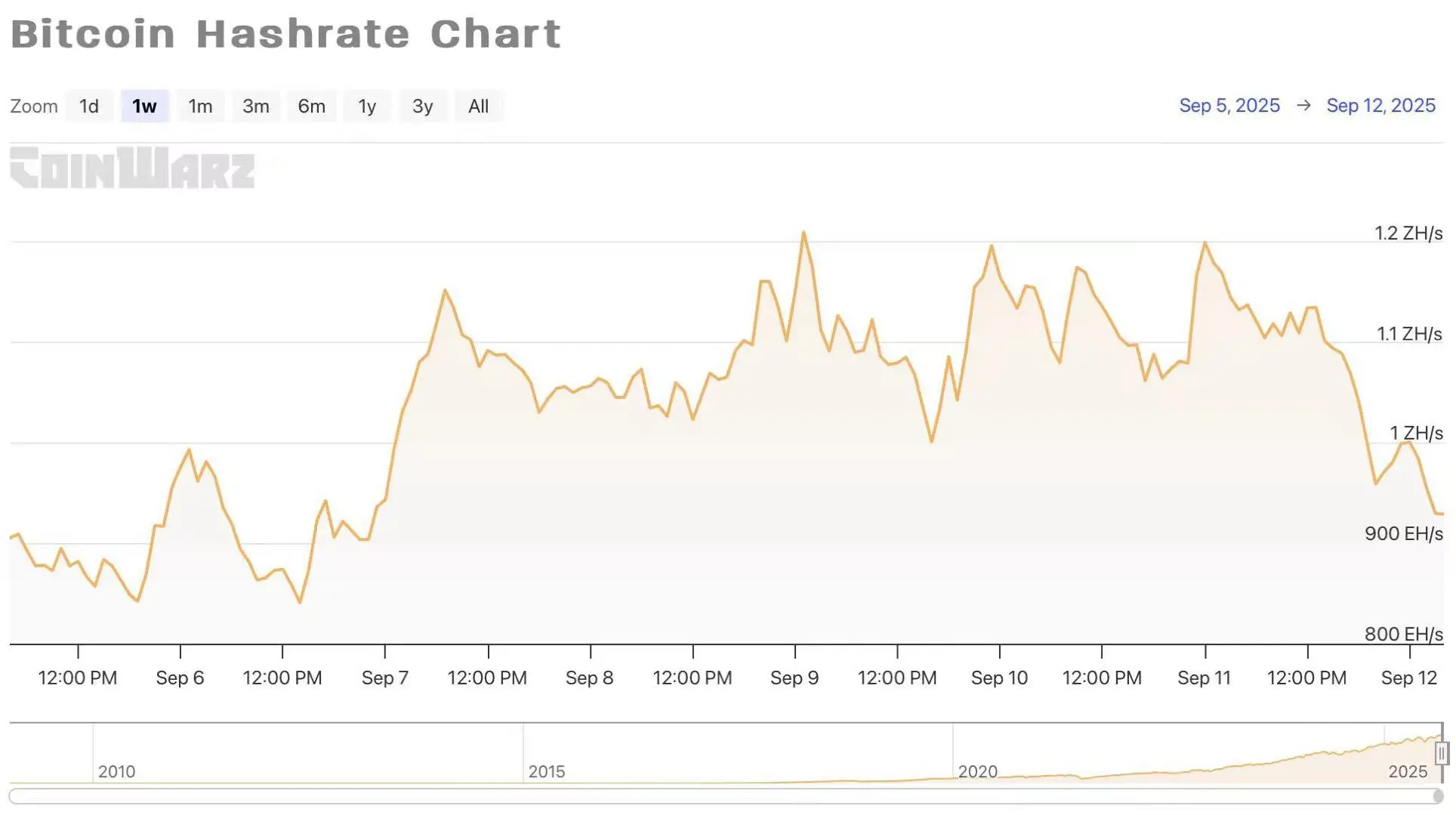
Weekly Bitcoin Network Hash Rate Data
4. Mining Revenue
According to YCharts data, in the past week, Bitcoin miners' daily total revenue (including block rewards and transaction fees) fluctuated between $51.56 million and $61.11 million, as follows:
September 6: $51.56 million
September 7: $53.78 million
September 8: $59.16 million
September 9: $59.62 million
September 10: $61.11 million
September 11: $55.43 million
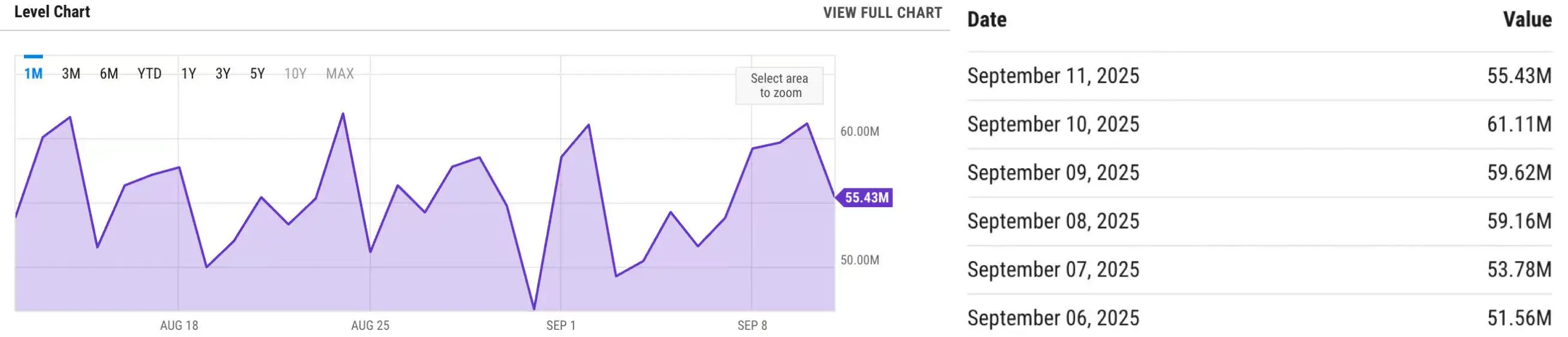
Bitcoin Miners Daily Revenue Data
Overall, Bitcoin miners' revenue showed a range oscillation trend this week. Revenue saw a noticeable increase from September 8 to 10, mainly influenced by Bitcoin price fluctuations, network computing power changes, and transaction fee levels.
From the perspective of daily revenue per unit of computing power (Hashprice), Hashrate Index data shows that as of September 12, 2025, Hashprice is $53.82 per PH/s per day. This week, Hashprice has generally followed the Bitcoin price trend, showing a gradual rise after a period of sideways movement, reaching a weekly high of $54.00 per PH/s per day on the morning of September 12.
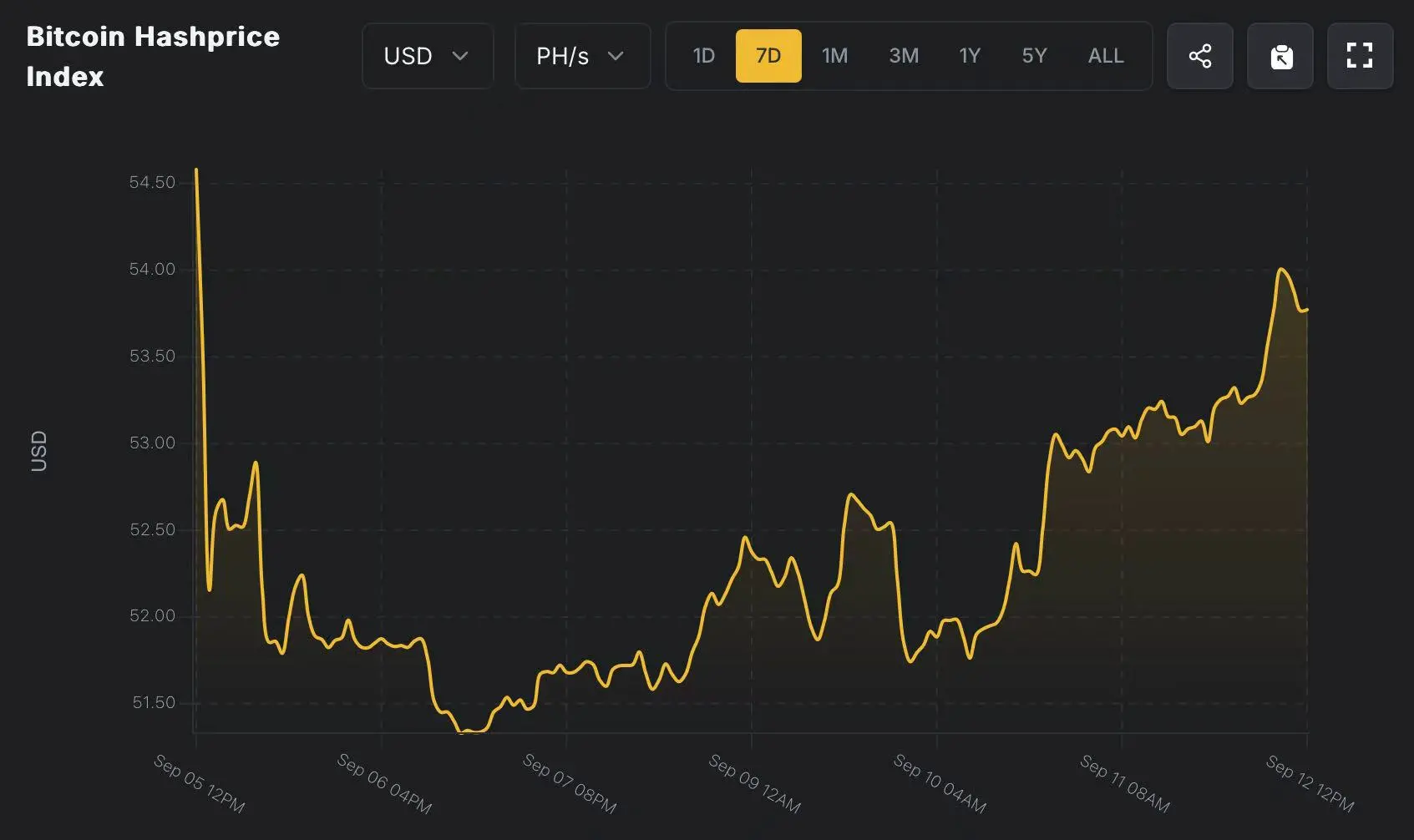
Hashprice Data
5. Energy Costs and Mining Efficiency
According to CloverPool data, Bitcoin mining difficulty adjusted at block height 913,248, increasing by 4.89% to 136.04 T, once again setting a historical high. As of September 12, 2025, the total network computing power reached 1.04 ZH/s, with mining difficulty at 136.04 T. The next difficulty adjustment is expected to occur on September 18, with an estimated increase of about 2.71%, bringing the difficulty to approximately 139.72 T. This trend indicates that Bitcoin's computing power growth is still in a steady upward phase, suggesting that the operating rate of mining machines globally continues to rise, with a large number of high-efficiency mining machines (such as S21, M60, and other new-generation ASIC miners) being continuously deployed to the network. The growth in computing power signifies further enhancement of network security, but it also raises the competitive threshold for miners and the total energy consumption.
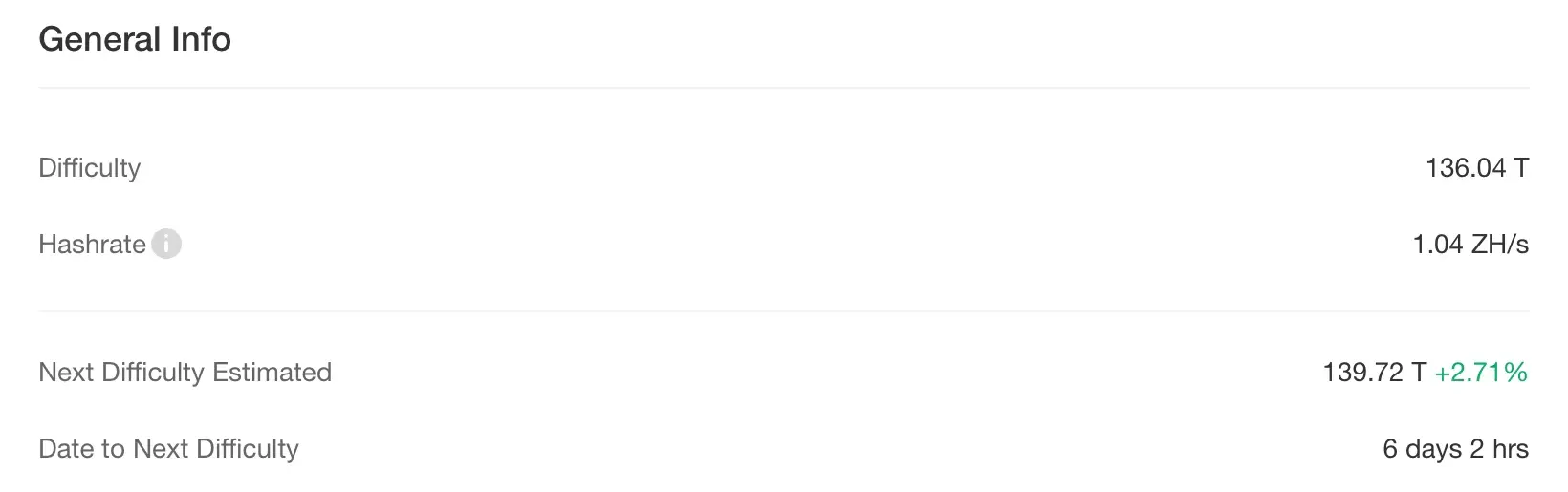
Bitcoin Mining Difficulty Data
From the perspective of mining costs, according to the latest model calculations by MacroMicro, as of September 9, 2025, Bitcoin's unit production cost is approximately $98,596.63, while the spot price during the same period is $111,530.55, resulting in a mining cost-to-price ratio of 0.88, indicating that miners still have about 12% gross profit margin on average. This data suggests that under the current difficulty and computing power levels, mainstream miners remain in a profitable range, especially operators using low electricity prices (such as in the Middle East, Kazakhstan, and some North American regions with hydro and wind resources) and high-efficiency new mining machines, which have strong risk resistance. However, for miners with electricity prices above $0.08 per kWh, profit margins may be nearing the critical point of contraction.
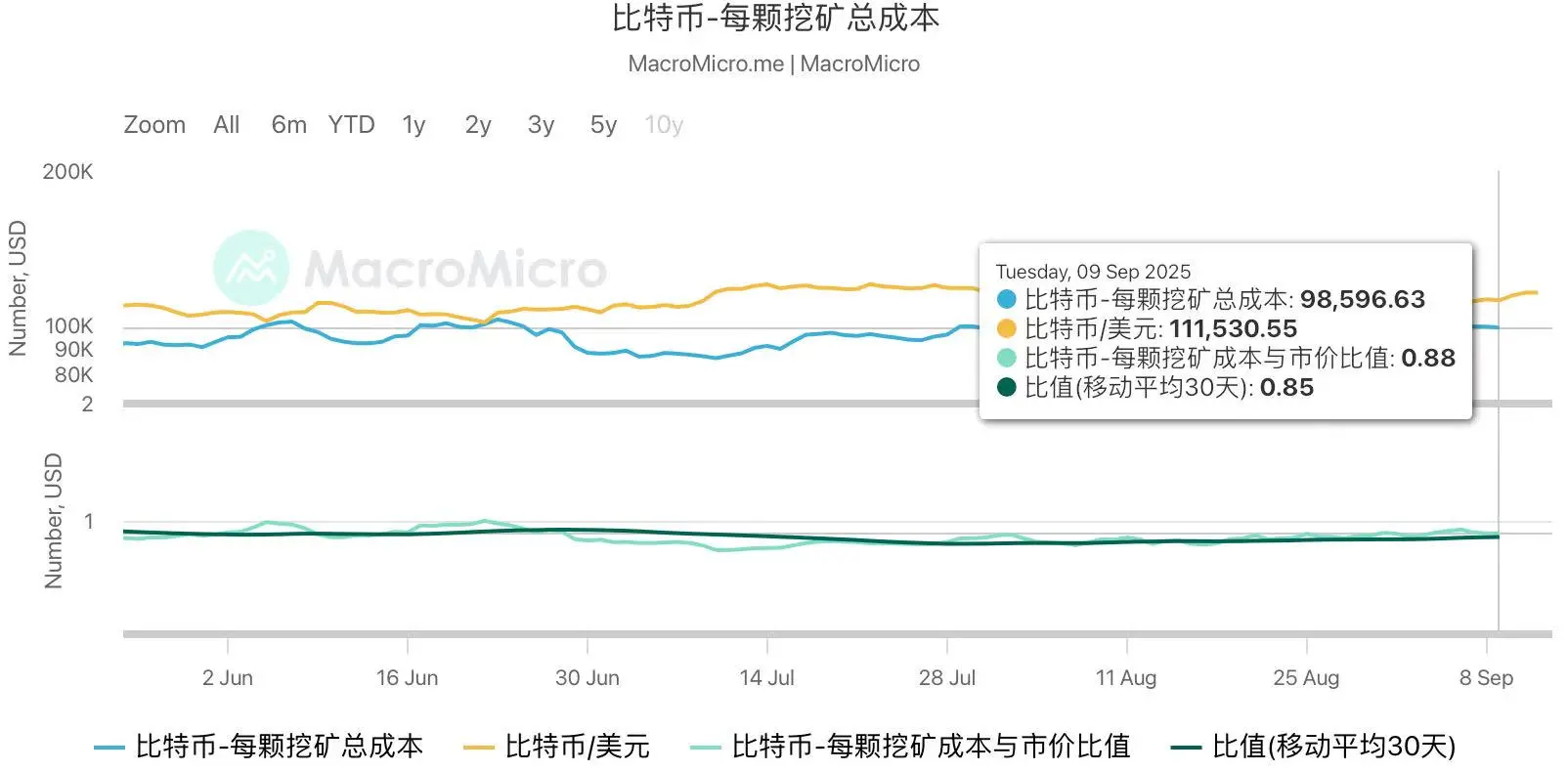
Total Mining Cost Data per Bitcoin
At the same time, the on-chain indicator Puell Multiple has declined, maintaining in the range of 1.20--1.21. The Puell Multiple measures miners' profitability and market overheating by comparing the daily Bitcoin issuance value with its annual average issuance value.
The calculation of the Puell Multiple is: daily Bitcoin issuance value / its annual average issuance value. When this value exceeds 4, it typically indicates that miners are overly profitable, and the market may be entering an overheating phase. When the value is below 0.5, it indicates that miners are generally in serious losses, often corresponding to market bottoms. The current level of 1.20--1.21 is in a healthy range, indicating that miners can still achieve reasonable returns, but the market has not shown signs of extreme bubbles. In other words, the mining ecosystem remains in a "neutral slightly bullish" state.
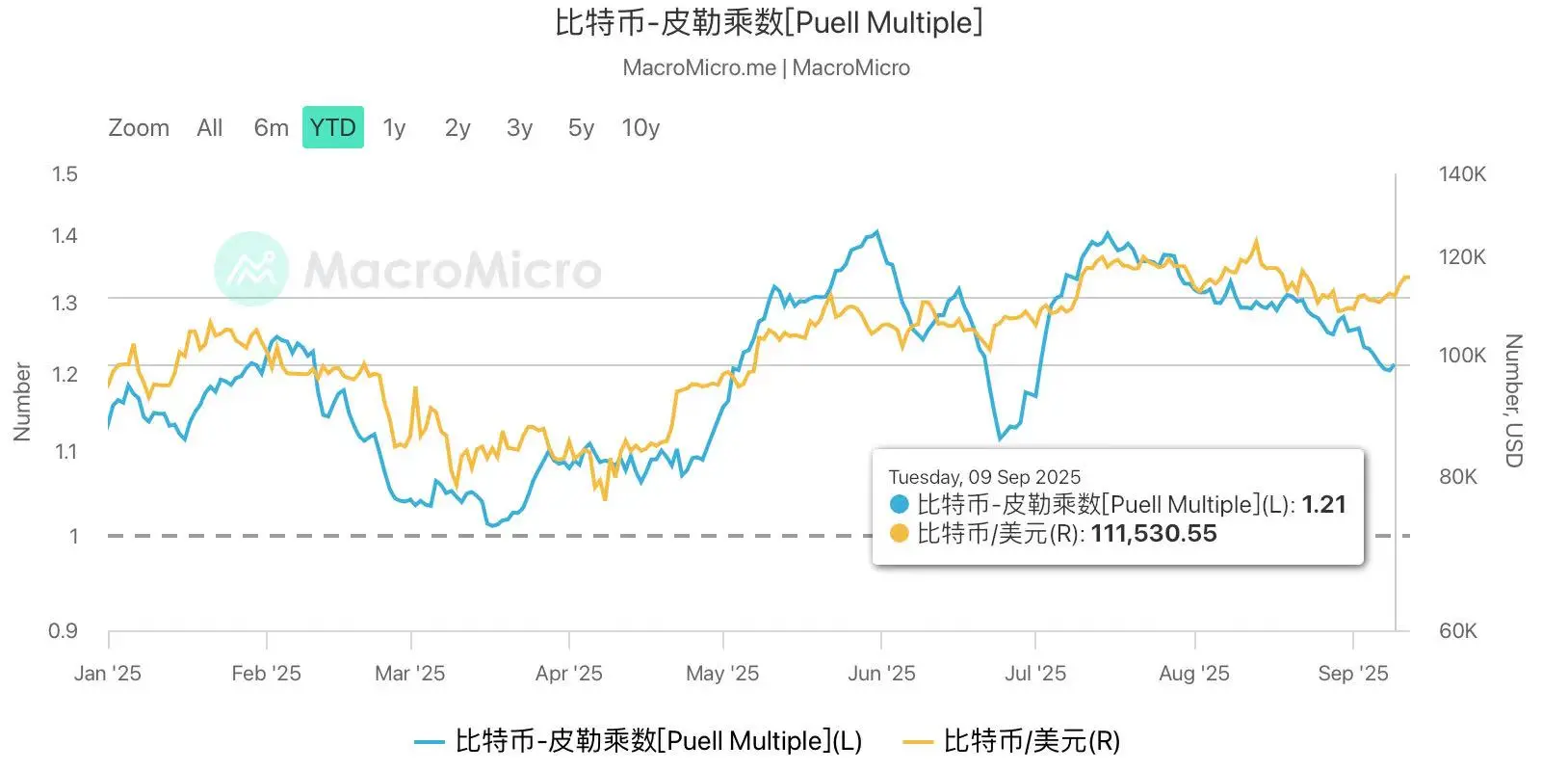
BTC Puell Multiple Data
Comprehensive Analysis
1. Mining Difficulty and Computing Power Growth: The total network computing power has surpassed 1.04 ZH/s, along with continuous increases in difficulty, indicating that the new round of mining machine iteration is bringing energy efficiency improvements. Leading mining companies further dominate in the trend of computing power centralization, accelerating the industry's concentration.
2. Miner Profitability and Risks: Currently, the spot price of Bitcoin is about $13,000 higher than the mining cost, placing miners in a profitable state overall. However, if the price falls below the $100,000 mark, miners in some high electricity cost areas may face cash flow pressures, potentially leading to a wave of shutdowns.
3. On-chain Indicator Signals: The Puell Multiple stabilizing in the 1.2 range shows that miners' profitability is normal, but far from entering the market top zone. Combined with the continuous rise in difficulty and computing power, it can be inferred that miners maintain an optimistic outlook on Bitcoin's mid-to-long-term price.
4. Outlook: With the next difficulty adjustment expected on September 18, miners' production costs will slightly increase in the short term. If the spot price remains above $110,000, the mining ecosystem will remain robust. However, if the price adjusts to the cost range ($95,000 -- $100,000), weaker miners' exits may lead to a temporary decline in computing power.
6. Policy and Regulatory News
Washington D.C. Attorney General Sues Bitcoin ATM Operator for Predatory Behavior
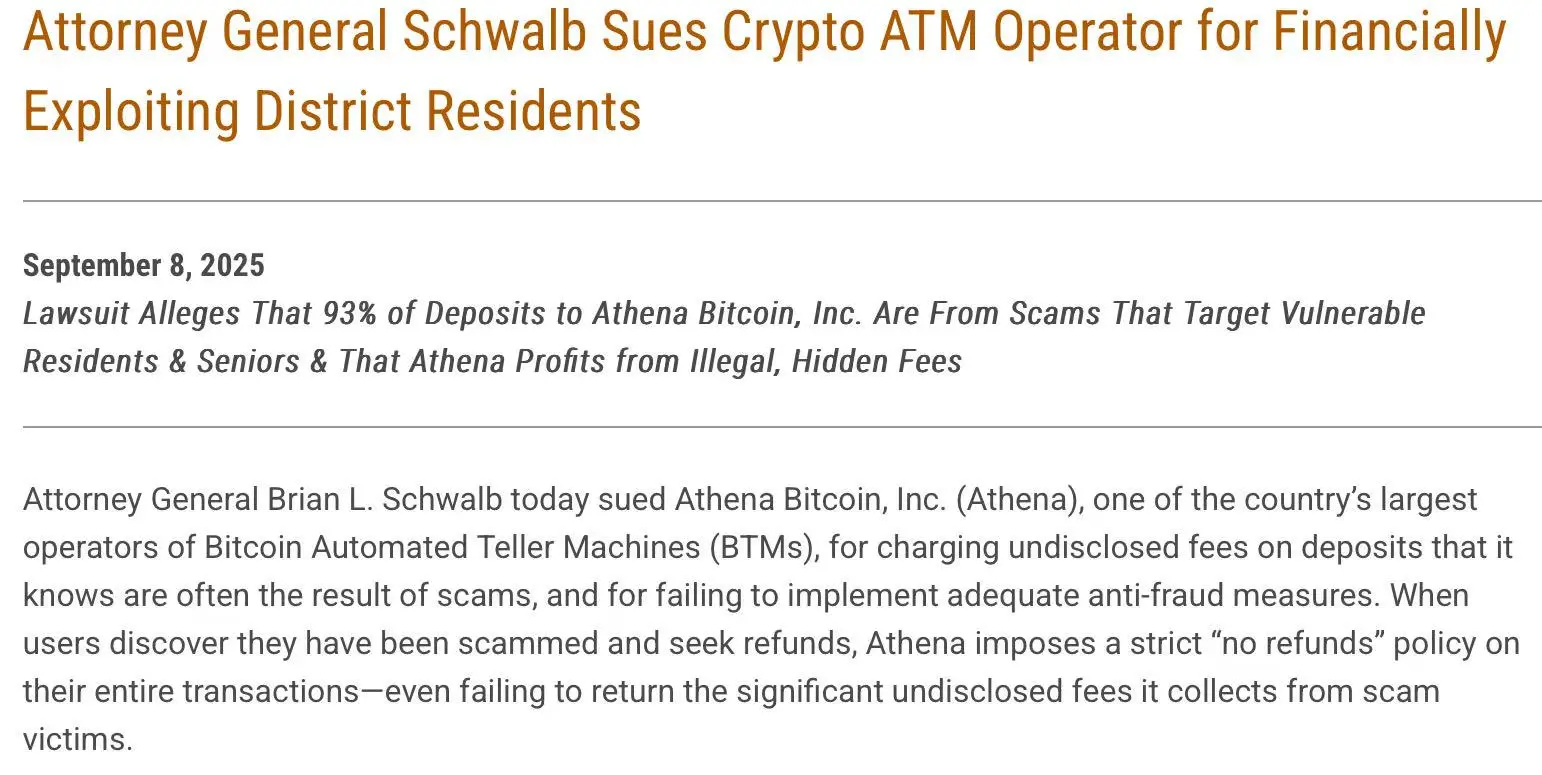
On September 9, it was reported that Washington D.C. Attorney General Brian Schwab filed a lawsuit against Bitcoin ATM operator Athena Bitcoin, Inc. on September 8, 2025, accusing the company of illegally profiting from financial scams targeting the elderly and vulnerable groups.
Investigations revealed that 93% of deposits made at Bitcoin ATMs operated by Athena in the district were directly related to scams, with the median age of victims being 71 years. The company is accused of charging hidden transaction fees of up to 26% (far exceeding the industry standard of 0.24%-3%) and implementing a strict "no refund" policy for scam victims. The Attorney General's office is demanding that Athena comply with the law, provide compensation to victims, and accept penalties.
Related Image
U.S. Congress Pushes for Bitcoin Reserve Study, Requires Treasury to Submit Feasibility Report within 90 Days
On September 9, it was reported that U.S. Congressman David P. Joyce submitted a funding bill requiring the Treasury to submit a feasibility and technical consideration report on strategic Bitcoin reserves and digital asset reserves within 90 days of the bill's enactment, covering custody methods, legal authorizations, cybersecurity measures, inter-departmental transfers, asset presentation on the Treasury's balance sheet, and third-party custodians.
The report must also assess implementation barriers and the impact on the Treasury's confiscated funds. In March of this year, President Trump signed an executive order to establish strategic Bitcoin reserves and digital asset reserves. Treasury Secretary Scott Bessent stated that they are exploring "budget-neutral" ways to expand Bitcoin reserves. Currently, global Bitcoin reserves held by various countries have exceeded 517,000 BTC, accounting for 2.46% of the total supply.
Kyrgyzstan Plans to Establish Strategic Bitcoin Reserves
From September 9 to 10, it was reported by The Bitcoin Historian that Kyrgyzstan's Finance Minister stated that a bill will be submitted to establish strategic Bitcoin reserves and hopes the government can participate in Bitcoin mining. The next day, Kyrgyzstan's parliament approved the relevant bill, officially promoting the establishment of strategic Bitcoin reserves.

Related Image
U.S. Department of Justice Seeks to Seize Bitcoin Stolen in Multiple SIM Card Attack Cases, Valued at Over $5 Million
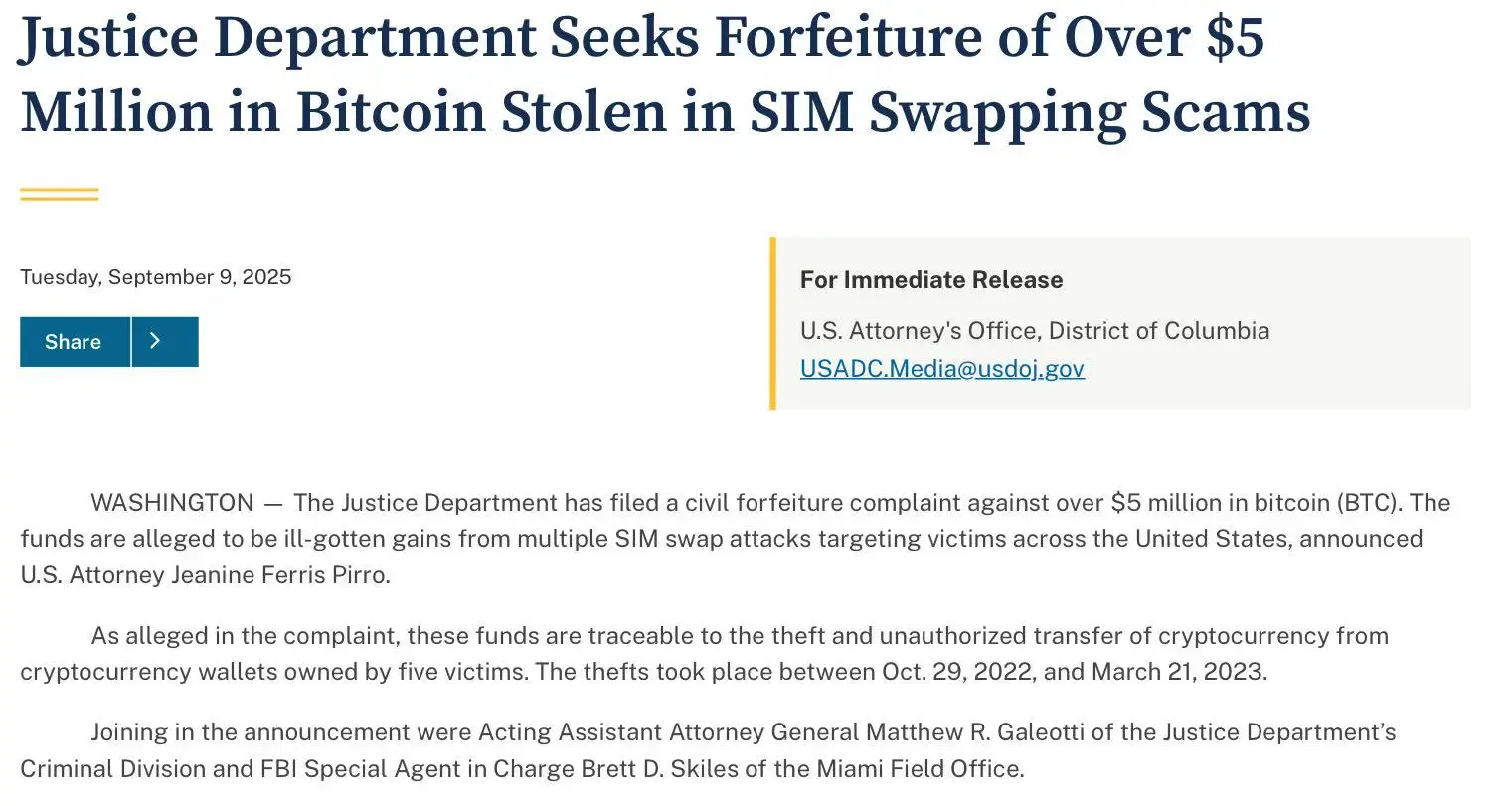
On September 9, it was reported that the U.S. Department of Justice has filed a civil forfeiture lawsuit for Bitcoin (BTC) valued at over $5 million, announced by U.S. Attorney Jeanine Ferris Pirro, claiming that these funds are allegedly ill-gotten gains from multiple SIM swap attacks against victims across the U.S.
The lawsuit states that these funds can be traced back to the theft of cryptocurrency wallets belonging to five victims and unauthorized transfers of cryptocurrency, which occurred between October 29, 2022, and March 21, 2023.
Related Image
Hong Kong Monetary Authority Issues Consultation Paper on Classification of Crypto Assets, Proposes to Divide Crypto Assets into Two Groups
On September 11, it was reported that the Hong Kong Monetary Authority sent a consultation paper (referred to as "Consultation Paper CRP-1") to the local banking industry regarding the new module of the Banking Regulatory Policy Manual (SPM), proposing to clarify regulatory guidelines for the Basel Committee on Banking Supervision's (referred to as "Basel Committee") new capital rules for crypto assets, which will be implemented in early 2026.
The new rules will categorize crypto assets into two groups, each further divided into two sub-groups (Group 1a, Group 1b, Group 2a, Group 2b). According to the revised Hong Kong Banking (Capital) Rules, Group 1a consists of tokenized traditional assets, while Group 1b consists of stablecoins with effective stabilization mechanisms; Group 2 assets include all unbacked crypto assets like Bitcoin and Ethereum, as well as any tokenized traditional assets and stablecoins that do not meet classification criteria, further subdivided into 2a (limited recognition of hedging) and 2b (unrecognized hedging).
7. Mining News
Data: An Independent Miner Successfully Mined a Bitcoin Block Using Only 200TH/s of Computing Power, Earning $347,980 in Rewards
On September 8, it was reported by The Block that an independent miner successfully mined Bitcoin block 913,593 with only 200TH/s of computing power, receiving a total reward of 3.129 BTC (approximately $347,980). CKpool developer Con Kolivas stated that this miner, using solo.ckpool.org, had only about a 1 in 36,000 chance of mining a block each day.
The miner's computing power is equivalent to a 2024 model Bitmain Antminer S21, accounting for about 0.00002% of the total Bitcoin network computing power (1.04 ZH/s).

Related Image
Market News: Brazil's Central Power Company to Launch Bitcoin Mining Business in Bahia State
On September 8, it was reported that Brazil's Central Power Company (Eletrobras) will launch a Bitcoin mining business in Bahia State.
Luxor Announces Partnership with Canaan to Provide Financing Support for Bitcoin Miners
On September 9, it was reported by The Miner Mag that Luxor has partnered with Canaan to provide financing support for Bitcoin miners. The first project of this partnership helped a U.S. institutional miner procure over 5,000 Avalon A15 Pro miners in August. This financing plan offers competitive interest rates and lower collateral requirements, with funds coming from Luxor's lending partners. As the hardware arms race among North American Bitcoin miners cools, Canaan hopes to promote institutional adoption of its equipment through financing options and support sales growth.

Related Image
Bloomberg: U.S. Republican Lawmakers Seek to Review Bitmain and Cango Inc.
On September 9, it was reported by Bloomberg that U.S. Republican lawmaker Zachary Nunn is calling for the federal government to review Bitcoin mining hardware manufacturers Bitmain and Cango Inc., stating that the expanding business of these two companies in the U.S. may pose national security risks.
Nunn pointed out that Bitmain and Cango "seem to be expanding their business in the U.S. through complex ownership structures and financing arrangements, which regulators and the public may not fully understand." In response, representatives from Bitmain and Cango stated that they strictly comply with all U.S. laws and have no connections with any government or state-owned enterprises.
Bitmain noted that it has taken note of rumors regarding its plans to acquire Cango, but "these rumors are completely unfounded," while denying that it is exploring direct ownership of U.S. power plants and stating that claims about its mining machines potentially affecting infrastructure are "nonsense." Cango stated that it does not comment on "market rumors" or potential merger transactions.
Bitmain Accuses Orb Energy of Misappropriating Bitcoin and Damaging Mining Machines
On September 10, it was reported by The Miner Mag that Bitmain has filed a motion in a U.S. bankruptcy court to reclaim thousands of Bitcoin mining machines held by Orb Energy, accusing the Texas-based company of misappropriating digital assets, obstructing access, and damaging equipment worth millions of dollars.
In an emergency motion filed on August 27, Bitmain stated that 2,700 Antminer servers located at Orb Energy's Van Vleck facility remain the property of Bitmain according to the custody sale agreement and should not be included in Orb's bankruptcy assets.

Related Image
Chinese Citizens Commission Overseas Virtual Currency "Mining Machines," Guangzhou Court Rules Contract Invalid
On September 11, it was reported that the Guangzhou Intermediate People's Court held a press conference on the effectiveness of foreign-related civil and commercial trial work and typical cases, ruling that a sales contract involving overseas operation of virtual currency "mining machines" was invalid due to disrupting China's financial order.
Wang Mouming and Zheng Mou are both Chinese citizens. They negotiated through WeChat, with Zheng purchasing 24 specialized servers for virtual currency "mining" from Wang for 1.024 million yuan and paying the full amount, agreeing that Wang would transport the "mining machines" to Mongolia for operation and maintenance, with electricity costs borne by Zheng and Chen Mouxiong. However, after the "mining machines" were transported to Mongolia, they frequently encountered online issues and remained under Wang's actual control without delivery. Therefore, Zheng sought to confirm the invalidity of the sales contract. Wang argued that Mongolian law should apply to this case and that the contract was valid. Chen Mouxiong clarified that he had no trading relationship with Wang and did not claim rights to the "mining machines." The Guangzhou Intermediate People's Court ruled that although this case involves foreign elements, both parties are Chinese citizens, and the contract stipulating the sale of "mining machines" to be operated in Mongolia for Bitcoin "mining" involves ecological, environmental, and financial security issues related to China's public interests, thus Chinese law should apply.
The "mining machines" in question are specialized equipment for "mining," which is energy-intensive and involves illegal financial activities, disrupting China's financial order. The contract in question is invalid due to violating public order and good morals, and relevant handling will be made based on the degree of fault of both parties and the performance of the contract.
8. Bitcoin News
Global Corporate and National Bitcoin Holdings (This Week's Statistics)
1. President of El Salvador Announces Purchase of 21 Bitcoins
On September 8, it was reported that El Salvador's President Nayib Bukele announced the purchase of 21 BTC to celebrate Bitcoin Day, bringing the official holdings to 6,313 BTC, valued at approximately $701 million, with a total increase of 28 BTC in the past 7 days.
2. HashKey Plans to Launch Over $500 Million Crypto Treasury Fund
On September 8, it was reported that HashKey Group plans to launch Asia's largest multi-currency DAT fund, with an initial fundraising of over $500 million, focusing on investments in BTC and ETH ecosystem projects, structured as an open-ended fund to balance liquidity and long-term strategy.
3. Binance Significantly Reduces ETH Holdings and Increases BTC Holdings in September
On September 8, it was reported that Binance net reduced 30,000 ETH (approximately $130 million) this month, leaving only 113 ETH; at the same time, it net increased 3,779 BTC, raising its holdings to 21,256 BTC, valued at approximately $419 million.
4. South African Listed Company Altvest Plans to Raise $210 Million to Purchase Bitcoin
On September 8, it was reported that Altvest Capital plans to raise $210 million to establish a Bitcoin reserve and rename itself Africa Bitcoin Corp., planning to use BTC as a core reserve asset, similar to cash or gold.
5. MicroStrategy Purchases Another 1,955 Bitcoins in September
On September 8, it was reported that MicroStrategy spent $217.4 million to buy 1,955 BTC between September 2 and 7, continuing to increase its treasury.
6. Exodus Movement Increases Holdings by 29 Bitcoins in August
On September 8, it was reported that Exodus Movement added 29 BTC in August, bringing its total holdings to 2,116 BTC.
7. Rectitude Holdings Launches Bitcoin Treasury Strategy
On September 8, it was reported that Rectitude Holdings signed a $32.6 million equity purchase agreement with Constantinople Limited, with funds to be used for purchasing and holding Bitcoin long-term.
8. Refine Group Spends 2 Million Swedish Krona to Purchase 1.89 Bitcoins
On September 8, it was reported that Refine Group AB purchased 1.89 BTC, raising its total holdings to 3.73 BTC.
9. Japanese Listed Company Convano Issues $139.2 Million Bond to Increase Bitcoin Holdings
On September 9, it was reported that Japanese listed company Convano (6574.T) is raising $139.2 million through the issuance of its fifth unsecured bond to increase its BTC holdings.
10. QMMM Plans to Establish a $100 Million Cryptocurrency Treasury
On September 9, it was reported that Nasdaq-listed company QMMM Holdings plans to set up a $100 million treasury to invest in BTC, ETH, SOL, and Web3 infrastructure projects.
11. Blueport Interactive Discloses Cryptocurrency Holdings
On September 9, it was reported that Blueport Interactive disclosed that the group holds 212 BTC, 2,040 ETH, and 10,513 SOL.
12. Metaplanet Purchases Another 136 Bitcoins and Plans to Raise $1.4 Billion
On September 8, it was reported that Japanese listed company Metaplanet spent $15.2 million to purchase 136 BTC, raising its total holdings to 20,136 BTC; it also plans to raise another $1.4 billion, with 90% allocated to increasing Bitcoin holdings.
13. BlackRock's Crypto Assets Holdings Near $100 Billion
On September 10, it was reported that according to Arkham data, BlackRock holds approximately $99.3 billion in crypto assets, including $83.41 billion in BTC, $15.89 billion in ETH, and a small amount of other tokens.
14. GameStop Narrows Q2 Losses and Discloses Holdings of 4,710 Bitcoins
On September 10, it was reported that GameStop's net loss for the second quarter was $18.5 million, while also disclosing the purchase of 4,710 BTC at a cost of $500 million, with an end-of-period valuation of $528.6 million.
15. The Smarter Web Company Increases Holdings by 30 Bitcoins
On September 10, it was reported that The Smarter Web Company announced an increase of 30 BTC, raising its total holdings to 2,470 BTC.
16. Listed Company POP Culture Completes a Total of $33 Million Bitcoin Investment
On September 10, it was reported that U.S. listed company POP Culture disclosed that it has completed a total of $33 million in Bitcoin investments, holding approximately 300 BTC. It is reported that the company is establishing a diversified cryptocurrency fund pool focused on investing in BTC, ETH, and BOT.
17. Robin Energy Completes Initial $5 Million Bitcoin Asset Allocation
On September 10, it was reported that international energy transportation company Robin Energy (stock code RBNE) has completed its initial $5 million Bitcoin asset allocation, becoming the latest energy company to diversify its portfolio through cryptocurrency. According to Google Finance data, RBNE's stock listed on Nasdaq surged over 90% on Wednesday, briefly hitting a high of $4.27 before retreating. During most of August, the stock price fluctuated around $1.87.
18. H100 Group Increases Holdings by 21 Bitcoins, Total Holdings Reach 1,025 Bitcoins
On September 10, it was reported that H100 Group announced an increase of 21 Bitcoins, bringing its total Bitcoin holdings to 1,025.
19. U.S. Listed Company LIXTE Spends $2.6 Million to Purchase Cryptocurrency, Increasing Allocation Ratio to 50%
On September 11, it was reported that Nasdaq-listed company LIXTE Biotechnology Holdings (stock codes: LIXT and LIXTW) announced on September 10 that it has made its first purchase of 10.5 Bitcoins and 300 Ethereum, totaling approximately $2.6 million, as part of its diversification strategy. According to the announcement, cryptocurrency currently accounts for 43.6% of LIXTE's asset holdings, and the company's board has approved increasing the allocation ratio of cryptocurrency to 50%. LIXTE Chairman and CEO Geordan Pursglove stated that this move aims to build a balanced and flexible digital asset strategy, enhancing the company's adaptability and long-term growth potential in the digital economy.
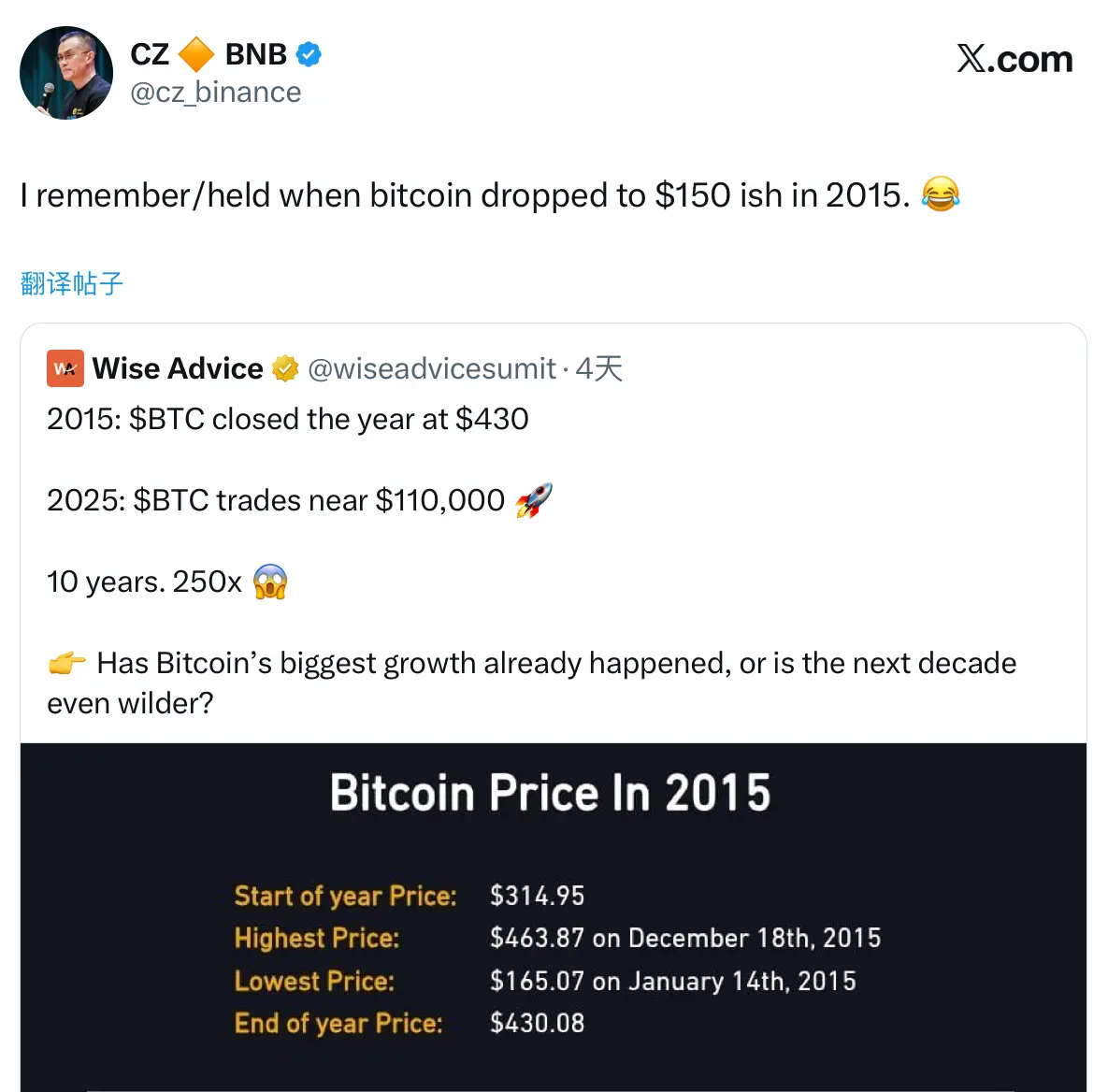
Zhao Changpeng: Still Holding Bitcoin When It Dropped to Around $150
On September 6, Binance co-founder Zhao Changpeng posted on platform X, stating: "In 2015, I remember holding Bitcoin when its price dropped to around $150."
Related Image
Opinion: BTC is Now the "Hardest Currency," May Completely Destroy All Asset Classes
On September 6, Joe Burnett, strategic director of Bitcoin treasury company Semler Scientific, posted on platform X, stating that the market is currently at the end of the long debt cycle mentioned by Ray Dalio, which means that stocks are being bid to extreme valuations, real estate is being pushed up in valuation, and fixed income products are also at extreme valuation levels.
The ultimate result of the long debt cycle is the devaluation of fiat currency, and the only exit is hard currency. Gold was the hardest currency in the past, and Bitcoin is the hardest currency now, which may completely destroy all asset classes.
SkyBridge Capital Founder: It Took Eight Years to Make My First Bitcoin Investment
On September 6, Anthony Scaramucci, founder and CEO of SkyBridge Capital, shared his journey from being a cryptocurrency skeptic to an advocate during a Q&A session on social media.
He stated that although he had the opportunity to come into contact with Bitcoin as early as 2012, it took him eight years to make his first Bitcoin investment because he initially did not understand Bitcoin and was very skeptical of it. However, after truly understanding blockchain and Bitcoin, he realized it was a great technological breakthrough.
Anthony Scaramucci added that as long as "you do some homework," 90% of people will lean towards Bitcoin.
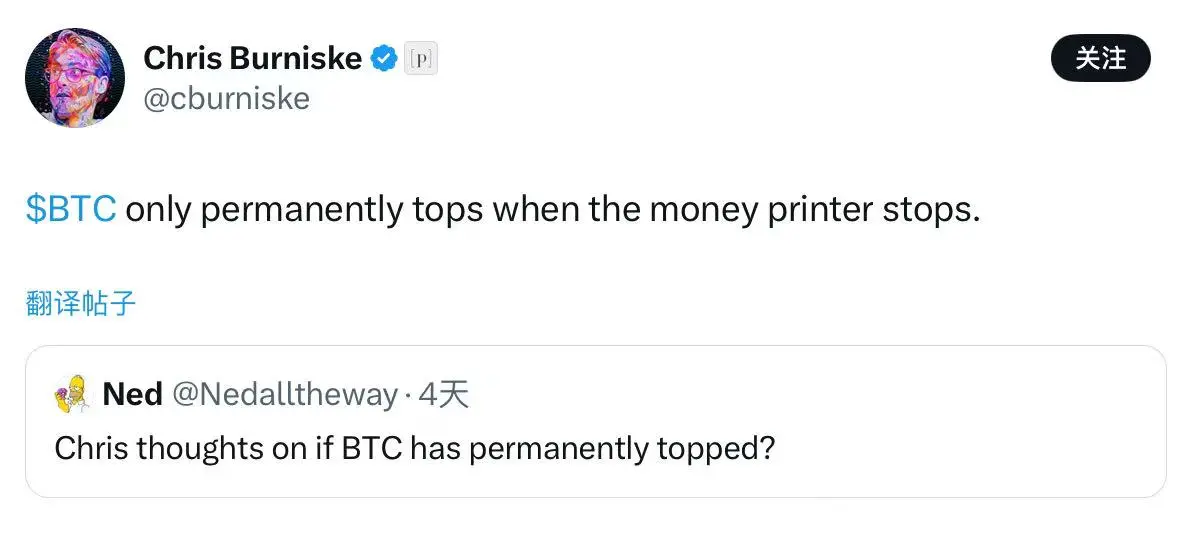
Opinion: Bitcoin Will Only Truly Peak When Money Printing Stops
On September 7, Chris Burniske, former head of crypto at Ark Invest and current partner at Placeholder VC, posted on platform X, stating that Bitcoin will only truly peak when the printing press stops running. The fluctuations within market cycles are short-term phenomena, while long-term trends are the inevitable rule.
Related Image
Analysis: Venezuela's High Inflation Rate Causes USDT and Other Stablecoins to Become "De Facto Currency" Locally
On September 7, it was reported that as Venezuela's annual inflation rate soared to 229%, stablecoins like USDT have become the "de facto" currency for millions of Venezuelans in the financial system.
It is said that locals refer to Bitcoin as "Binance Dollar," while the country's currency, the bolívar, has virtually disappeared from daily business activities. Hyperinflation, strict capital controls, and a fragmented exchange rate pattern have led people to increasingly prefer using stablecoins over cash or local bank transfers. From small grocery stores to medium-sized businesses, USDT has replaced fiat cash as the preferred settlement method locally.
Trump Family Increases Crypto Wealth by $1.3 Billion in Weeks
On September 8, it was reported by Bloomberg and Seeking Alpha that through the token WLFI and Bitcoin mining company American Bitcoin Corp (Nasdaq: ABTC), the Trump family has added approximately $1.3 billion in paper wealth in just a few weeks, with the two projects briefly raising the family's net worth to about $7.7 billion.
Brazil's Largest Private Asset Management Firm Itaú Asset Establishes Dedicated Crypto Department
On September 8, it was reported by Cointelegraph that Brazil's largest private asset management firm Itaú Asset Management has established a dedicated crypto department within its mutual fund sector. It is reported that Itaú Asset manages over 1 trillion reais ($185 billion) in assets for clients.
Currently, the company offers 10 trading pairs including BTC/ETH/SOL/USDC and has developed its own custody solutions, with existing products including Bitcoin ETFs and exposure to digital assets in pension funds; the new department will advance digital asset investments around fixed income, derivatives, and staking strategies.

Related Image
Tom Lee: After Rate Cuts in September, Bitcoin Could Easily Rise to $200,000 by Year-End
On September 8, it was reported by Bitcoin Magazine that Tom Lee, in an interview with CNBC, stated that the Federal Reserve's rate cuts would bring double benefits: one is lowering interest rates, especially mortgage rates may decline (with the narrowing of the 10-year Treasury yield spread), and the second is boosting business confidence (the ISM index has been below 50 for 31 consecutive months, setting a historical record). This is why the potential rate cut by the Federal Reserve in September will support the stock market, especially benefiting small-cap stocks, the financial sector, and cryptocurrencies.
Tom Lee stated: "I believe that the potential Federal Reserve rate cut on September 17 (announced in the early hours of September 18 Beijing time) will be an important catalyst. Cryptocurrencies usually perform well in the fourth quarter, so I think Bitcoin can easily rise to $200,000. I know this is a significant increase, almost doubling, but these should double."
Analysis: $7 Trillion Money Market Fund Reserves May Propel the Crypto Market into the Next Uptrend
On September 9, it was reported that according to data from the Investment Company Institute (ICI), total assets in U.S. money market funds increased by $52.37 billion in the week ending September 3, reaching a historic high of $7.26 trillion. Analysts believe this massive amount of funds may propel Bitcoin and other altcoins into the next uptrend.
David Duong, head of institutional research at Coinbase, stated that as the Federal Reserve further cuts rates, retail funds may flow from money market funds into stocks, cryptocurrencies, and other assets. Jack Ablin, chief investment strategist at Cresset, pointed out that if money market fund yields drop from 4.5% to 4.25% or 4%, investors will reallocate funds to stocks and cryptocurrencies.
J.P. Morgan: Institutional Adoption of Cryptocurrencies is Still in Early Stages, but Momentum is Increasing
On September 10, it was reported by CoinDesk that J.P. Morgan released a report stating that institutional adoption of cryptocurrencies is still in its early stages, but momentum is increasing.
The report noted that the IPO of Bullish in August and the passage of the GENIUS Act have intensified attention on the industry, and regulatory clarity has eliminated one of the biggest obstacles faced by large investors. The report mentioned signs of participation, with the Chicago Mercantile Exchange (CME) reporting that the number of open contracts for cryptocurrency derivatives held by institutional investors has reached an all-time high, with institutions currently holding about a quarter of Bitcoin ETPs; a survey by Ernst & Young showed that 85% of companies have allocated or plan to allocate digital assets by 2025, with regulation being a key driving factor.
The report also stated that in the stock market, Bullish has become a benchmark for institutional investors; since its IPO, the exchange's stock price has risen by 45%, and if it obtains a BitLicense later this year, its growth momentum will be even stronger. J.P. Morgan has a "neutral" rating on Bullish stock, with a target price of $50. The stock rose slightly to $54.5 on Wednesday.
Related Image
 Risk warning Risk warning




Popular articles





