








NAKA's stock price plummeted 54% in one day. Is the market starting to tire of DAT?

 Investors are generally weak on the Bitcoin Trust (DAT) strategy, reflecting a saturation of market demand and a return to rationality. At the same time, altcoin DATs continue to emerge, but there is controversy within the industry regarding the prospects of such companies.
Author: Chloe, ChainCatcher
On September 15, the stock price of KindlyMD (NAKA) dropped to $1.28, falling 54% within 24 hours before the deadline, and over 90% in a month. This company, which transitioned from healthcare to Bitcoin (BTC) assets, is now facing dual pressures from its equity dilution plan and investors' general fatigue towards its Digital Asset Treasury (DAT) strategy.
KindlyMD was originally listed on NASDAQ as an integrated healthcare technology company, and its transformation began with the merger with Bitcoin (BTC) asset Nakamoto Holdings. Founder David Bailey previously served as a cryptocurrency policy advisor to former U.S. President Trump and is well-versed in industry regulatory dynamics.
A month ago, KindlyMD announced a plan to raise $540 million through a stock issuance to expand its Bitcoin reserves. In mid-August, KindlyMD announced its first purchase of Bitcoin, acquiring approximately 5,744 Bitcoins through its subsidiary Nakamoto, with a total transaction price of about $679 million, averaging around $118,200 per coin, while Bitcoin's price was around $110,000 at that time.
The stock peaked above $15 in mid-August, then began to plummet sharply, accelerating its decline throughout September.
Company Announces PIPE Financing, Stock Price Halves
"As these shares enter the market, the company expects stock price volatility may intensify in the short term. For shareholders seeking short-term trades, the company advises exiting," David Bailey stated on social media on September 12, indicating that the company had submitted an S3 form to register the shares sold in the PIPE financing.
PIPE financing is a method of raising funds by selling shares to private investors, typically at a discount to the market price. Once the S3 registration is completed, these shares can enter public market trading. The introduction of a large number of new shares (in this case, shares from PIPE financing) increases the supply of stock in the market, which, if not matched by a corresponding increase in demand, may put downward pressure on the stock price, leading to volatility.
KindlyMD's move directly allows for the gradual issuance of shares at the current market price, raising significant concerns among investors about equity dilution.
Related to Saturation Signals in Digital Asset Treasury (DAT)?
A report released by Grayscale in August recorded a decline in investor enthusiasm for Digital Asset Treasury (DAT), noting that Bitcoin exchange-traded products experienced their first monthly net outflow since March, with redemptions totaling $755 million. The report measures supply-demand imbalance by comparing the market capitalization to the underlying cryptocurrency asset value using the "mNAV" ratio.
According to Grayscale, the mNAV ratio of major DAT companies has approached 1.0, indicating that supply and demand have reached equilibrium, rather than the premium valuations these products previously enjoyed. The results show that investors are no longer willing to pay a premium for exposure to cryptocurrencies through public stock instruments.
In a report released in August 2025, Grayscale disclosed that the decline in investor enthusiasm for Digital Asset Treasury (DAT) was primarily due to Bitcoin exchange-traded products (ETPs) experiencing their first monthly net outflow since March, with redemptions totaling $755 million. This reflects that investors are reducing their holdings and enthusiasm for Bitcoin spot ETPs. Meanwhile, ETH-related spot ETPs attracted significant inflows, with a net inflow of approximately $3.9 billion in August, marking two consecutive months of net inflows, indicating that investors prefer diversified asset allocations, particularly with enhanced confidence in Ethereum and its applications (such as DeFi and smart contracts).
The "mNAV" mentioned in the report measures the supply-demand balance between the stock price of DAT companies and the market value of their held cryptocurrency assets. The mNAV (market NAV) ratio compares the company's market capitalization to the market value of its underlying cryptocurrency assets. When the ratio approaches 1.0, it indicates that the market price aligns with the actual value of the held assets, reflecting a balance in supply and demand. Grayscale points out that the mNAV ratio of most major DAT companies has approached 1.0, indicating that the market is no longer willing to provide premium valuations for these companies, meaning investors are no longer paying extra to gain cryptocurrency exposure through stock routes.
Thus, the decline in investor enthusiasm, outflows from Bitcoin ETPs, and the disappearance of valuation premiums for DAT companies reflect a saturation and rational return of demand for such digital asset investment tools across the market.
Despite the fatigue shown in Bitcoin DAT, altcoin DAT continues to emerge.
Are Altcoin DATs Criticized for Being Confusing?
Regarding altcoin DATs, recent announcements from tokens like Solana and Cronos indicate the establishment of new digital asset treasuries, showing that while investor enthusiasm for overall DAT companies is declining, institutional players continue to launch related products.
According to reports in August, NASDAQ-listed Mill City Ventures III may raise another $500 million to fund its recently announced Sui token DAT strategy. Galaxy Digital noted on July 31 that narrative-driven investments are prompting the company to expand its treasury, not limited to Bitcoin.
Cryptocurrencies such as ETH, Solana, XRP, BNB, and HyperLiquid are gradually gaining favor in corporate treasuries outside of Bitcoin.
According to data from BitcoinTreasuries.NET, publicly listed companies hold Bitcoin valued at approximately $117.91 billion. Ethereum, as another cryptocurrency, is increasingly valued, partly because it can be staked to generate annual returns, serving as both a store of value and a source of income.
Data from StrategicETHReserve indicates that approximately 3.14% of the total supply of Ethereum is held by listed DAT companies. Galaxy Digital CEO Mike Novogratz stated that the interest of DAT companies in the broader cryptocurrency market may be a reason for the recent price consolidation of Bitcoin. "Bitcoin is currently in a consolidation phase, partly because most DAT companies are starting to experiment with other tokens."
However, David Bailey criticized the term "digital asset treasury" itself as confusing, noting that an increasing number of companies are holding assets other than Bitcoin on their balance sheets. "Many companies are including underperforming altcoins on their balance sheets, which muddles the DAT narrative."
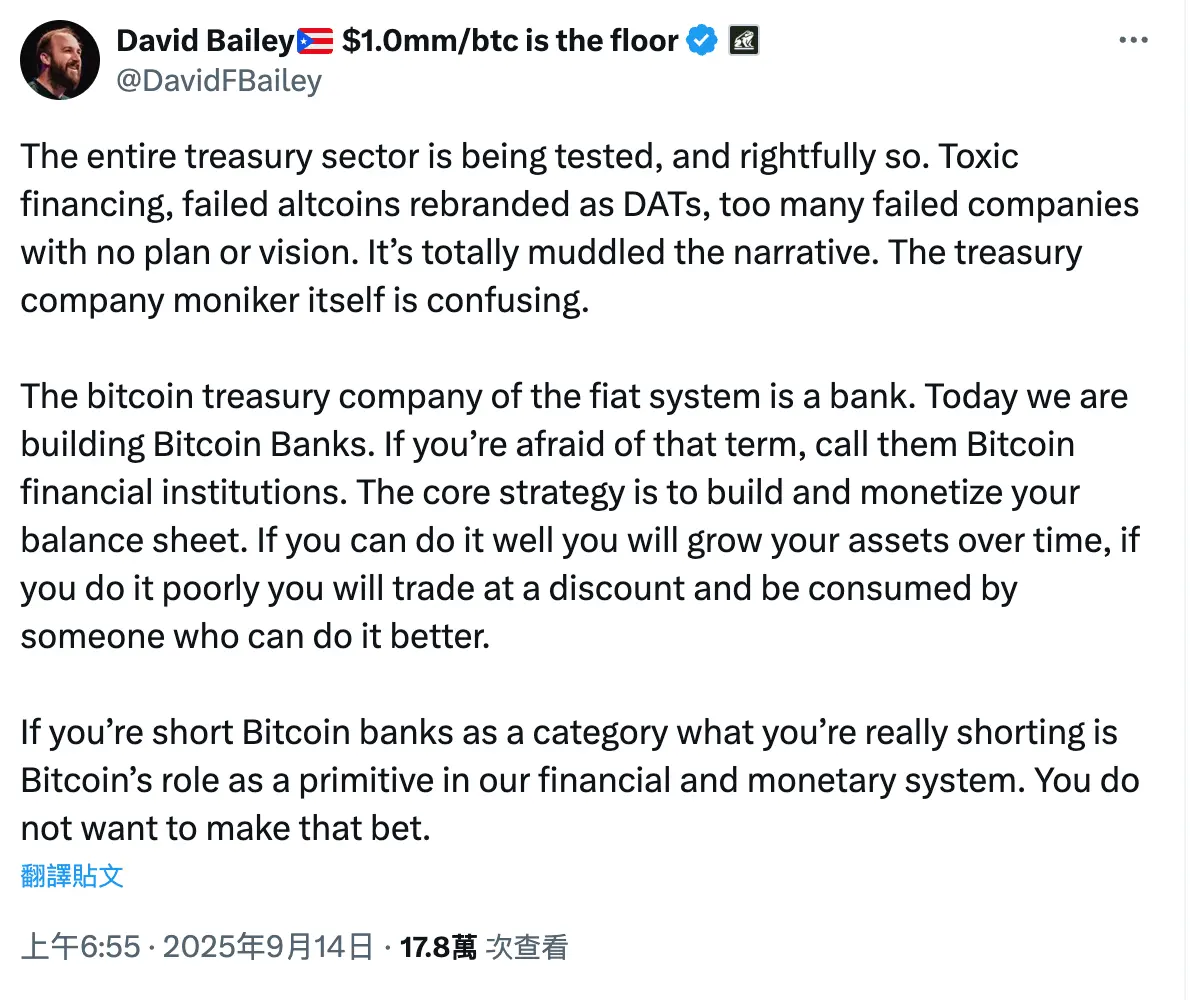
Image source: X @DavidFBailey
Currently, altcoins are heavily allocated in many companies' financial reports, leading to market doubts about certain digital asset companies (including some DAT or similar financial entities). Altcoins are under scrutiny in treasuries, and Bitcoin treasuries are now facing questions as well.
Venture capital firm Breed stated that only a few Bitcoin treasury companies can withstand the test of time and avoid falling into a "death spiral" of trading close to net asset value.
 Risk warning
 Risk warning



Popular articles





