HashWhale Crypto Weekly Report (2025/10/09–2025/10/03)

 Price fluctuations in intervals, elastic computing power, stable miner economy
Author: Georgia Jansen | Editor: Georgia Jansen
1. Bitcoin Market

Bitcoin Market Image
This week, Bitcoin has been trading within a wide but manageable range, pulling back to around $121,048 on October 10 after reaching an all-time high of $126,198.07 on October 6. This represents a decline of about 4.08% from Monday's peak, with overall fluctuations around the $120k--$126k range. The market capitalization is approximately $2.41 trillion, with a recent 24-hour trading range of $119,812--$123,739, indicating that both bulls and bears are still actively contesting before the weekend.
Phase 1: Consolidation Before Breakout and New High (October 4--6)
Starting close to $120k, the price steadily increased throughout the week, reaching a new high of $126,198.07 on October 6. This is an upward movement of about 5% from the ~$120k area, consistent with the continuation of a larger upward trend. This phase is characterized by trend-following buying and momentum continuation, with spot trading leading and derivatives following.
Phase 2: Pullback After New High (Evening of October 6--October 8)
After hitting the peak, the price retraced to around $121k by October 8. From the peak of $126,198.07 to ~$121k, the decline was about 4%, which is roughly consistent with the current 4.08% drop from the ATH. This is a typical digestion after a breakout: profit-taking at new high levels, momentum pullback, and a retracement to the previous breakout zone.
Phase 3: Attempted Rebound and Range Struggle (October 8--9)
Since the low on October 8, Bitcoin has repeatedly rebounded to the $123k mid-range, but selling pressure re-emerged. Overlapping candlesticks during the day and a series of lower highs indicate that buying interest exists, but the strength is not sufficient to force the price to fully retest $126k.
Phase 4: Consolidation Around the $120k Line (October 9--10)
The recent 24-hour range of $119,812--$123,739 depicts the current equilibrium: buyers are firmly defending the psychological level of $120k, while upward movement is hindered above several thousand dollars. As the week draws to a close, $120k remains a key level where spot demand repeatedly appears; the upper resistance is at $123k--$124k, with the historical high of $126,198.07 above that.
Next Key Points:
If the price can stabilize above $120k and create higher lows, the probability of retesting $126,198.07 remains; however, if it effectively breaks down and closes below $120k on a daily basis, it would indicate deeper digestion, and the price may explore previous demand zones for upward movement. Given the strong breakout on October 6 and the current only about 4% pullback, as long as $120k continues to attract dip-buying and does not close at a weekly low, the path remains neutral to constructive.
2. Market Dynamics and Macroeconomic Background
Capital Flows
1. BTC ETF Capital Flows
This week’s Bitcoin ETF capital movements:
October 6: +$1.2052B
October 7: +$0.8756B
October 8: +$0.4407B
October 9: +$0.1978B (as of writing)

ETF Inflow/Outflow Chart
Capital trend characteristics: Four consecutive days of net inflow; momentum is slowing but has not reversed.
The first four days of this week recorded positive net inflows, totaling $2.7193B, continuing the strong absorption trend of ETFs;
Although the daily inflow scale has gradually decreased ($1.2B → $0.9B → $0.44B → $0.20B), it still shows that institutions are steadily increasing their positions at high levels rather than fearing heights or reducing positions.
2. Global ETP Capital Trends
According to the latest CoinShares weekly report, global crypto asset ETPs recorded nearly $6B in net inflows last week, setting a new weekly historical high and pushing assets under management (AUM) to $254B.
This strong influx of capital was primarily driven by Bitcoin's breakthrough to a record high of $125,750, with the U.S. contributing about $5B in net inflows for the week.
Global capital continues to flow into Bitcoin-related products, highlighting institutional confidence and allocation demand for the new high market.

Related Image
3. On-chain and Market Flow Indicators
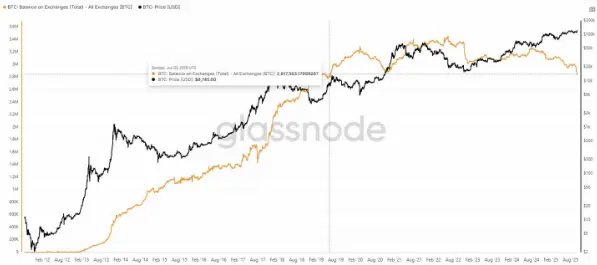
Exchange Bitcoin Reserves Drop to Near 6-Year Low
According to Glassnode, the Bitcoin supply held by exchanges is just above 2.8 million, close to a 6-year low, indicating that long-term holders are continuously moving coins to cold wallets, further reducing circulating supply.
UTXO Count Drops to Cycle Low, Indicating Reaccumulation Phase
According to NewsBTC, the number of unspent transaction outputs (UTXO) has dropped to about 166.6 million, the lowest since April 2024. Analysts point out that this indicator typically moves inversely to price, reflecting long-term holders focusing on "hoarding coins," indicating a strategic reaccumulation phase.
Related Image
Technical Indicator Analysis
Relative Strength Index (RSI 14)
According to Bitbo data, as of October 10, Bitcoin's 14-day RSI is 66.02, on the edge of mild overbought. An RSI between 60--70 typically reflects strong upward momentum, but if it stays above 70 for an extended period, it may signal an increased risk of short-term pullback.
The RSI recently rose from about 62 to 66, indicating that bulls have significantly strengthened this week and buying momentum continues. As the RSI approaches the upper bound of 70, if the price consolidates at high levels while the RSI fails to make new highs, it may form a momentum divergence, signaling an increased risk of short-term pullback or range-bound trading. Overall, the market remains in a strong state, but short-term overheating should be noted.

Bitcoin 14-Day RSI Chart
Moving Average (MA) Analysis
MA5 (5-day): $123,228
MA20 (20-day): $117,797
MA50 (50-day): $116,670
MA100 (100-day): $114,988
Current Price: $121,365.80

MA5, MA20, MA50, MA100, M200 Chart
From the moving average structure, short, medium, and long-term moving averages remain in a bullish arrangement, with prices above all key moving averages, indicating that the medium-term trend remains solidly upward.
In the past 7 days, MA5 has acted as a lifting support, guiding prices upward. From October 7 to 9, Bitcoin repeatedly found support near MA5 and rebounded strongly, ultimately forming a phase high near $124,000 on October 9.
Currently, the price is slightly below MA5 but still significantly above MA20 and MA50, indicating that short-term momentum has slowed but has not damaged the broader upward structure. If it can reclaim ~$123,200 (MA5), it is expected to test the $124,000 resistance area again; if it falls below MA20 (~$117,800), short-term pullback pressure will increase.
In summary, the moving average system remains healthy, with MA20--MA100 steadily rising, indicating a solid medium-term structure; short-term focus should be on the gains and losses of MA5, which may determine whether the price consolidates at high levels or restarts a breakout.
Key Support and Resistance
Support: The key short-term support levels are in the $120,250 and $121,000 areas. During the pullback on October 10, the price found strong support near $120,250 and stopped falling, indicating that this level has become a short-term dip-buying zone. On October 8, the price briefly dipped to ~$120,880 but quickly stabilized and rebounded, further reinforcing the effectiveness of the $121,000 area as support. This zone has become a recent stronghold for bulls; if it is lost, the risk of a short-term pullback will significantly increase.
Resistance: Initial resistance is concentrated at $122,000, with the next key resistance at $124,000. The upward movement on October 9 stopped at $124,000 and fell back, indicating heavy selling pressure at that point. Attempts to break above $122,000 on October 8 and 9 were unsuccessful, suggesting that while upward momentum is still present, more volume is needed to support it. As of October 10, Bitcoin has been consolidating in the $121,000--$122,000 range, with trading becoming calmer as the market awaits the next directional choice.
Summary
Technical Perspective------Healthy moving average structure and strong RSI------indicate the continuation of the medium-term upward trend. However, after consecutive upward movements, short-term momentum appears somewhat fatigued, with prices oscillating at high levels.
If the price can break above $122,000 with increased volume and stabilize, it is likely to retest the $124,000--$125,500 area; conversely, if $121,000--$120,250 is lost, it may pull back to near MA20 (~$117,800).
Market Sentiment Analysis
As of September 26, the Fear and Greed Index is at 54, indicating "neutral to greedy," reflecting a cautiously optimistic overall sentiment. Investors remain vigilant about short-term volatility, but confidence has not significantly weakened.
From October 4 to October 9, daily readings were: 59, 58, 59, 62, 55, 58, fluctuating overall in the 54--62 range. The relatively wide swings reflect sensitivity to price changes, with investors quickly switching between "wait-and-see," "chasing," and "caution."
At the beginning of the week, the index around 59 indicated "moderate greed," reflecting a constructive rise in risk appetite. The index rose as prices steadily climbed in the first half of the week. On October 7, when prices hit a new high, the index peaked at 62, with the market generally expecting continued upward movement. In the second half of the week, Bitcoin oscillated and pulled back, while the Federal Reserve's meeting minutes showed disagreements on future rate cuts, raising concerns about macro liquidity. Sentiment dropped to the 55--58 range, shifting from brief optimism to cautious observation.
Overall, sentiment shifted from optimism to caution during the week, highlighting investors' high sensitivity to macro policies and price fluctuations. In the context of ongoing macro uncertainty, sentiment volatility may continue to dominate short-term trends.

Fear and Greed Index Chart
Macroeconomic Background
FOMC Meeting Minutes
The minutes from the September 16--17 meeting were released on October 8, 2025. Officials remain cautious about further rate cuts: while there is a general openness to more easing within the year, concerns about accelerating inflation and labor market resilience emphasize uncertainty and debate regarding the timing and magnitude of rate cuts. Implications for crypto and other risk assets: the market is reassessing the probability of easing, with monetary policy support potentially weaker or more volatile in the short term.
The U.S. federal government shutdown continues; multiple Senate votes have failed.
On October 8, the Senate's sixth vote on the short-term funding bill (CR) also failed, marking the shutdown's nth/eighth day (counting from the publication date). The deadlock involves issues such as military pay and medical subsidies. Direct macro impacts include short-term fiscal uncertainty, delays in some economic data and government services, and a drag on market sentiment (although the strengthening dollar indicates that the market is more focused on risks and safe-haven flows elsewhere).

Related Image
SEC "Innovation Exemption" Advancement
SEC Chairman Paul Atkins stated that the rules for advancing the "innovation exemption" will be developed, aiming to enter formal legislative procedures by the end of 2025 or the first quarter of 2026. He mentioned in Manhattan that the federal government shutdown might slow the process but will still prioritize it and welcomes Congress's efforts on related bills (such as GENIUS). Market interpretation: if ultimately realized, a clear "innovation exemption" will significantly enhance the predictability of compliant digital asset innovations, benefiting institutional activities and Bitcoin mainstreaming in the long run; in the short term, it still depends on regulatory texts and political friction.

Related Image
Dollar Approaches Two-Month High
On Wednesday, the dollar strengthened against G10 peers, nearing a two-month high, as fiscal and economic concerns in Asia-Pacific and Europe weighed on related currencies. Hedge funds increased their short positions on the euro and yen, boosting the dollar's strength. Despite the ongoing U.S. government shutdown, negative developments elsewhere have overshadowed its drag, leading the market to reassess the U.S. macro outlook.
A strong dollar typically suppresses risk assets priced in dollars (including Bitcoin). The dollar's strength often reflects rising risk aversion and capital flowing back to the U.S., potentially limiting Bitcoin's upward space in the short term.
3. Hashrate Changes
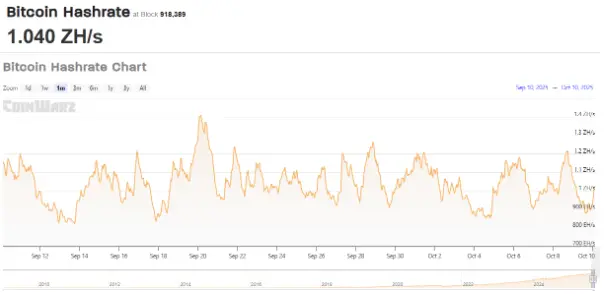
This week, Bitcoin network hashrate fluctuated within a clear range on CoinWarz's 1-month chart, with an estimated peak near the end of the period at 1.040 ZH/s (block 918,389). Over the past 7 days, the readings on the chart generally operated between the high 900 EH/s range and the low to mid 1.1--1.2 ZH/s range (1 ZH/s = 1,000 EH/s). The pattern resembles rapid intraday swings rather than a one-sided trend, consistent with miners adjusting loads, temporary maintenance, and regional grid dynamics affecting available power in short periods, thus influencing mining operations.
Phase 1: Early Week Pullback to Around 1.0 ZH/s "Cooling Down"
Around October 3--4, the curve dipped to ~1.0 ZH/s, occasionally briefly falling below. Such weakness is common when some mining clusters undergo short-term maintenance or electricity price signals prompt miners to proactively limit production for hours. The operational implication is straightforward: when hashrate declines, the average block generation interval may slightly exceed 10 minutes until hashrate returns; the mempool pressure temporarily increases, pushing transaction fees up. For miners, if fees rise, a brief hashrate decline may actually enhance single-hash revenue, as competitors for online hashes decrease during that window.
Phase 2: Midweek Expansion to 1.1--1.2 ZH/s Range
Around October 5--8, the curve quickly rose multiple times, with several peaks approaching the 1.2 ZH/s grid line. This typically reflects (a) the return of previously limited capacity, (b) opportunistic new devices coming online, and (c) more favorable electricity conditions reducing marginal electricity costs. The network-level effect is that block intervals converge back to the 10-minute target, and the mempool clears faster. For miners, higher hashrate compresses the expected BTC output per unit hash, meaning they need to maintain lower electricity prices to preserve profits. The rapid rebound indicates that the currently available hashrate reserves can switch quickly.
Phase 3: Pre-weekend Tug-of-War and Return to ~1.0--1.1 ZH/s Mean
Approaching October 9--10, the curve retreated from midweek highs, sliding back to the ~1.0--1.1 ZH/s range. This push-pull characteristic is common near the edge of regional grid constraints or in environments facing rolling maintenance cycles. Operationally, block times fluctuate around the target without sustained deviations. For miners, this repetition highlights the importance of dynamic load management, flexible power contracts, and regional diversification in smoothing short-cycle revenue fluctuations.
Why These Swings Matter------Difficulty, Fees, and Miner Economics: Bitcoin difficulty adjusts every 2,016 blocks to anchor the average block time at 10 minutes. Weekly hashrate fluctuations will affect the completion speed of these 2,016 blocks, thus influencing the direction and magnitude of the next difficulty adjustment. If the average hashrate during the current cycle is closer to the median seen this week (~1.0 ZH/s), then the difficulty pressure will generally align with recent adjustments; if the network spends more time at higher peaks (~1.1--1.2 ZH/s), it tends to increase.
Driving Factors:
Such levels of short-term hashrate fluctuations are largely explained by power market and weather factors (heat waves, storms, transmission constraints) as well as planned or emergency maintenance. The machine type structure is also important: mining farms with a higher proportion of new-generation miners rebound faster after limiting production; submerged cooling facilities respond more tightly under thermal stress. This week’s multi-peak curve indicates that miners are actively managing loads rather than facing prolonged downtime.
Risks and Resilience: The main operational risk of a tug-of-war week is the revenue volatility related to brief shifts in block times. Resilience comes from miners hedging against power costs, obtaining demand response revenue, and having automated production limiting capabilities. At the network level, this week’s performance of around high 900 EH/s to low 1.2 ZH/s indicates that hashrate has not structurally deviated upward or downward but is periodically breathing during the resolution of power and weather noise. If this trend continues, difficulty should remain within a corridor without extraordinary fluctuations; the fee market will also tend to normalize in the absence of abnormal on-chain demand shocks.
Outlook:
The baseline scenario is that hashrate continues to oscillate narrowly around ~1.0 ZH/s, with intraday pulses to the mid 1.1 ZH/s range when power conditions are favorable. In this scenario, block times should generally approach the target, and the next difficulty change is likely to be mild. The bullish scenario is if the network spends more time at the upper end observed this week (near the 1.2 ZH/s grid line), indicating incremental capacity coming online or reduced production limits; this would tend to push difficulty up, slightly compressing BTC output per unit hash. The bearish scenario is if the power market tightens or maintenance extends, leading to multiple dips below ~1.0 ZH/s; this would lengthen average block times until the next difficulty adjustment, while short-term support remains on the line for hashrate to capture higher fee revenue.
The values shown at the top of the chart (1.040 ZH/s for block 918,389) are derived from recent block times; short-term hashrate estimates naturally fluctuate and are better interpreted as a range rather than a single point. The visible range in the 1-month view provides this context: one side repeatedly approaches the low 1.2 ZH/s band, while the other side frequently probes the high 900 EH/s band. Understanding it as a "breathing" network rather than a linear trend is more helpful for operational and risk management decisions.
Bitcoin Hashrate Image
4. Miner Revenue
This week, Bitcoin miner revenue remained robust, with the Bitcoin Hashprice index maintaining a narrow range of approximately $50.5 to $52.7 per PH/s per day in the 7-day view; YCharts' latest reading shows that the network's total daily revenue on October 6, 2025, was $58.60 million. Practically, a 100 PH/s mining cluster would generate daily gross revenue of about $5,050--$5,270 at this week's extreme (before deducting electricity and pool fees). Its pattern resonates with the tug-of-war between spot prices and network hashrate, characterized by rapid intraday fluctuations rather than a one-sided trend.

Hashprice Index Image
Phase 1: Early Week Lift from $50.5 Line (October 3)
At the beginning of the week, the index briefly hovered at the lower end of $50.5 per PH/s per day, then quickly rose to ~$51.9 within a few hours. This stepwise increase raised the dollar revenue per unit hash by about 2.5% within hours, which is significant for operators sensitive to electricity prices. The rebound synchronized with a stronger spot market at the beginning of the week, directly supporting the hashprice in USD terms.
Phase 2: October 4--5 Horizontal Strength with a Sudden Intraday Surge
During the period from October 4 to 5, the hashprice oscillated most of the time between ~$51.3 and ~$51.8, then briefly surged above $52.5 per PH/s per day on the evening of October 5 before falling back. Such short-term surges often stem from stronger spot prices and/or temporarily rising transaction fees, thereby increasing miners' actual revenue in USD terms. Even a one-hour jump from $51.5 to $52.5 would add about $100 in revenue per PH/s per day, which can have a significant impact when scaled.
Phase 3: Weekly High Point and Rapid Reversal (Evening of October 7--Morning of October 8)
The strongest segment of the week occurred from the evening of October 7 to the early morning of October 8, with the hashprice climbing to the upper end of the range at ~$52.7 per PH/s per day before quickly falling back below ~$51.0. This two-step movement created a swing of about 3%--3.5% within less than a day. For operators fully hedged against electricity prices but not against price fluctuations, gross margins would directly reflect this whip; mining pools with short settlement periods would more quickly translate this volatility into payouts.
Phase 4: Mid-range Tug-of-War and Slight Dip/Rebound Before Weekend (October 8--10)
After the pullback at the beginning of October 8, the hashprice rebounded to the ~$52 area, then oscillated between ~$51.0 and ~$52.0 until October 9. From the evening of October 9 to the early morning of October 10, it briefly dipped to ~$50.8, then rebounded to ~$51.2 on the morning of October 10. The week closed in the mid-range, indicating that miners' unit revenue in USD neither significantly deteriorated nor accelerated in improvement.
Implications for Mining Cash Flow:
Within this observation range, if a 1 EH/s (1,000 PH/s) operation runs at this payment rate, the theoretical daily gross revenue would fluctuate between $50.5 million and $52.7 million, indicating that a mere $2 change per PH/s per day is highly sensitive for large mining clusters. For most small to medium-sized operations, the $50.5--$52.7 range this week implies moderate but perceptible daily revenue fluctuations that need to be balanced with fixed electricity commitments and production limiting opportunities.
Driving Factors:
The Hashprice index embeds three major variables: BTC price (positive), transaction fees (positive), and difficulty/competition (negative when rising). The intraday strength this week aligns with the relative firmness of spot prices at the beginning and middle of the week; the rapid reversal corresponds with the swift turnaround of spot prices and the repeated switching of network hashrate between high 900 EH/s and low 1.2 ZH/s. These conditions will compress or expand the dollar revenue per unit hash without necessitating structural changes in mining cluster sizes.
Risk Management Points: During most of the time around ~$51--$52, operators who can flexibly limit production or shift loads based on hourly electricity prices can enhance revenue capture during high payment windows. Conversely, fixed electricity contracts provide predictability but make it harder to capture intraday price differences. Pool selection and settlement periods are also important: shorter settlements transmit volatility faster, while longer settlements can smooth weekly fluctuations.
Next Week's Outlook: If BTC maintains the recent range and hashrate continues to oscillate but remains manageable, the baseline scenario is a continuation of the ~$50--$53 per PH/s per day corridor. An upward push towards high $52 to low $53 is more likely to require further upward movement in spot prices or a temporary rise in fees; if hashrate stays more at this week's upper end or spot prices pull back, the probability of returning to the low $50s increases. In planning, miners should conduct cash flow stress tests around the ~$50 mark and consider demand response revenue or short-term BTC hedges to buffer against rapid reversals in hashprice.
Miner Revenue Conclusion: The top dollar revenue environment remains resilient, with the latest network daily revenue at $58.60 million, and unit economics mostly situated in the narrow range of ~$50.5--$52.7 per PH/s per day. This combination supports stable gross margins for efficient mining clusters and shifts the focus to electricity cost discipline, uptime, and pool/settlement optimization rather than survival profitability issues. Unless BTC prices break decisively or hashrate continues to surge, miners can expect similar revenue conditions in the short term, interspersed with intraday fluctuations that reward operational agility.

BTC Miners Revenue Per Day Image
Policy and Regulatory News
Massachusetts Hearing Date Set Before Session
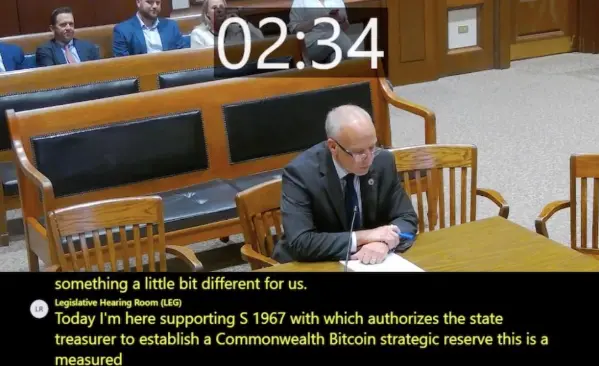
On September 29, 2025, multiple notifications indicated that the proposed Bitcoin reserve bill in the state would hold a hearing on October 7, with a lukewarm response during the session.
Related Image
Luxembourg's Policy Paves the Way for Allocation Behavior
In July 2025, Luxembourg updated its FSIL policy to allow alternative assets, paving the way for its Bitcoin ETF allocation this week (October).

Related Image
Bybit License Defined as UAE's First Federal Approval.
On October 9, 2025, legal/industry media reported that the license obtained by Bybit is the first nationwide full license under the SCA, distinct from the Dubai VARA system.
Tokenized Stocks Raise Investor Protection Warnings
On October 8, 2025, Reuters reported that traditional financial institutions and legal experts warned that the market's rush to issue tokens anchored to publicly traded company stocks, which often lack shareholder rights, poses risks to investor protection and market stability; meanwhile, both the U.S. and Europe are advancing frameworks to accommodate tokenized stocks.
Dubai Regulators Launch Consultation on New Crypto Token Regulations
On October 1, 2025, the Dubai Financial Services Authority released Consultation Paper No. 168, proposing updates to the DIFC crypto token regulatory framework------covering classification, authorization, and regulation------and inviting feedback on the adjustment proposals.
Nigeria Releases Sustainable Digital Finance Framework
On October 4, 2025, Nigeria released a "Sustainable Digital Finance" framework aimed at guiding crypto and fintech activities based on ESG principles, setting risk management and compliance expectations for the digital asset market.
Vietnam Crypto Pilot Sees No Applicants
On October 5, 2025, the Deputy Minister of Vietnam stated at a press conference that due to capital requirements and product restrictions, no companies have applied to participate in the domestic crypto trading pilot.
Kazakhstan Discloses Seizure of $16.7M and Tightens Regulation
On October 8, 2025, Kazakhstan's Financial Monitoring Agency stated that it has closed 130 unlicensed platforms and seized $16.7 million in digital assets, while planning to implement stricter identity verification and monitoring measures for cash and card transactions.
Stratiphy--21Shares Partnership Coincides with UK Retail ETN Opening
On October 8, 2025, wealth app Stratiphy announced a partnership with 21Shares to provide crypto ETNs to UK retail investors, coinciding with the new regulations from the UK's Financial Conduct Authority allowing retail participation in crypto ETNs.
India Pilots Tokenized Bank Deposits
On October 7, 2025, the Chief General Manager of the Reserve Bank of India stated that the central bank and commercial banks will pilot tokenized deposits. Policymakers are also discussing frameworks related to stablecoins and digital currencies.
CARF/CRS 3.0: Compliance Thresholds Raised
On October 8, 2025, analysis from Foodman CPAs indicated that the OECD's crypto asset reporting framework (CARF) and CRS 3.0 will drive institutions to incorporate crypto regulation into their core governance, data, and risk management systems.
Japan's Incoming Prime Minister Signals Support for Web3
On October 4, 2025, Sanae Takaichi was elected as the leader of the Liberal Democratic Party. Experts told Cointelegraph that her cabinet may "optimize" token regulation and promote the development of Japan's crypto economy around her inauguration on October 15.

Related Image
French Central Bank Calls for Direct ESMA Regulation and Tightening Stablecoin Rules
On October 9, 2025, French Central Bank Governor François Villeroy de Galhau stated at the ACPR-AMF Fintech Forum that the European Securities and Markets Authority should directly regulate major crypto firms and tighten MiCA rules on multi-issuer stablecoins.

Related Image
Gemini Expands in Australia in Line with New Regulations
On October 8, 2025, Gemini announced an expansion strategy aligned with upcoming regulatory changes in Australia, preparing for broader retail access.

Related Image
U.S. Shutdown Drags Market Structure Bill, Increasing Market Volatility
On October 8, 2025, reports indicated that the U.S. federal government shutdown has entered its second week, delaying the advancement of comprehensive crypto market structure legislation, while Bitcoin and Ethereum experienced significant pullbacks.
Bitcoin Information
Senator Lummis Advocates for Minimum Tax Exemption on BTC Payments
On October 9, 2025, Senator Cynthia Lummis publicly called on U.S. policymakers to implement a minimum tax exemption for everyday small Bitcoin payments, emphasizing the growing bipartisan consensus on treating low-value crypto transactions as cash consumption.
Deutsche Bank: Central Banks May Hold Bitcoin Before 2030
On October 10, 2025, Deutsche Bank researchers predicted that by 2030, global central banks may include Bitcoin as a reserve asset alongside gold, citing rising institutional adoption and diversification of digital reserves.
Robert Kiyosaki Says "60/40 is Dead," Points to Bitcoin
On October 9, 2025, Robert Kiyosaki stated that the traditional 60/40 stock-bond portfolio is "dead" and views Bitcoin as a path to financial freedom amid macro instability.
BC Police Warn: $200,000 Crypto Scam in Parksville
On October 9, 2025, Oceanside RCMP revealed that a woman in Parksville was scammed out of $200,000 based on an investment she learned about from a friend, warning the public to be vigilant against related scams.
"Bitcoin Jesus" Roger Ver Reaches Deferred Prosecution Agreement with Prosecutors
On October 10, 2025, reports indicated that Roger Ver reached a deferred prosecution agreement in his U.S. tax case, where charges would be dropped if he complies with the terms, although the agreement has not yet been submitted to the court.
Barry Silbert Launches Yuma Asset Management (AI + Crypto)

Related Image
On October 9, 2025, Barry Silbert announced the launch of Yuma Asset Management, investing in Bittensor/decentralized AI and crypto projects, including anchor commitments from DCG.
BurraPay Partners with Byte Federal to Provide Exchange Services
On October 9, 2025, BurraPay announced an agreement with Byte Federal to provide crypto exchange services, expanding payment and deposit/withdrawal functionalities.
Bitcoin.com and VERSE Community Approve Burning of 86.2 Billion Tokens
On October 9, 2025, the Bitcoin.com/VERSE community passed a proposal to burn approximately 86.2 billion VERSE tokens (reducing total supply by 38--42%) over four years, with an immediate burn of 15--17% planned for October to December 2025.
"Wall Street Revival" Sparks $150B "Abandoned" Bitcoin Discussion with Dust Transaction to Dormant Address

Related Image
On October 9, 2025, an entity using the name "Solomon Brothers" sent a dust transaction to Bitcoin addresses related to dormant claims, reigniting discussions about approximately $150 billion in "abandoned" Bitcoin.
Arthur Hayes: "Long Live the King"------The Four-Year Cycle is Dead
On October 9, 2025, Arthur Hayes published "Long Live the King," arguing that the traditional four-year cycle has become ineffective under the contemporary monetary system, spreading related views on X.
Binance Wallet Launches "Meme Rush" Early Access Platform
On October 9, 2025, Binance announced "Meme Rush," an exclusive feature of the Binance wallet, providing structured early access to meme tokens for verified/non-private key users.

Related Image
BNB Hotspot: Trader Turns $3,000 into $2 Million (BNB Chain)
On October 9, 2025, reports highlighted that a trader reportedly turned $3,000 into ~$2 million on the BNB chain, reflecting ongoing capital rotation in high-risk meme sectors.
Grayscale Bitcoin Mini Trust Updates and Agreements with Coinbase/BNY Mellon
On October 9, 2025, Grayscale's SEC filings indicated updates to agreements with Coinbase and BNY Mellon to ensure the operation and management of its Bitcoin Mini Trust ETF.
Related Image
Jack Dorsey Calls for Tax Exemption on Everyday BTC Payments
On October 8, 2025, Jack Dorsey publicly advocated for tax exemptions on everyday small Bitcoin transactions to promote mainstream payment adoption.
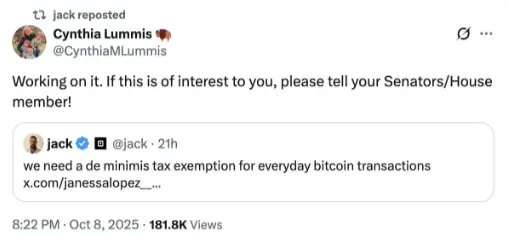
Related Image
Luxembourg FSIL Becomes Eurozone's First National Fund to Allocate BTC
On October 9, 2025, reports confirmed that Luxembourg's sovereign fund FSIL allocated about 1% through a Bitcoin ETF, following a policy update in July that allowed for the allocation of alternative assets, including crypto.

Related Image
Bitcoin Depot Prices $15M Registered Direct Offering
On October 6, 2025, Bitcoin Depot announced a registered direct offering of $15 million in Class A common stock through a securities purchase agreement.
Israel Crypto Trader Robbery: Attack on September 7, Prosecution This Week
On October 9, 2025, it was reported that assailants stabbed a crypto trader in Herzliya on September 7 and stole approximately $600,000 in BTC and USDT; the related case was prosecuted during the week of October 9.

Related Image
CoinShares: Crypto Funds Weekly Net Inflows Hit Record $5.96B
On October 9, 2025, CoinShares data showed that digital asset funds recorded a record weekly net inflow of $5.96B, with Bitcoin products absorbing $3.55B, and the peak daily inflow for U.S. ETFs occurring on October 3.

Related Image
PayPay Acquires 40% of Binance Japan, Boosting Crypto Payments
On October 9, 2025, PayPay, a subsidiary of SoftBank, disclosed its 40% stake in Binance Japan, planning to integrate PayPay Money with crypto buying and withdrawals.
Arizona Bitcoin ATM New Law Takes Effect to Combat Fraud
On September 26, 2025, Arizona's "Cryptocurrency Self-Service Terminal Licensing and Anti-Fraud Law" took effect, lowering transaction limits, mandating prompts/receipts, and requiring refunds to victims under certain conditions.

Related Image
Massachusetts Bitcoin Reserve Bill Hearing Received Tepid Response
On October 7, 2025, Massachusetts legislators held a hearing on a bill to establish a state-level Bitcoin reserve, with a lukewarm response and few questions from the audience.
"Kidnapping for Private Keys" Report Reveals $600,000 Bitcoin Extortion Case
On October 9, 2025, an investigative report described a $600,000 Bitcoin extortion scheme related to a broader context of hostage and crypto crime in Israel, echoing court documents from the September 7 Herzliya attack.
U.S. Treasury Hints at Strategic Bitcoin Reserve Approach
On October 9, 2025, Yahoo Finance reported that the U.S. holds approximately $17B in Bitcoin and outlined plans to further accumulate BTC primarily through confiscated proceeds under the "strategic Bitcoin reserve" framework first proposed earlier in 2025.

Related Image
Bloomberg: Silbert's Yuma Launches AI-Crypto Asset Management
On October 9, 2025, Bloomberg reported that Barry Silbert launched Yuma, focusing on AI-crypto strategies, benefiting from the market's recovery.
Grayscale/BNY/COIN Operational Updates Align with ETF Infrastructure
On October 9, 2025, documents showed that Grayscale, Coinbase, and BNY Mellon updated their operational agreements for the Bitcoin Mini Trust, aligning with ongoing improvements in ETF underlying pipelines.
Senator Lummis's Minimum Tax Exemption Initiative Aligns with Payment Scenarios
On October 9, 2025, policy advocates amplified Lummis's call for tax exemptions on small BTC consumption to normalize everyday payments.
Bybit's VAPO License Becomes a Regulatory Milestone in UAE
On October 9, 2025, Bybit received a nationwide full license from the SCA, surpassing the local jurisdiction of Dubai VARA, setting a national standard in the UAE.
"Meme Rush" Launch Triggers Surge in Meme Coin Volatility
On October 9, 2025, analysis indicated that after Binance launched "Meme Rush," meme coins on the BNB chain experienced significant volatility, highlighting concentration/liquidity risks under the early access mechanism.
Record Institutional Inflows Coincide with BTC All-Time Highs
From October 3 to 9, 2025, aggregated data showed that U.S. Bitcoin ETF daily net inflows peaked on October 3, contributing to a record weekly net inflow of $5.96B and driving Bitcoin to new all-time highs.
PayPay-Binance Japan Alliance Signals Payment and Crypto Integration
On October 9, 2025, corporate statements and media confirmations indicated PayPay's 40% stake, planning to provide access paths to crypto for 70 million users.
Related Image
Bitcoin Depot Financing Supports Expansion of Self-Service Terminal Network
On October 6, 2025, Bitcoin Depot disclosed a registered direct offering of $15 million to fund operations and expansion.
Record Capital Flows Highlight "Institutional Comfort" Theme
On October 9, 2025, capital flow breakdowns indicated that the U.S. had the largest load, with Switzerland/Germany setting local records.
Arizona Consumer Protection New Law Details
On September 26, 2025, the state attorney general confirmed the effective date and terms of the anti-fraud law for self-service terminals, including receipts, prompts, limits, and victim refund rights, focusing on protecting vulnerable groups like the elderly.
Cointelegraph Reviews Massachusetts Hearing Tone
On October 9, 2025, a review emphasized that despite the bill's advancement, legislators' responses remained lukewarm, and the path forward remains unclear.
Bybit Plans Expansion and Hiring in Abu Dhabi and Dubai Under New License
On October 9, 2025, subsequent reports indicated that Bybit would expand its operations and hiring in Abu Dhabi and Dubai under the SCA license.
Hayes's Views Gain Mainstream Media Attention
On October 9, 2025, multiple media outlets amplified Hayes's argument that liquidity and policy, rather than halving, dominate the current Bitcoin cycle.
"Solomon Brothers" Dust Transaction Reignites Discussion on Dormant Bitcoin Ownership
On October 9, 2025, a dust transaction from the "Solomon Brothers" wallet reignited discussions about unclaimed Bitcoin and legal ownership narratives.
Grayscale Documents Clarify the Role of GBTC-mini's Service Providers
On October 9, 2025, updated agreements clarified the responsibilities of Coinbase and BNY Mellon in custody/management.
Vietnam Consults Tether on Stablecoin Opinions During Crypto Pilot Progress
From September to October 2025, reports indicated that Vietnam consulted Tether for opinions while advancing its crypto pilot as part of a phased implementation.

Related Image
Meme Token "Early Access" Mechanism Highlights Risks
On October 9, 2025, analysis of Meme Rush pointed out that in a structured early access environment, concentration and liquidity characteristics could amplify volatility.
Parksville Case Highlights Rising Global Crypto Crime
On October 9, 2025, the RCMP's Parksville warning joined the sequence of reports on violent and non-violent crypto crimes across various jurisdictions this year.
Capital Flow Reports Link to October 3 ETF Daily Peak
On October 9, 2025, weekly capital flow reports emphasized October 3 as the peak for net subscriptions in U.S. Bitcoin ETFs, situated within a record week.
Massachusetts Review Highlights Uncertain Future
On October 7, 2025, despite the hearing, the bill's direction remains unclear, with legislators showing general disinterest.
Byte Federal Partnership Adds Another Example to BurraPay Integration
On October 9, 2025, the BurraPay-Byte Federal partnership continued its multi-faceted integration in compliance scenarios.
Dorsey's Payment Stance Aligns with Lummis's Minimum Tax Exemption Initiative

Related Image
On October 9, 2025, Dorsey's call for tax exemptions on small BTC payments aligned with congressional initiatives to simplify everyday crypto usage.
Institutional Buying is the Macro Mainline This Week
On October 9, 2025, capital flow breakdowns showed that U.S. ETFs led, with Europe (especially Switzerland and Germany) setting their own weekly records.
Arizona Self-Service Terminal New Law Emphasizes Victim Refund Rights
On September 26, 2025, the state attorney general announced details of the refund window and receipt/prompt requirements, aiming to protect vulnerable groups like the elderly.
FSIL Allocation Framed as ETF Path Under Policy Guidance
On October 9, 2025, industry reports indicated that to reduce operational risks, FSIL allocated about 1% through an ETF path.
Yuma Launch Anchored by DCG-Related AI-Crypto Arguments
On October 9, 2025, reports detailed that Yuma's strategy is to provide qualified investors with exposure to Bittensor subnet and broader decentralized AI assets.
 Risk warning Risk warning