








Cryptocurrency Crash and Buffett's Disappeared Partner | Bill It Up Memo

 Trump's remarks trigger a "financial nuclear bomb"
Original author: Bill Qian
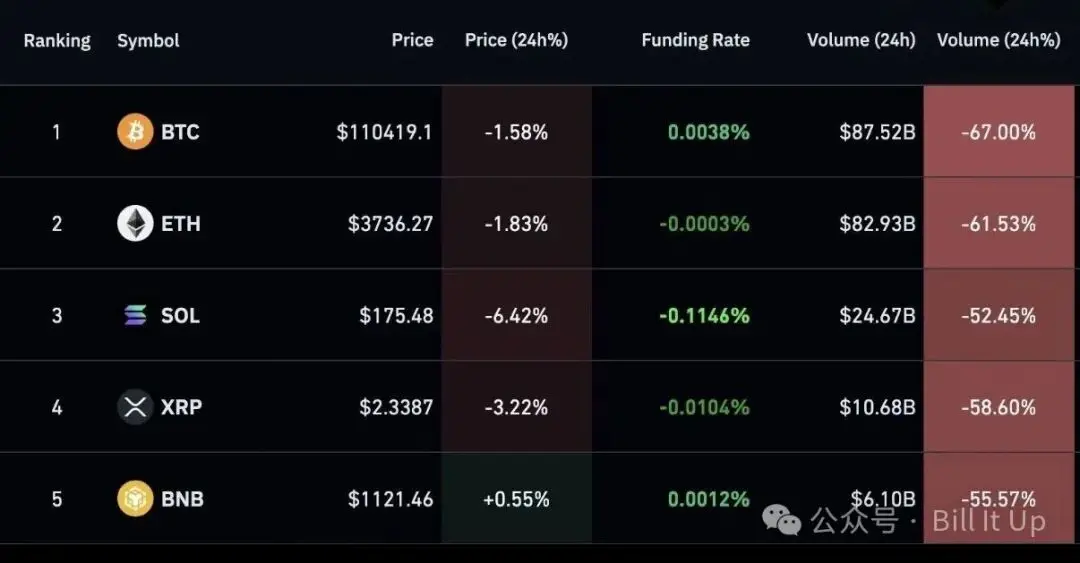
What happened this weekend? A threat from Trump on social media (imposing a 100% tariff on Chinese goods and an export ban on all critical software) acted like a financial nuclear bomb, triggering market panic. Cryptocurrency assets evaporated significantly within 24 hours: approximately $19.1 billion in positions were liquidated, with long positions accounting for the vast majority. High-leverage long positions turned the market into dry tinder, and even a slight disturbance led to a stampede; market quotes became chaotic, and DeFi liquidity dried up, adding fuel to the fire. Even the world's third-largest USDe instantly de-pegged to $0.65 (not due to USDe itself, but a pricing mechanism error at Binance), and mainstream coins like ETH and SOL were not spared, plummeting more than 20% during trading. As a result, this Saturday, on October 11, 2025, many friends in the crypto industry went bankrupt overnight, and some were even found dead from gunshot wounds in their Lamborghinis over the weekend.
In our industry, fortune is truly sought in danger.
Here are some of my personal reflections:
1. Tail, Tail, Tail! The reason "The Black Swan" and Taleb have become global phenomena is that in an age of digitization, intelligence, and interconnectedness, the resonance of global greed, anger, and ignorance generates karma that makes low-probability events no longer low-probability and tail events no longer tail. Even in the past five years, we have experienced COVID, FTX, UST, Binance's lawsuit in the U.S., and now this flash crash; it seems that without a major stimulus each year, the year feels incomplete. Therefore, we must always be prepared for that major stimulus to arrive.
2. Does your investment portfolio affect your sleep? "The Psychology of Money" shares an interesting point: whether you can sleep at night is a very important indicator of your investment portfolio. After all, making money is meant to make oneself happy, not to crazily increase cortisol levels and then lose everything in liquidation and pain.
3. The crypto market is an offshore small-cap stock market: Former practitioners studied halving cycles for four years, but now the crypto market has grown up, leaving the laboratory environment and entering the global macro market. Everyone should become a macro student and learn more about Druckenmiller and Soros.
4. Survivorship bias: As of 8 AM on October 11, the total amount of liquidations across the network was approximately $19.134 billion, with long liquidations amounting to about $16.679 billion, marking the most brutal slaughter in crypto history. However, on social media, you will mostly see people sharing how they made money from this crisis. If you don't look at other news, you might think we just experienced a major rally. This reminds me of World War II when engineers discovered many bullet holes in the wings of returning bombers and fighters, and then held meetings to discuss reinforcing wing armor; later, they realized that planes with fuel tank breaches couldn't make it back. What you should do is reinforce the armor of the fuel tanks.
5. Centralized exchanges struggle to achieve transparency in rules: Until this incident, users could see that the price of USDe used by Binance was its own, rather than a weighted price derived from various market prices. However, this time Binance plans to take responsibility for its mistake and compensate users, which is a step forward for the industry.
6. The House Always Wins:
a. A certain Bitcoin whale closed 90% of its BTC short positions on Hyperliquid and fully closed its ETH short positions, making approximately $190 to $200 million in profit in just one day. Notably, this whale established a nine-figure BTC and ETH short position just minutes before the market dropped. This is only its publicly disclosed position on Hyperliquid; its operations on centralized exchanges or other platforms remain unknown, and this account may have played a key role in that day's market. This whale's family name might be Trump. In this world, wealth is not only obtained through value creation like Tesla and Alibaba, but also through value transfer and value plunder. This is unfair, but it is the truth.
b. The world increasingly needs Open Finance/DeFi: The common people need it for convenience and permissionless access; the big players need it for permissionless, anonymity, and tax avoidance; policymakers need it for convenience, anonymity, and the ability to open long and short positions at any time. Therefore, DeFi will only continue to thrive.
7. Recently, I came across a story about a man: Rick Guerin. He was the third early partner of Buffett and Munger, and like them, he believed in value investing, but was more aggressive—he liked to use leverage to amplify returns. During the stock market crash of 1973-1974, he was forced to liquidate due to high leverage, suffering heavy losses, and had to sell a large amount of Berkshire stock to repay margin calls. After that, he gradually faded from public view and missed out on Berkshire's remarkable growth over the following decades. Buffett later mentioned him, saying, "The three of us were actually on the same path; it’s just that Charlie and I wanted to get rich slowly, while Rick wanted to get rich quickly."
I hope we can all become Buffett and Munger, and not Rick.
 Risk warning Risk warning



Popular articles





