








In 2025, why did digital gold Bitcoin lose to real gold?
 Core Viewpoint

 Young Bitcoin still has a long way to go in its evangelism.
Author: Liam, Deep Tide TechFlow
Do you remember the end of 2024, when everyone was writing asset predictions for 2025?
Stock investors were focused on the S&P and the A-shares, while those in the crypto circle were betting on Bitcoin.
But if someone had told you that the best-performing asset in 2025 would not be Bitcoin, nor anything else, but that "old antique" gold that Gen Z despises, you would have thought they were joking.
But reality is just that magical.
In the past five years, Bitcoin has outperformed gold by more than 10 times with a rise of over 1000%, repeatedly topping the list of the strongest assets of the year. However, by 2025, the script had completely reversed: gold has risen over 50% since January, while Bitcoin has only increased by 15%.
The early buyers of gold are laughing, while elite traders in the crypto industry are silent.
Even more bizarrely, gold and Bitcoin seem to have entered a parallel universe: when gold rises, Bitcoin falls; when Bitcoin falls, gold rises.
On October 21, gold suffered a heavy blow, dropping 5% in a single day, while Bitcoin, as if injected with adrenaline, reversed its downward trend and began to rise…
Why has Bitcoin, known as digital gold, become unanchored from physical gold?
Buying Gold in Turbulent Times
In 2025, who are the craziest buyers of gold? Not retail investors, not institutions, but central banks around the world.
Data doesn't lie: in 2024, global central banks net purchased 1,045 tons of gold, breaking the thousand-ton mark for three consecutive years.
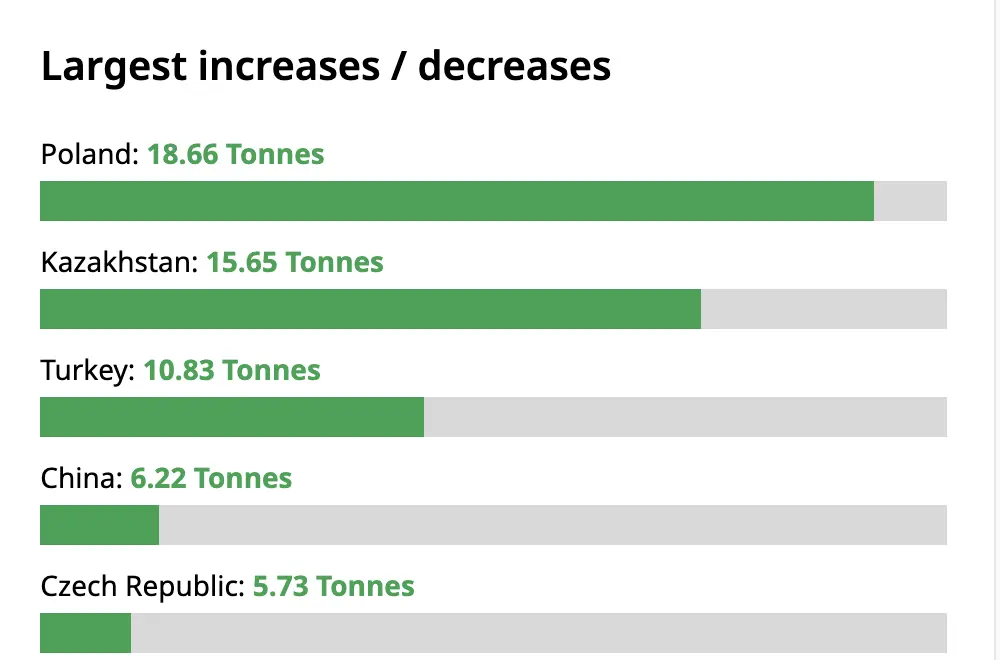
According to the World Gold Council's Q2 2025 data, Poland increased its holdings by 18.66 tons, Kazakhstan followed closely with an increase of 15.65 tons, and the People's Bank of China steadily added 6.22 tons…
Why are developing countries increasing their gold reserves?
Looking at the proportion of gold reserves held by central banks, developed and developing countries are two completely different worlds:
The U.S. has 77.85% of its asset reserves in gold, holding 8,133 tons, far ahead of second-place Germany with 3,350 tons, followed by Italy and France, which hold 2,452 tons and 2,437 tons of gold, respectively.
The People's Bank of China's gold reserves account for only 6.7% of its total asset reserves, but the absolute amount has reached 2,299 tons and is continuously increasing.
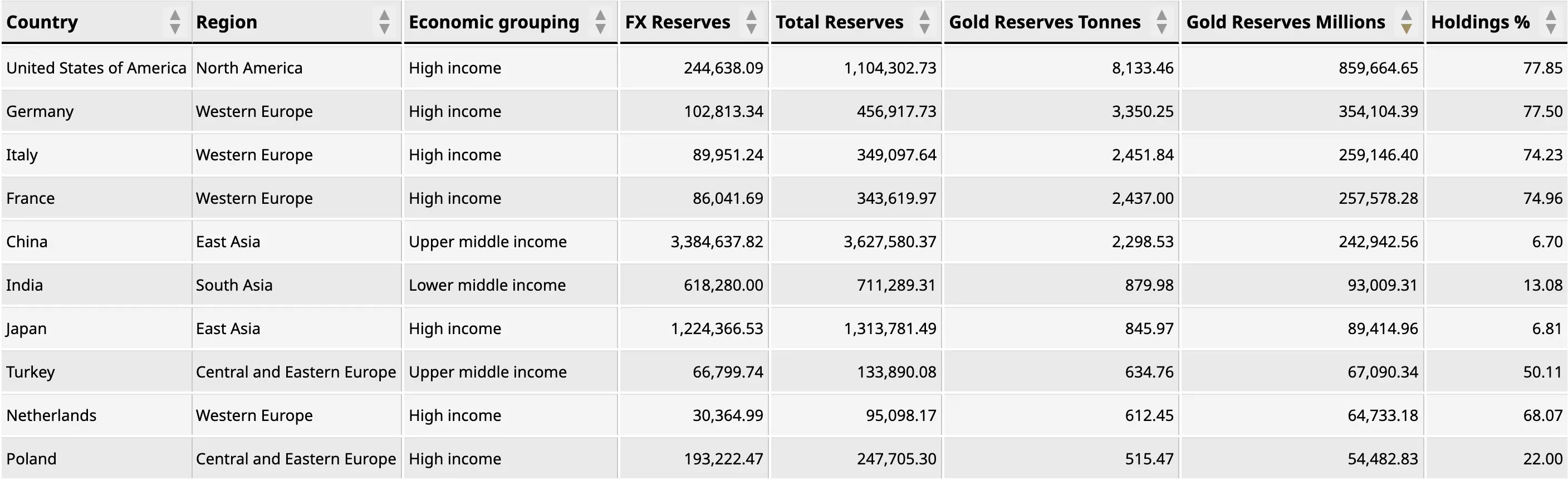
This comparison is quite clear; emerging market countries still have significant room to increase their gold holdings. Economies like China have gold reserves that account for less than 7%, while developed countries in Europe and America generally exceed 70%. It's like a "catch-up" game; the greater the gap, the stronger the motivation to catch up.
Exaggeratedly, the proportion of central bank gold purchases in total demand has skyrocketed from less than 10% in the 2000s to 20%, becoming an important support for gold prices.
Why have central banks suddenly become so enthusiastic about gold? The answer is simple: the world is chaotic, and the dollar is no longer trustworthy.
The Russia-Ukraine conflict, the situation in the Middle East, and Sino-U.S. trade frictions… the global village has turned into a warring states era.
For a long time, the dollar has been the core foreign exchange reserve for central banks around the world, also serving as a safe-haven asset. But now, with the U.S. preoccupied with its own issues, the existing $36 trillion debt has a ratio to GDP of 124%, and the Trump administration's erratic policies have created enemies abroad and division at home…
Especially after the outbreak of the Russia-Ukraine conflict, when the U.S. can freeze other countries' foreign exchange reserves at will, nations have realized: only the gold stored in their own safes is truly their own wealth.
Although gold does not yield interest, at least it won't suddenly "disappear" due to the policies of a particular country.
For both individuals and nations, gold serves as a risk hedge; the more chaotic the world becomes, the more gold is pursued. However, when news like "the Russia-Ukraine conflict may be coming to an end" emerges, a drop in gold prices is also understandable.
Digital Gold or Digital Tesla?
The most awkward asset in 2025 may be Bitcoin, whose long-term narrative is "digital gold," but it has instead become "digital Tesla."
Data from Standard Chartered shows that Bitcoin's correlation with the Nasdaq is now as high as 0.5, reaching 0.8 at the beginning of the year. And its correlation with gold? A pitiful 0.2, which even dropped to zero at one point earlier this year.
In plain terms: Bitcoin is now tied to tech stocks; when the Nasdaq rises, it rises, and when the Nasdaq falls, it falls.
Everything has its cause and effect.
Under the Trump administration's push, the U.S. attitude towards Bitcoin shifted from "illegal cult" to "welcome aboard." The approval of Bitcoin spot ETFs in 2024 marked Bitcoin's formal incorporation into the dollar system.
This was supposed to be a good thing, proving Bitcoin's legitimate status. But the problem is, once you become part of the system, it's hard to fight against it.
Bitcoin's initial allure lay in its rebellious spirit, not relying on any government and not being controlled by any central bank.
But now? Wall Street giants like BlackRock have become the largest buyers in the market, and Bitcoin's price fluctuations are entirely dependent on the Federal Reserve and Trump, to the extent that crypto traders now have to stay up late listening to Powell and Trump's speeches, effectively turning themselves into macro analysts of the dollar.
In terms of consensus, Bitcoin is still in many places at the "what is this thing" recognition stage, while gold is already at the level of "my grandmother's grandmother also likes it."
The number of holders of gold bracelets and necklaces among Chinese aunties may exceed the total number of Bitcoin HODLers worldwide.
Compared to gold, young Bitcoin still has a long way to go in its evangelism.
Gold in One Hand, Bitcoin in the Other
Many people like to choose between gold and Bitcoin, but smart investors know this is a fill-in-the-blank question.
Although central banks around the world are buying gold like crazy and gold prices are soaring, this process cannot continue indefinitely. When gold prices reach a certain level, issues such as storage, transportation, and delivery of physical gold will arise, at which point Bitcoin's advantages will become apparent.
Imagine a specific scenario where a country erupts in war, and the wealthy find gold too heavy and too conspicuous to quickly transfer their wealth. At this moment, Bitcoin in a hardware wallet becomes the best choice; such an event has already happened in Russia.
In simple terms, gold is "heavy value storage," while Bitcoin is "lightweight value storage."
If gold prices reach a terrifyingly high level, funds will need to seek similar alternatives that are cheaper. In this case, Bitcoin has the opportunity to gradually break free from the influence of the dollar and Trump, gaining a spillover from gold and moving back toward "digital gold."
In summary, the relationship between Bitcoin and gold should not be understood as one replacing the other, but rather as inheritance and evolution.
Gold is the wealth memory of human civilization, while Bitcoin is the wealth imagination of the digital age.
70-year-old Aunt Li buys gold jewelry, while 25-year-old programmer Li Xiaoming hoards Bitcoin; everyone has a bright future.
Recommended Reading:
Epic Collapse! BTC Struggles to Hold the $100,000 Mark, Why is the Altcoin Market Suffering?
 Risk warning Risk warning




Popular articles





