








TRON Industry Weekly Report: Inflation Relief Brings Short-term Benefits, Detailed Explanation of How Multipli.fi Tokenizes DeFi Trading Strategies
 The research report provides an in-depth analysis from four dimensions: macroeconomics, fluctuations in the crypto market, trending sectors, and potential projects, with a focus on the high-performance DEX aggregator Titan, the institutional-grade hybrid trading platform GRVT, and the yield generation protocol Multipli.fi.
# I. Outlook
1. Summary of Macroeconomic Trends and Future Predictions
Last week, the U.S. macroeconomic landscape faced two key challenges: first, the ongoing government shutdown severely hindered the release of statistical data; second, against the backdrop of data scarcity, the only relatively "active" inflation data (September CPI) surprisingly narrowed. Specifically, the White House clearly stated that due to the "budget impasse," most official inflation data may not be released as scheduled in the coming month, putting the market in a "data vacuum." At the same time, the year-on-year CPI for September recorded about 3%, slightly lower than the expected 3.1%, which is seen as a signal that inflationary pressures may have eased, thus stimulating the stock market to reach historical highs.
Looking ahead, investors need to closely monitor whether the upcoming employment, manufacturing, and service sector data can fill the "data vacuum," as well as when the government will resume full operations, as these will determine the direction of monetary policy and market risk appetite.
2. Market Movements and Warnings in the Cryptocurrency Industry
Last week, the cryptocurrency market entered a phase of oscillation and recovery after experiencing two consecutive weeks of severe liquidation, but overall confidence remains fragile. Bitcoin stabilized above $100,000 and made several attempts to rebound, briefly rising to around $115,000, but trading volume significantly decreased, and market funds became more cautious.
Although market sentiment has slightly eased from previous panic, it is still in the early stages of recovery. If the current range can be stabilized and accompanied by strengthened signals of a shift in Federal Reserve policy, it is expected to attract incremental funds back into the market. Overall, this round of rebound resembles a technical recovery after liquidity clearance, still lacking new funding drivers. The cryptocurrency market remains in a "cautious recovery" phase, with trends yet to truly reverse amid macro risk fluctuations.
3. Industry and Sector Hotspots
Total funding of $10.5 million, led by Galaxy, for Titan, a high-performance meta-aggregator based on Solana, providing optimal pricing and intelligent trading experience. Titan is a next-generation DEX aggregator built on the Solana blockchain, aimed at optimizing liquidity and enhancing trading experience; total funding of $33.3 million, led by ZKsync and EigenCloud, for GRVT, a compliant hybrid trading platform for institutions that offers low latency and high transparency, combining the user experience of centralized exchanges (CEX) with the security of decentralized exchanges (DEX).
# II. Market Hotspot Sectors and Potential Projects of the Week
1. Overview of Potential Projects
1.1. Brief Analysis of Total Funding of $10.5 Million, Led by Galaxy, for Titan, a High-Performance Meta-Aggregator Based on Solana
Introduction
Titan is a next-generation DEX aggregator built on the Solana blockchain, aimed at optimizing liquidity and enhancing trading experience. Titan provides traders with optimal pricing by integrating decentralized exchanges, with a particular focus on security and high performance.
To achieve its goals, Titan currently offers three core functions:
- Unique Spot Trading Path (DEX Aggregator)
Titan has developed its proprietary algorithm, Argos, to solve the problem of finding the best trading path in current aggregators.
Test results show that users can obtain better prices 80% of the time.
- Meta Aggregation on Solana
Titan aggregates not only DEXs but also other aggregators, ensuring users always receive the best quotes.
Zero additional fees throughout the process.
- Titan Prime Mode
Automatically optimizes users' swap settings, including slippage and transaction landing.
Achieves optimal execution through Titan's meta-aggregator.
Additionally, Titan's interface will display real-time additional earnings obtained through the platform, as well as trading volume and recommendation data.
Architecture Overview
1. DEX Aggregator
There are various ways to conduct spot trading on Solana. You can choose to trade directly on centralized exchanges (CEX, such as Binance or Coinbase), decentralized exchanges (DEX, such as Orca or Raydium), or through DEX aggregators (such as Titan or Jupiter). If you only trade on CEX or DEX, your trading liquidity comes from a single source, which may not yield the best prices.
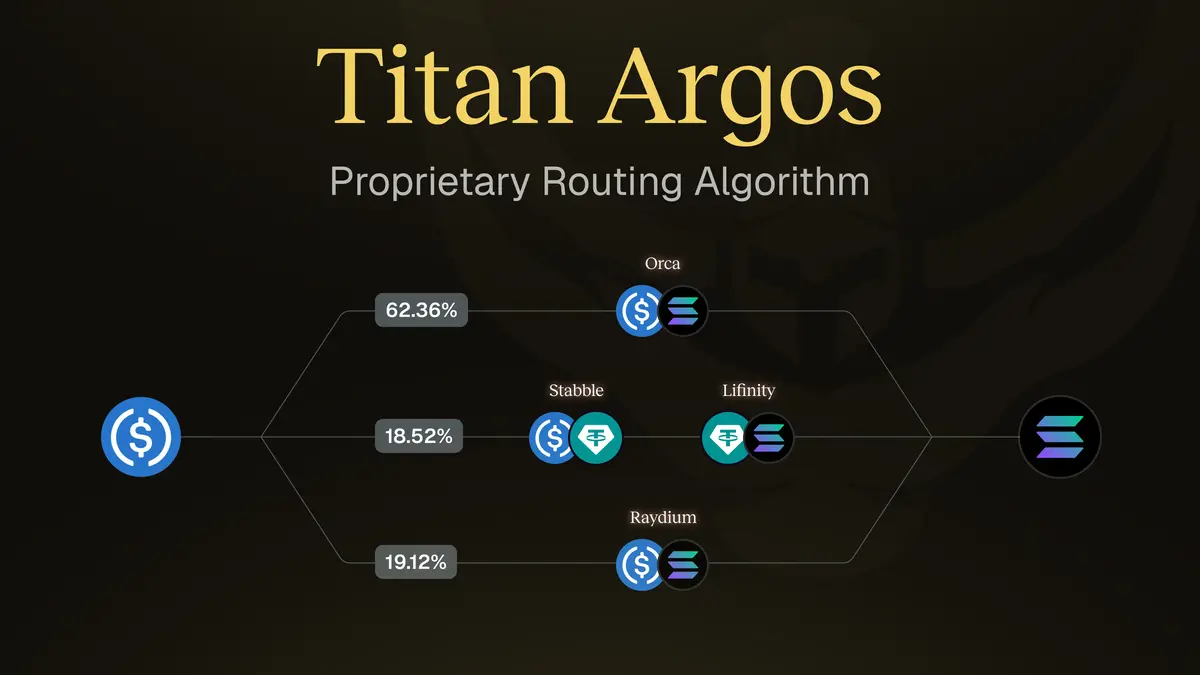
In traditional financial markets, brokers connect to multiple liquidity sources to provide users with the best quotes. In the cryptocurrency market, without specialized infrastructure and complex compliance checks, the only way to achieve this is by aggregating liquidity across different DEXs, which are referred to as DEX aggregators.
The issues faced by DEX aggregators are somewhat unique. In traditional markets, speed requirements are extremely high (nanosecond level), and order flow must be processed almost instantaneously; however, in the cryptocurrency market, due to the widespread distribution of liquidity, traders have enough time to deploy advanced analytics to find the optimal path.
Conducting DEX aggregation on Solana is particularly advantageous due to the extremely low network fees. This makes it possible to find complex trading paths without being consumed by high gas fees like on Ethereum. Therefore, on low-cost chains, DEX aggregators become the preferred trading method for users to maximize asset value.
2. How Titan Achieves Excess Performance
Traditional DEX aggregators typically rely on shortest path algorithms to determine routing between liquidity sources. While these algorithms are proven and easy to implement, they face two major issues in the cryptocurrency market environment:
Liquidity is temporarily excluded: Due to latency requirements and algorithm assumptions, some liquidity sources are removed during the routing process, reducing the integrity of price discovery.
Insufficient price impact handling: If the TVL (Total Value Locked) of related pools is low, prices can fluctuate rapidly due to large trades. Existing methods usually fragment liquidity (e.g., Jupiter splits paths into 1% chunks), which increases the scale of the search network and can lead to inaccuracies when pools are poorly parsed.
Titan's Solution
Titan has developed the Kairos algorithm, which no longer relies on traditional shortest paths but uses optimization algorithms.
Kairos can handle price impacts with machine-level precision without needing to fragment pools or exclude certain liquidity sources.
The result is the ability to provide truly optimal on-chain prices, improving the efficiency and price advantage of user transactions.
3. Meta Aggregation
On low-cost public chains, DEX aggregators are already the best trading method, but the quotes provided by each aggregator differ. This is due to the different algorithms and datasets they use.
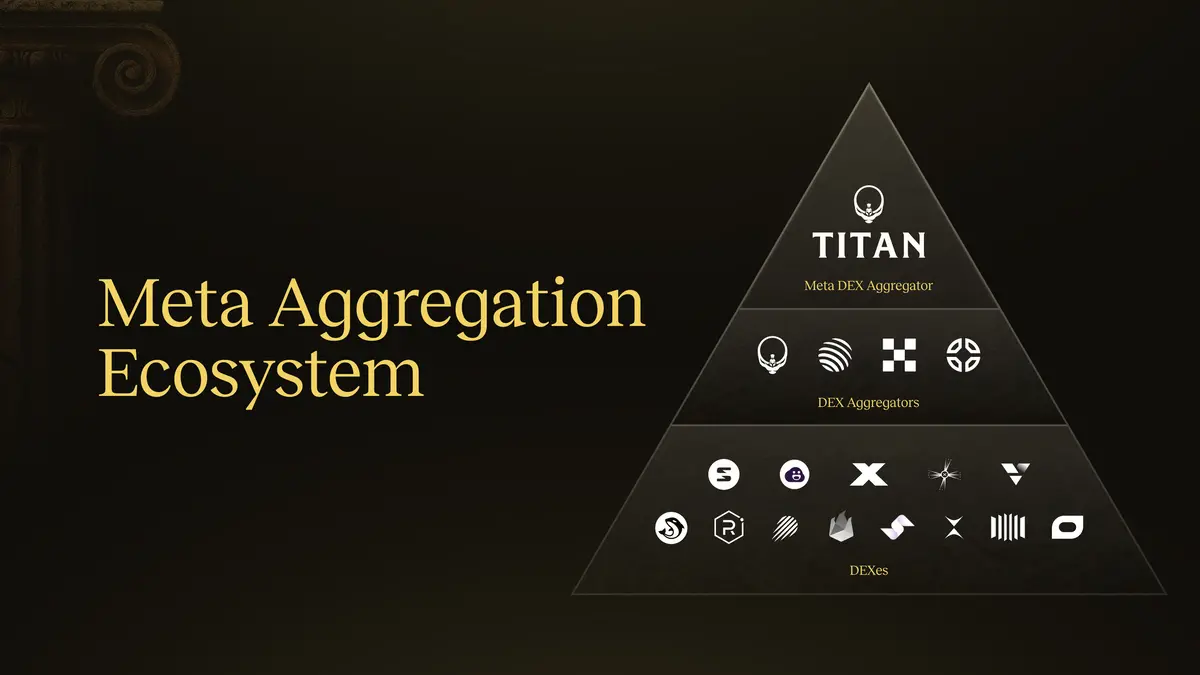
Regardless of the technology used or which aggregator is chosen, Titan integrates the results of multiple DEX aggregators to provide users with the best quotes, thus becoming a "Meta Aggregator." This way, users can always be assured that they are getting the best trading price at any moment.
This mechanism is similar to brokers in traditional stock markets:
Exchange → DEX
Market Maker → DEX Aggregator
Broker → Meta Aggregator
Titan is positioned at this meta-aggregation layer, ensuring users always receive the best prices.
How to Compare and Validate
To truly leverage meta-aggregation, the quotes from aggregators must be accurate and comparable, coming from the same block. Additionally, erroneous quotes must be excluded, and latency issues resolved.
Titan's solution is to directly simulate all quotes on the blockchain, thus obtaining the real available quantity for users at the time of execution. This not only eliminates discrepancies caused by latency but also ensures that quotes from different aggregators can be fairly compared within their validity period, providing users with the latest and most reliable information.
Tron Comments
Titan's advantage lies in its high performance and low fee environment based on Solana, combined with its proprietary Kairos algorithm to provide precise liquidity routing, avoiding the fragmentation and liquidity exclusion issues of traditional aggregators. Additionally, through Meta Aggregation, it integrates multiple DEX aggregators to ensure users always receive the best prices in the market; coupled with the Prime mode that automatically optimizes trading parameters, the overall trading experience is transparent, convenient, and efficient.
Its disadvantage is that, as an emerging platform, it still needs to establish broader ecological cooperation and user trust. Over-reliance on Solana's network performance may pose risks inherent to the chain itself, and during periods of high volatility or extreme liquidity shortages, the algorithm's advantages may still be limited.
1.2. Interpretation of Total Funding of $33.3 Million, Led by ZKsync and EigenCloud, for GRVT, a Compliant Hybrid Trading Platform for Institutions Offering Low Latency and High Transparency, Merging CEX Efficiency with DEX Security
Introduction
GRVT (Gravity) Institutional Investment is a hybrid trading platform that combines the user experience of centralized exchanges (CEX) with the security of decentralized exchanges (DEX). Its core advantages lie in low latency, high scalability, and user privacy protection, while strictly adhering to regulatory compliance requirements (KYC and AML).
Architecture Analysis
1. Overview of GRVT's Hybrid Trading Architecture
GRVT adopts a hybrid architecture: off-chain matching and data storage, while ensuring execution validity on-chain through smart contracts. This architecture aims to improve throughput by processing transactions off-chain, thereby reducing the burden on the Ethereum mainnet.
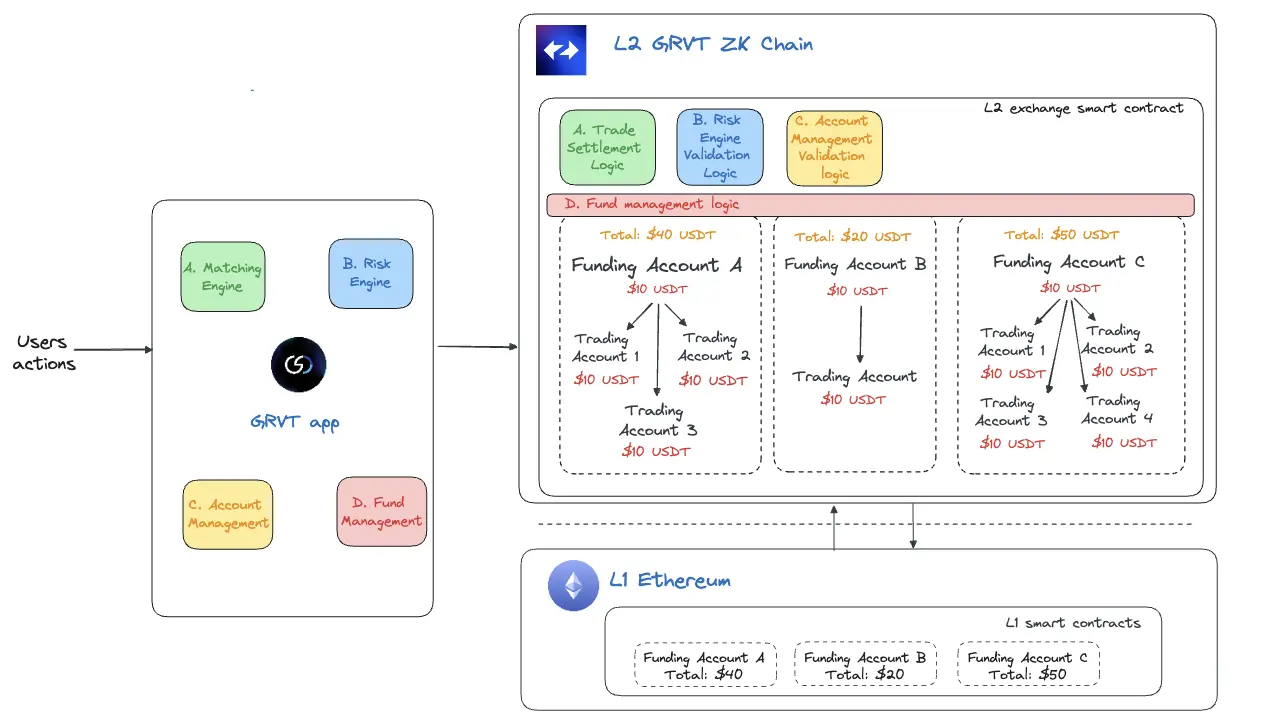
Off-chain
All user operations are first processed by the GRVT server.
Only operations involving funds (such as trading, account creation) will ultimately go on-chain; non-fund operations (such as KYC) remain off-chain.
Key user operations will be forwarded to the GRVT chain, mainly including:
Matching Engine: Matched orders will be sent on-chain.
Risk Engine: Liquidation operations will go on-chain.
Account Management: Such as creating trading accounts and binding wallets with available funds.
Fund Management: Including transfers of internal and external funds.
On-chain
Some off-chain operations will be pushed to the GRVT chain and published in the form of Zero-Knowledge Proofs (ZKP) to verify off-chain transactions on Ethereum.
Major on-chain operations include:
Trade Settlement: Successfully matched orders are settled on-chain.
Risk Engine Validation: Liquidation operations are verified on-chain through smart contract logic for fairness.
Account Management Validations: Account-related operations are verified on-chain.
Fund Management: Fund transfers are verified and settled on-chain.
GRVT Native Deposit Contracts
GRVTBridgeProxy
Contract address for interaction when depositing native tokens:
0xE17aeD2fC55f4A876315376ffA49FE6358113a65L1NativeTokenVault
Actual contract address where funds are stored:
0xbed1eb542f9a5aa6419ff3deb921a372681111f6
When users deposit native tokens through GRVT, the interaction occurs at GRVTBridgeProxy, but the final assets will be stored in L1NativeTokenVault.
2. GRVT's Account and User System
Account Types
Funding Account
The highest level of identity on the GRVT chain.
Primarily used for fund management: handling deposits, withdrawals, external transfers to other funding accounts, and internal transfers to associated trading accounts.
Trading Account
Each funding account can be associated with multiple trading accounts.
To engage in derivatives trading, funds must first be transferred from the funding account to the designated trading account.
Users
Individual Account: Each account corresponds to at most one user, who can access all trading accounts under that account.
Enterprise Account: Each account can have one or more users. Depending on permissions, users can access either the funding account or trading accounts individually.
User Identifiers
Rule: One user = One email = One wallet
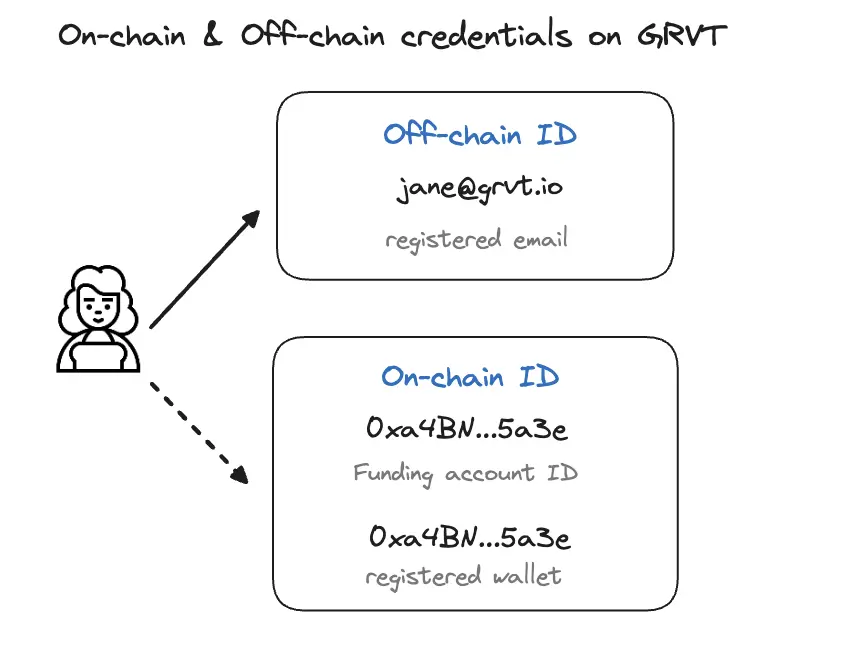
In GRVT, each user must register both Web2 credentials and Web3 credentials:
Web2 Credentials (Email)
Users must register via email (set a password or use Google/Microsoft OAuth to log in).
Purpose: Access non-trading functions, such as completing KYC, referral rewards, viewing portfolios and holdings, etc.
Features: Supports read and write, but cannot be used directly for trading.
Web3 Credentials (Wallet)
Users must register a wallet in GRVT to enable trading functions.
Only transactions signed by the registered wallet will be executed by the trading engine.
All operations affecting asset ownership (such as trading) must be completed through the registered wallet.

3. GRVT Account Identifiers and API Keys
Account Identifiers
Funding Account
On-chain ID: The Funding Account ID is the same as the wallet address that created the account.
Enterprise Account: Can have multiple users, each user’s wallet can be linked to that funding account.
Enterprise Account Representation
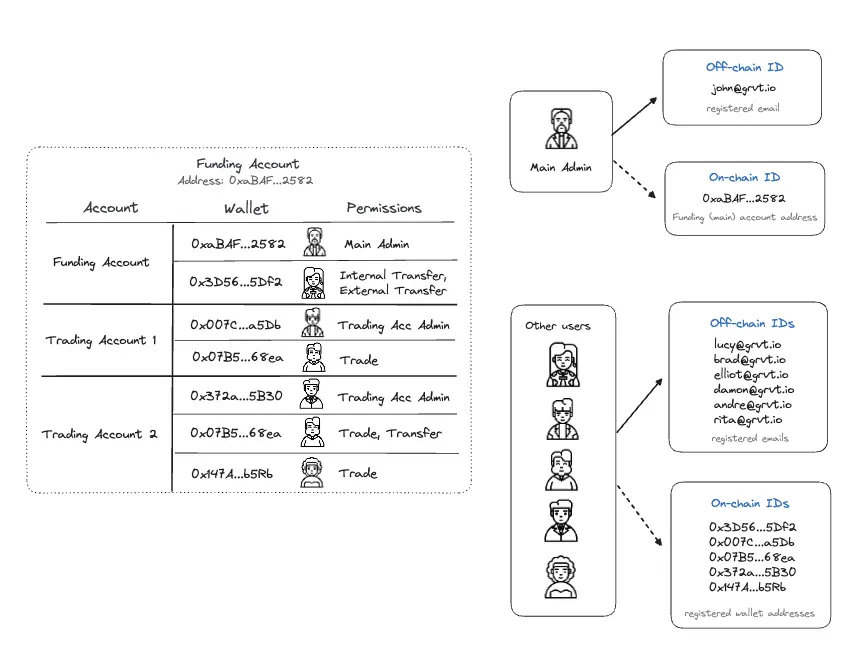
Off-chain funding account representation: Read + Write
API Keys
Registration Level: API Keys are registered only at the Trading Account level and have trading permissions only.
Binding Requirements: Each API Key must be bound to a valid Ethereum public key address.
Authentication Method
When authenticating using an API Key, a session token will be received.
This session token must be used in subsequent read/write requests.
Authorization Method
There are two ways to authorize API Keys:
- Input (Secure Method)
User already has a public/private key pair.
Submit the public key address, and the private key is kept by the user.
- Generate (Convenient Method)
The GRVT frontend client generates the public/private key pair in the browser.
Users can copy the private key; GRVT will not store the private key.
Signature Standard: The private key must use the EIP-712 signing method to sign orders.
4. Mapping of API Keys and Trading Accounts
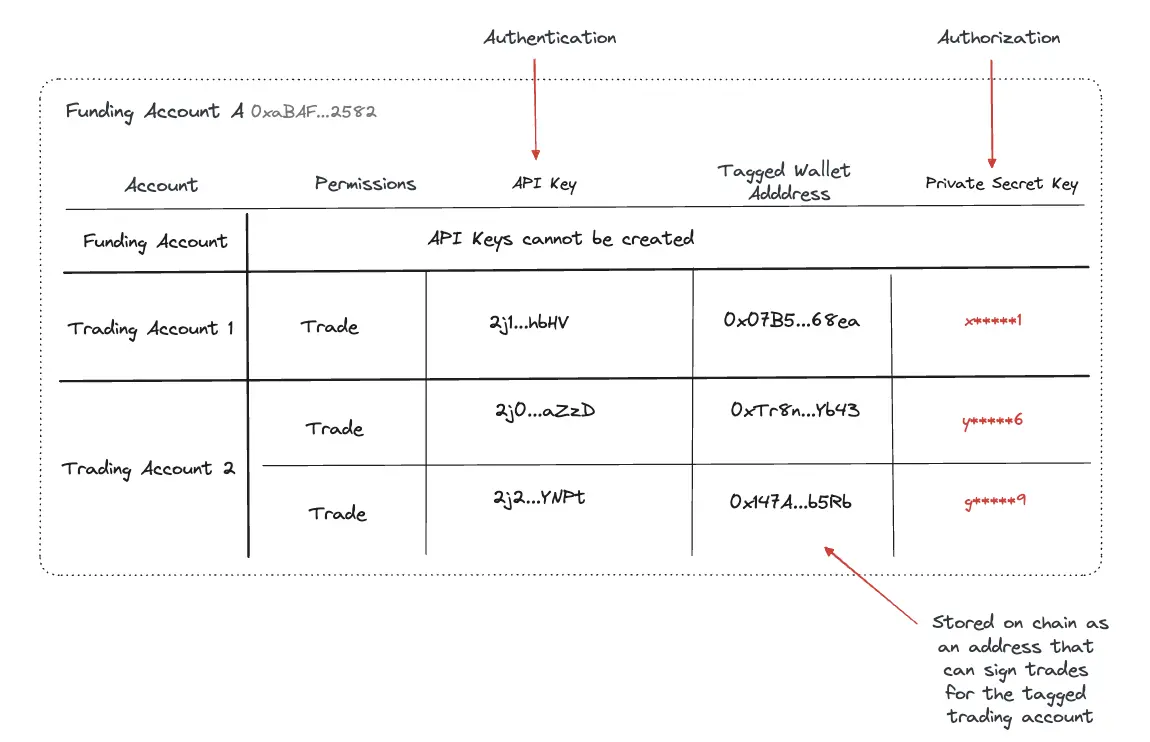
API Keys are registered at the trading account level, and each trading account can bind different API Keys for programmatic trading.
Mapping Relationship:
Trading Account ↔ API Key(s)
Each API Key must be bound to a valid Ethereum public key address for order signing (EIP-712 standard).
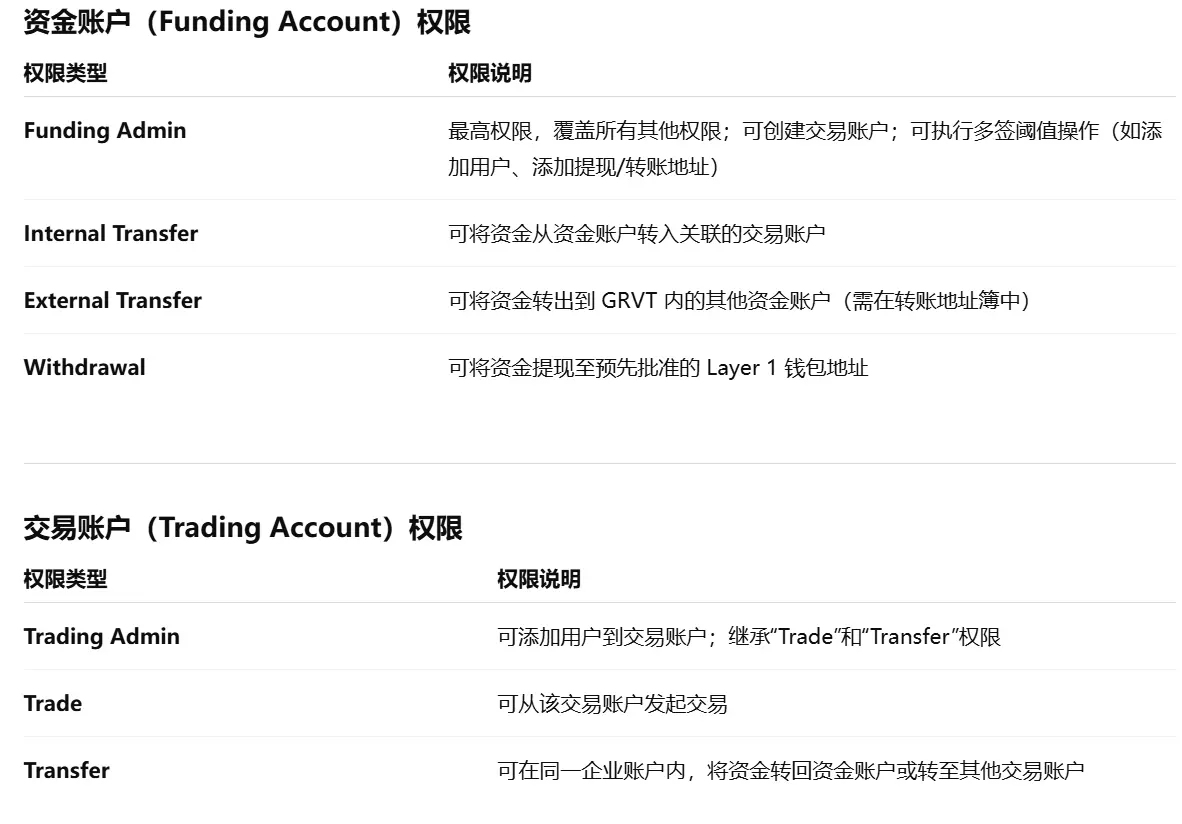
- PBAC (Permission-Based Access Control) -- Business Accounts
GRVT has designed Permission Based Access Control (PBAC) for enterprise accounts, distinguishing between funding account permissions and trading account permissions.
5. Multi-signature Management Operations
On Business Funding Accounts, some key high-permission operations require multi-signature approval.
Approvers: Only users with the Funding Admin role have the authority to approve these operations.
Threshold Mechanism: Funding Admin can customize the multi-signature threshold, for example, 2/3, meaning at least 2 out of 3 administrators must sign for the operation to take effect.
Management operations involving multi-signature
Add/Edit funding account user permissions
Set new multi-signature thresholds
Add/Remove wallets in the withdrawal address book
Add/Remove funding account addresses in the external transfer address book
Tron Comments
GRVT's advantage lies in its hybrid architecture, combining the high-performance matching of CEX with the on-chain security of DEX, providing a low-latency, high-throughput trading experience while ensuring fund transparency and security through zero-knowledge proofs and multi-signature mechanisms. It also supports a flexible account system (individual/business), fine-grained permission management, and compliant KYC/AML, making it more friendly to institutional users.
Its disadvantage is that some operations rely on centralized servers, which carries a certain trust assumption; additionally, compliance requirements may limit some users' participation, and as an emerging platform, the ecological scale and liquidity still need to be accumulated.
2. Detailed Explanation of Key Projects of the Week
2.1. Detailed Explanation of Total Funding of $21.5 Million, with Participation from Pantera, for Multipli.fi, a Yield Generation Protocol That Simplifies On-chain Experience for Complex Arbitrage Participation
Introduction
Multipli.fi is a decentralized, cross-chain yield generation protocol aimed at unlocking real, risk-adjusted returns for traditionally yield-deficient assets such as Bitcoin, Ethereum, stablecoins, and tokenized real-world assets (RWA).
The core mechanism aggregates neutral strategies commonly used by institutional funds (such as Contango Arbitrage, Funding-Rate Arbitrage, etc.) and tokenizes these strategies into transferable xTokens through on-chain contracts, allowing ordinary users to directly access specialized yield strategies as if holding tokens.
Multipli.fi's unique advantage lies in its patented AlphaIQ™ prediction engine, which dynamically allocates capital to the best-performing strategy pools, helping users achieve transparent, secure, and efficient yields on-chain. Additionally, all products possess DeFi composability and liquidity, allowing users to hold long-term or freely trade in the secondary market.
In short, Multipli.fi opens up institutional-level yields to ordinary DeFi users by packaging complex institutional arbitrage and hedging strategies into easy-to-use on-chain tokens.
Architecture Overview
1. Admin Flow and Setup
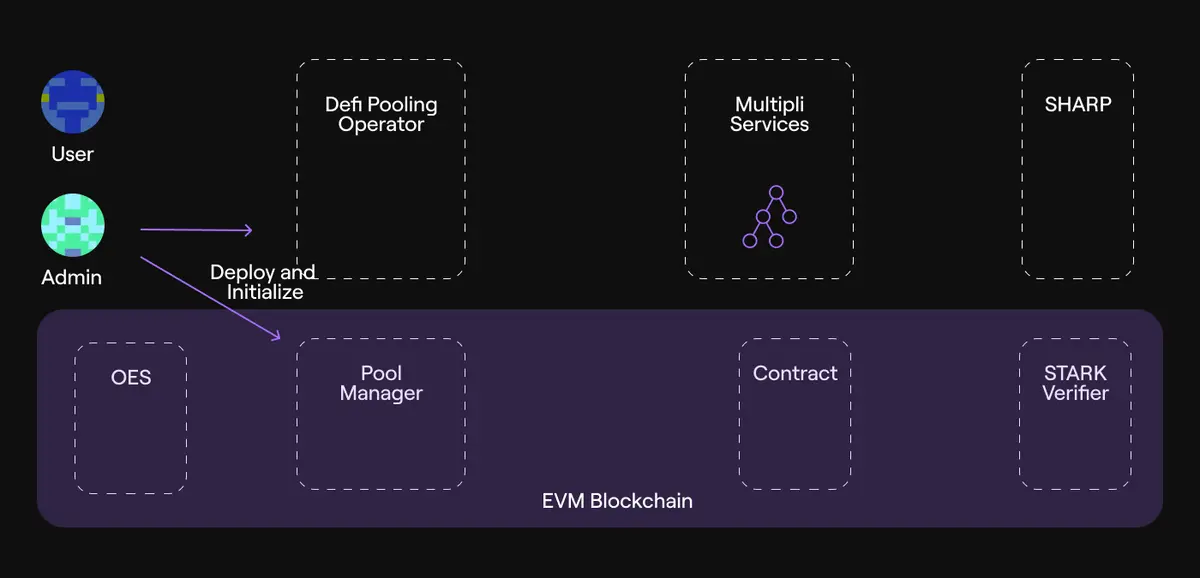
Before registering a Ride (deployment activity), the administrator needs to complete the following steps:
- Deploy and Register New Token Types
- Deploy and register new ride ticket token types for each ride.
- Set Token Types
Determine the type of capital tokens that users will invest.
Determine the type of strategy tokens that users will ultimately receive.
- Determine Price and Slippage
Set the price and slippage range for exchanging capital tokens for strategy tokens.
Users will confirm acceptance of these conditions by signing on-chain limit orders when joining the ride.
- Deploy Pool Manager Smart Contract
This contract needs to have the following functions:
Mint and Sell Ride Tickets: Mint ride ticket tokens, deposit them into the Multipli contract, and submit on-chain limit orders to purchase with capital tokens.
Configure Price: For example: 1 BTC = 1xBTC.
Ride Departure: Execute specific on-chain strategies. Withdraw user-invested capital tokens from the Multipli contract, exchange them for strategy tokens in on-chain DeFi contracts; then deposit the strategy tokens back into the Multipli contract and submit limit orders to exchange strategy tokens for users' ride tickets.
- If the strategy token price is too high, exceeding the user's acceptable slippage range, the execution will fail: the ride ticket will be returned to the Multipli contract and refunded to the passenger.
Ride Liquidation: Withdraw ride tickets from the Multipli contract and burn them.
- Set Strategy Execution Price and Slippage
- Set the price and slippage parameters required for strategy execution in the Pool Manager smart contract.
2. User Onboarding Process
User Joins Ride
The administrator calls the Pool Manager smart contract to mint and sell ride tickets, thus enabling the ride.
When users join the Yield Generation Pool, they need to sign three limit orders in advance, which will be stored by the DeFi Pooling Operator.
Three Limit Orders
- Limit Order 1
Content: User purchases X ride tickets with X yield tokens.
Purpose: Allows users to generate returns through the invested yield tokens.
- Limit Order 2
Content: If the ride is canceled, the user returns X ride tickets to buy back X yield tokens.
Purpose: Ensures the safety of user funds.
- Limit Order 3
Content: If the ride successfully reaches its destination, the user exchanges X ride tickets for Y strategy tokens.
Note: The ratio of Y to X is determined by the price and slippage set during the ride registration phase.
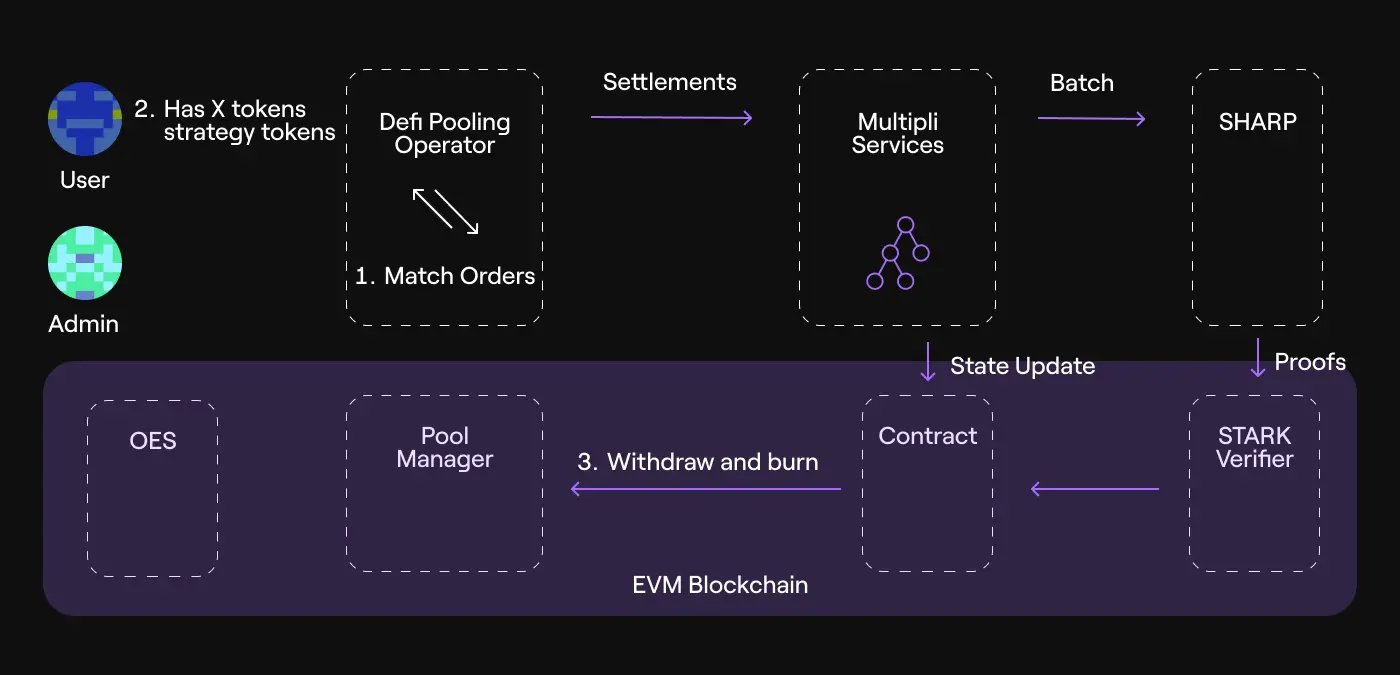
User Onboarding Matching Process
The administrator initiates the user onboarding phase.
During this phase, the operator will match the user's first limit order (buying tickets) with the ticket sale orders submitted to the Pool Manager smart contract during the registration phase.
Once matched, the user officially joins the ride.
Multiple users can join simultaneously, and each user can purchase different quantities of tickets, but the ticket price remains consistent.
3. Ride Execution
After the administrator issues the departure command, the Pool Manager will withdraw user funds from the Multipli smart contract and trade on-chain at the preset price/slippage to purchase strategy tokens.
If the trading price is within the user's acceptable range → strategy token purchase succeeds, stored back in the Multipli contract, and limit orders are placed for users to exchange.
If the trade fails (price too high) → capital tokens are refunded, and users return their original funds with tickets.
4. User Off-boarding
After the ride arrives, users can exchange ride tickets for strategy tokens; if the strategy did not execute successfully, they can exchange back for original capital tokens.
Once all settlements are completed and confirmed on-chain, the administrator calls the liquidation function to destroy ride tickets, concluding the process.
Self Custody
Users always maintain self-custody of funds, holding three types of tokens: capital tokens, strategy tokens, and ride tickets.
Users can withdraw capital or strategy tokens at any time through Multipli's withdrawal mechanism.
Ride tickets are only valuable within the platform and can be exchanged for:
a) Strategy tokens when the strategy executes successfully
b) Original capital tokens when the strategy does not execute
Tron Comments
The advantage of Multipli Ride lies in its abstraction of complex institutional-level arbitrage and yield strategies into an on-chain "journey," achieving automation and transparency of fund flows through limit orders and smart contracts. Users maintain self-custody throughout the process and have a clear exit mechanism (either exchange for strategy tokens or return to original capital), thus balancing security and compliance. Additionally, the standardized "ticket" model lowers the participation threshold and enhances composability and liquidity.
Its disadvantage is that the process relies on the setting of on-chain prices and slippage, which can easily lead to execution failures in the event of severe market fluctuations; multi-stage matching and limit order management increase complexity, which may also affect user experience; at the same time, actual yields highly depend on the effectiveness of strategy execution and the stability of the DeFi environment, posing uncontrollable risks.
# III. Industry Data Analysis
1. Overall Market Performance
1.1. Price Trends of Spot BTC, ETH, and TRX
BTC
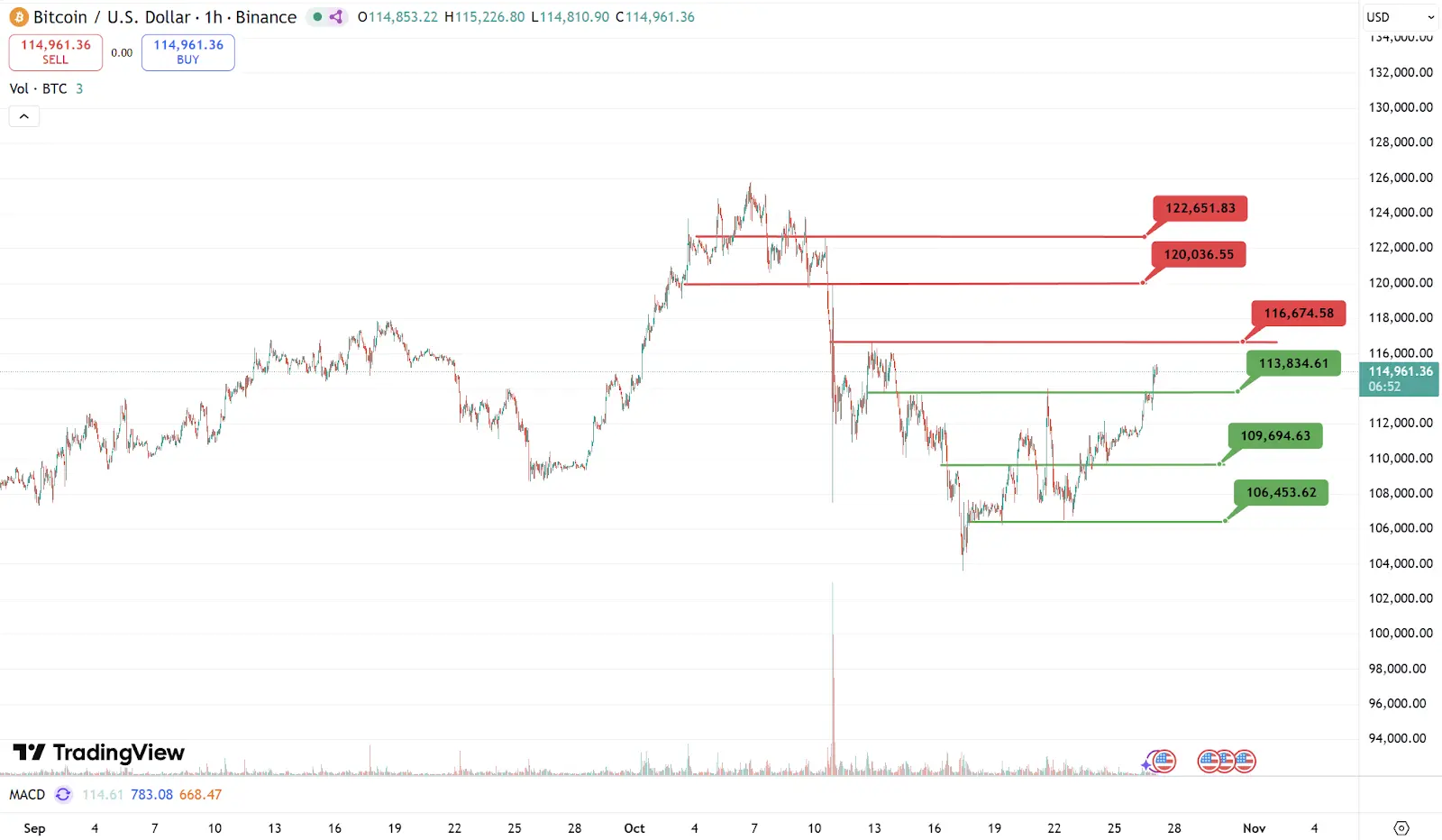
Analysis
Key resistance this week: $116,670, $120,000, $122,650
Key support this week: $113,800, $109,700, $106,450
ETH
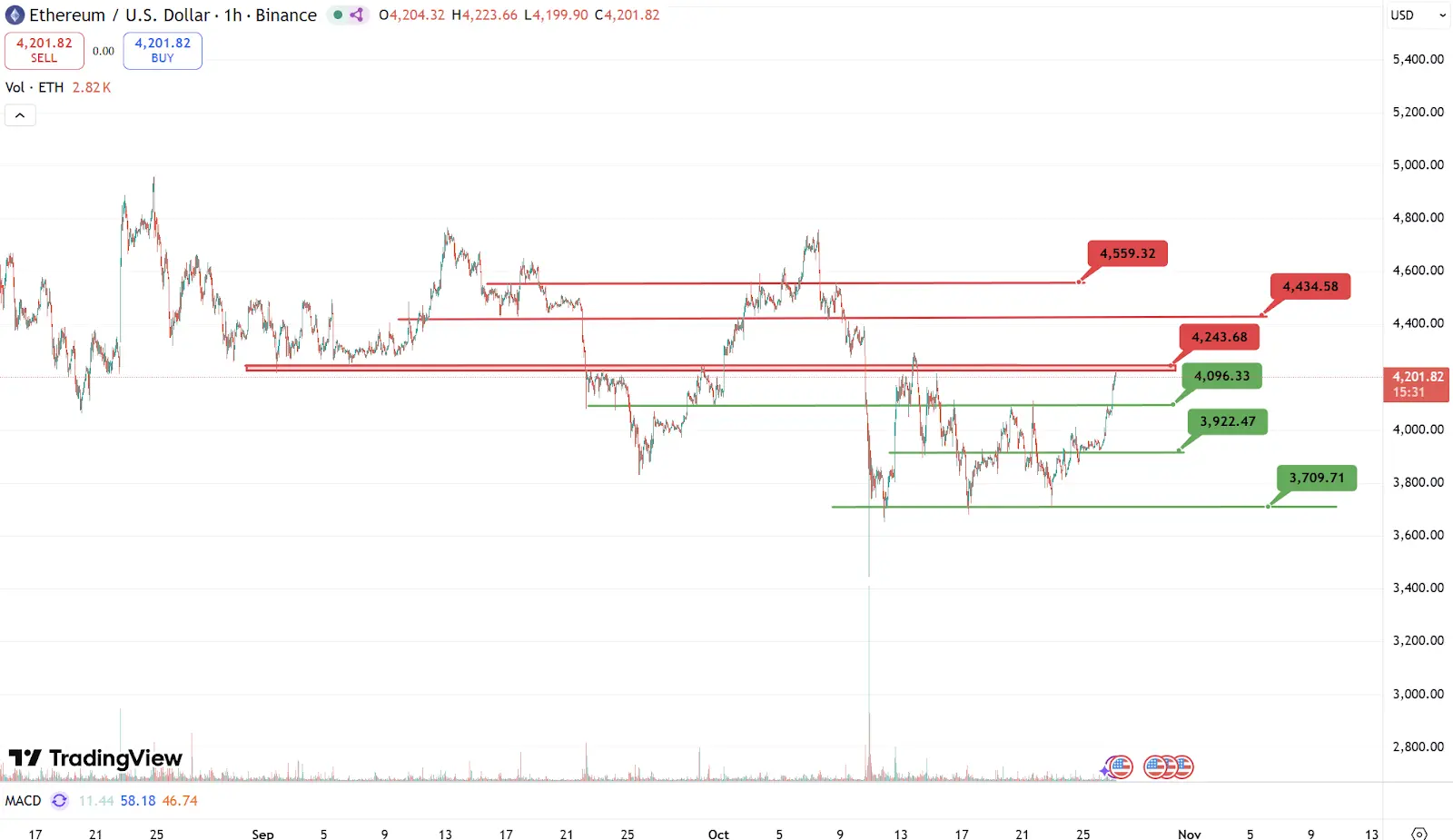
Analysis
Key resistance this week: $4,240, $4,430, $4,560
Key support this week: $4,010, $3,920, $3,700
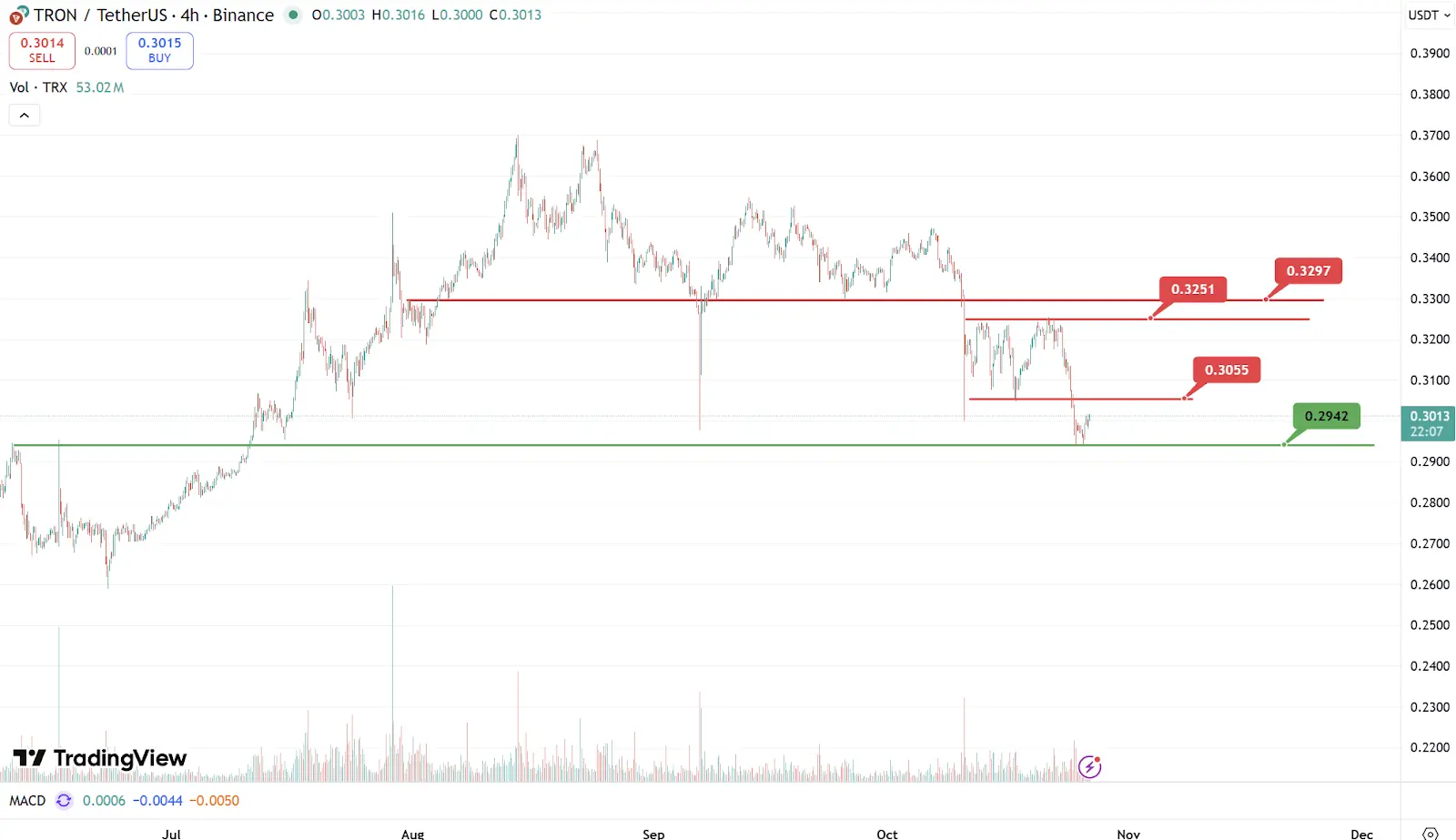
TRX
Analysis
Key resistance this week: $0.3055, $0.3250, $0.3300
Key support this week: $0.2940
2. Summary of Hot Sectors
A. Market Sentiment and Performance
The overall market capitalization of the cryptocurrency market slightly rebounded this week. Reports indicate that in the first half of October 2025, the market entered a "macro risk reassessment" phase.
For example, Bitcoin returned to around $110,000.
However, there are also warning signals: increased volatility between assets and signs of momentum exhaustion.
Analytical Significance:
The market is no longer simply surging but has entered a "consolidation + selective breakout" phase.
Mainstream assets (such as Bitcoin and Ethereum) are performing relatively steadily, while small-cap/altcoins exhibit greater volatility.
Investor sentiment remains cautious, with some funds in a wait-and-see mode for policy or technological catalysts.
B. Strengthening Institutional and Fund Movements
Reports indicate that institutional/enterprise users' intentions to allocate to cryptocurrency assets are strengthening.
At the same time, the macro environment (such as interest rates and liquidity) is being recalibrated, with cryptocurrency assets gradually being viewed as a strategic allocation.
Analytical Significance:
If more institutions enter, it will help the market evolve from "retail-led" to "mixed," thereby enhancing maturity.
However, increased institutional involvement also means a lower risk appetite, and fund flows may be more cautious, leading to characteristics of "slow entry and fast exit" in the market.
For trading, there may be more focus on large fund movements, on-chain indicators, and exchange inflow/outflow data.
C. High Differentiation in Small-Cap/Altcoins
This week, some tokens experienced significant increases (e.g., "Humanity," "Clanker" rose over 100%).
However, many projects also saw sharp declines or extreme volatility.
Analytical Significance:
Against the backdrop of stable mainstream assets but lacking major catalysts, the market structure exhibits characteristics of "funds betting on hotspots and explosive increases."
At the same time, this funding behavior is accompanied by high risks: significant increases and decreases coexist.
Investment advice for investors: If participating in small-cap/altcoins, be very cautious in controlling positions and risks.
# IV. Review of Macroeconomic Data and Key Data Release Points for Next Week
In September, the U.S. CPI rose by 3.0% year-on-year, slightly lower than the market expectation of 3.1%, and rose by 0.3% month-on-month; the core CPI (excluding food and energy) was also 3.0% year-on-year, with only a 0.2% month-on-month increase, indicating that inflation, while still above the Federal Reserve's 2% target, is slowing down. The main drivers are the continued rise in housing and service prices, while the decline in energy and used car prices provides some offset. This indicates that inflation remains sticky, but overall pressure is milder than in previous months, and the Federal Reserve does not need to tighten monetary policy again in the short term, with interest rate cut expectations still being digested by the market.
Although the U.S. government remains shut down, the Bureau of Labor Statistics (BLS) has received temporary funding authorization to resume the release of some key economic data. The CPI released last week belongs to the delayed September data and does not represent a full government resumption, but is an exception exempted to avoid a "data vacuum" in the financial system.
# V. Regulatory Policies
Kyrgyzstan
Collaborated with Binance to launch the national stablecoin "A5A7," pegged to the Russian ruble and operating on the BNB chain.
Also launched a digital som (digital version of the som) for government payments.
This stablecoin has been placed on sanctions lists by Western countries due to its involvement in helping Russia evade related sanctions.
Ghana
The Bank of Ghana stated it would accelerate the promotion of cryptocurrency asset regulatory legislation, aiming to complete relevant legislation by December 2025.
Currently, over 3 million Ghanaians are actively using cryptocurrency assets, with regulatory needs and monitoring infrastructure development progressing simultaneously.
Japan
The Financial Services Agency (FSA) is considering allowing securities subsidiaries of banking groups to provide cryptocurrency trading services and may lift the ban on banks purchasing and holding cryptocurrencies as investments.
If implemented, this would promote deeper engagement of traditional financial institutions in the cryptocurrency market, increasing market competition and accessibility.
 Risk warning Risk warning


Popular articles





