








Roam launches a dynamic adjustment mechanism for startup difficulty, and token output enters a market adaptive phase

 The Roam project has officially launched its dynamic difficulty adjustment mechanism, aimed at ensuring the long-term sustainability of its PoW (Proof-of-Work) model, especially in response to market fluctuations. This mechanism mimics the difficulty adjustment principle of Bitcoin but is calibrated based on the actual health of the network.
The difficulty adjustment mechanism of Roam has officially launched, ensuring the long-term sustainability of Roam's PoW model—especially in a challenging market environment.
Just as Bitcoin adjusts its mining difficulty every 2,016 blocks (approximately every two weeks) to maintain a 10-minute block time, Roam will recalibrate its difficulty approximately every 11.5 days (1,000,000 seconds or 1,000 cycles) based on the actual health of the network.

Key Points of Difficulty Adjustment
Reference Indicator:
The number of Check-Ins—directly reflecting active nodes, user participation, and network vitality.
(In the future, more parameters will be added based on network evolution, such as staking pool size, network coverage intensity, etc.)Algorithm Source:
The difficulty adjustment mechanism is detailed in Section 4.5.2 of the Roam White Paper and has been fully implemented.Anti-Cheat Mechanism:
Only the check-in data from verified advanced users (gold and blue badges) will be included in the difficulty adjustment calculations.
The system updates weekly to prevent witch attacks or false active behaviors.
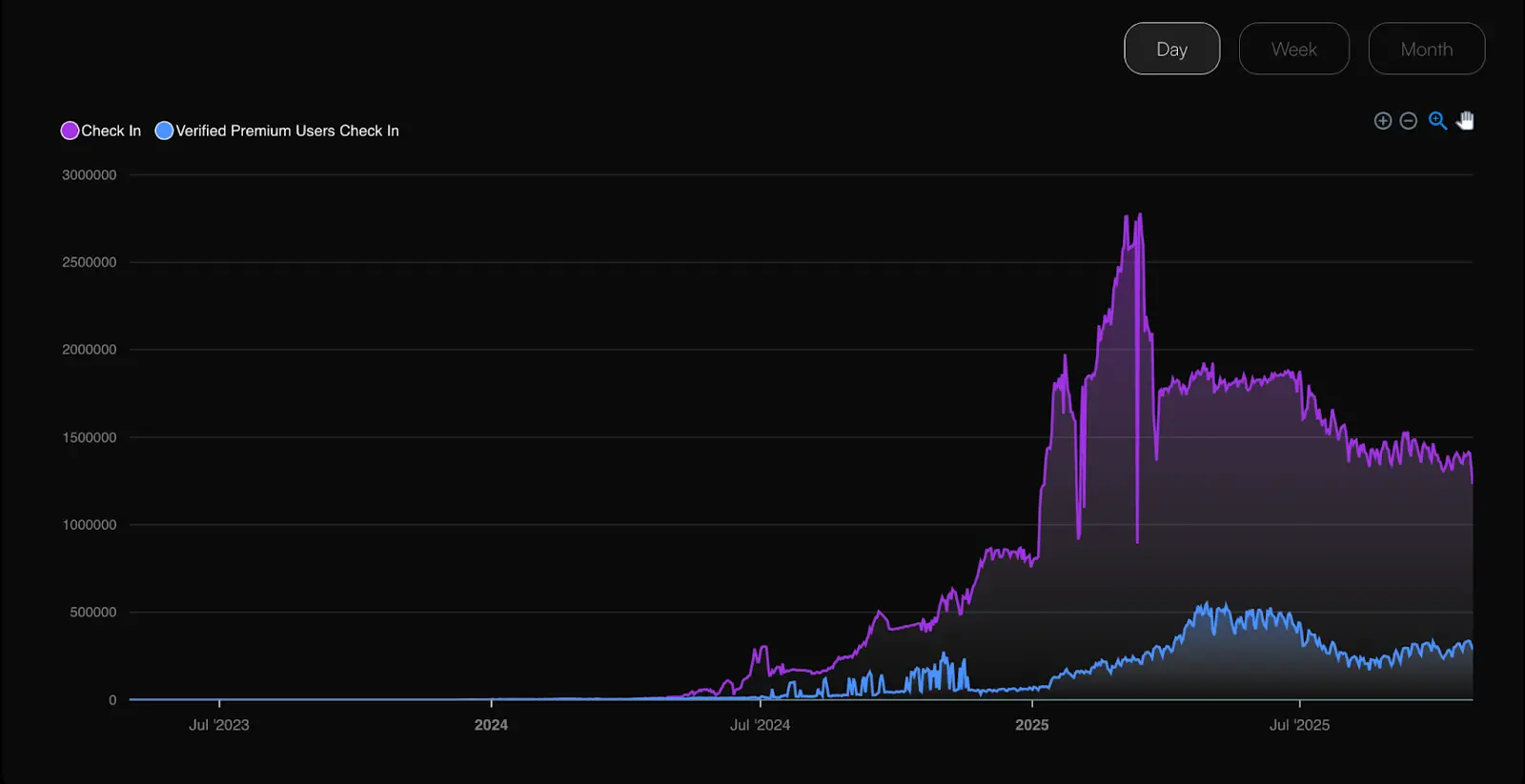
(△ According to data from Roam Explorer, the blue line represents the check-in data from certified advanced users, including gold and blue badge users, source: https://weroam.xyz/explorer)
Dynamic Token Economic Model
Cryptographic networks thrive on incentives, but activity often fluctuates with token prices. Roam's difficulty adjustment mechanism transforms volatility into resilience:
|------|------------------------------| | Market Phase | Adjustment Behavior | | Bear Market | ↓ Reduce token output when prices fall → Decrease selling pressure, stabilize token price | | Bull Market | ↑ Reissue previously delayed tokens when activity hits new highs → Accelerate growth |
Unreleased tokens will not be destroyed but temporarily postponed, reintroduced into circulation during upward cycles, with the reduced portion automatically allocated to subsequent cycles rather than concentrated in a single cycle.
Current Network Status
After the market crash on October 11, Roam demonstrated significant resilience, not only completing price recovery in just a few days but also rebounding quickly. During this period:
The average Check-In number for the most recent assessment cycle: Ranked 8th among 20 historical cycles;
Historical peak: Late April (token price above $0.25);
Peak check-in number: 4,352.43 (consistent with the aforementioned price peak).
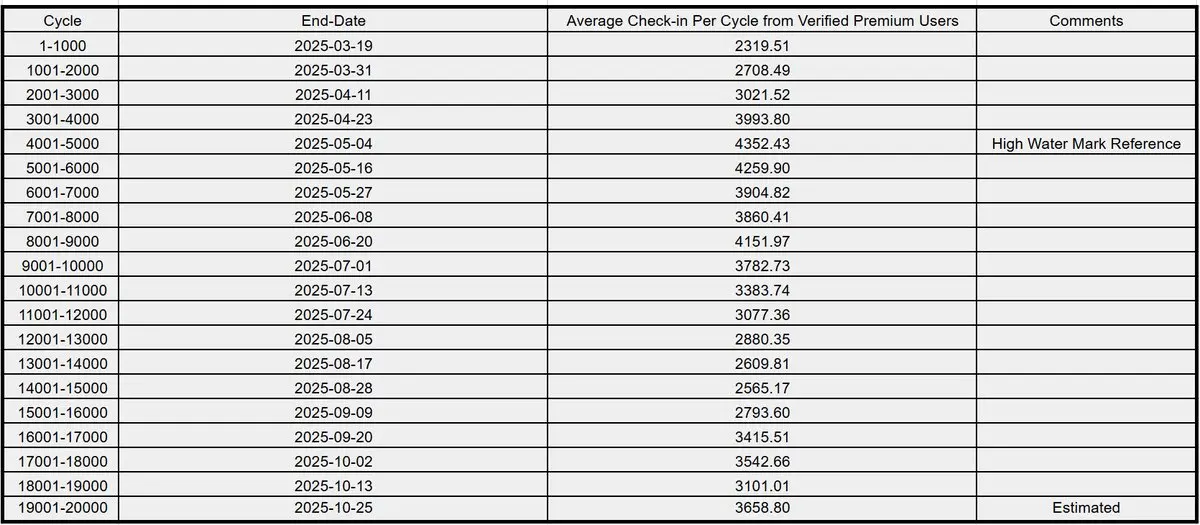
(△ Average check-in data from advanced certified users in 20 historical cycles, with false data excluded. Source: X)
First Adjustment Results:
|------|-----------------------| | Indicator | Value | | Adjustment Ratio | 15.83615% | | Output Impact | ↓ Reduce token output starting from Cycle 20,001 | | Next Assessment | To be conducted after Cycle 21,000 |
If the average Check-In number during the period from Cycle 20,001 to 21,000 exceeds 4,352.43 →
→ The system will set a new peak; simultaneously,
→ Restore and increase the token output rate, and reissue previously delayed tokens.
The difficulty adjustment mechanism endows the token economic model with adaptability, seeking stability amid fluctuations and accumulating growth momentum in a stable state. This is not only a technical upgrade but also Roam's commitment to sustainable growth and long-term value. By linking incentives to real usage scenarios and proactively protecting prices and participant returns during market downturns, Roam is building a decentralized network that can grow steadily in any market cycle.
 Risk warning Risk warning




Popular articles





