








Tron Industry Weekly Report: "Eagle-style interest rate cuts" failed to reverse the fatigue of the risk market, how the RWA protocol Falcon led by WLFI connects DeFi liquidity with traditional finance

# I. Outlook
1. Macroeconomic Summary and Future Predictions
Last week, the U.S. macroeconomy experienced significant fluctuations in policy and confidence. The consumer confidence index fell to a near six-month low, and employment expectations weakened, indicating that domestic demand momentum remains suppressed. Meanwhile, the government shutdown has lasted nearly a month, dragging down some economic activities and causing delays in data releases, putting pressure on fiscal spending and market confidence. Against this backdrop, the Federal Reserve announced its latest interest rate decision, maintaining the benchmark interest rate range unchanged, but the wording was clearly dovish, emphasizing signs of slowing economic growth and easing inflation, and suggesting that if the economy continues to cool, it will consider entering a further rate-cutting cycle within this year or early next year.
The market interpreted this as "confirmation of easing," leading to a decline in bond yields, a weakening of the dollar index, and short-term rebounds in gold and U.S. stocks, but overall volatility increased. Looking ahead, the U.S. economy is likely entering a transition period of "low growth, low inflation, and loose monetary policy," with the core policy focus shifting from suppressing inflation to stabilizing growth. If the government shutdown continues to drag on and corporate investment confidence remains weak, more liquidity support measures may be seen before the end of the year; however, if prices rise again or fiscal spending exceeds expectations, the Federal Reserve may still maintain a cautious wait-and-see approach. Overall, the short-term policy direction is leaning towards easing, but economic signals still point to moderate slowdown.
2. Market Changes and Warnings in the Cryptocurrency Industry
Last week, the cryptocurrency market continued its weak trend, with rebounds failing to sustain. Overall market trading volume decreased, with funds continuing to flow out of high-risk assets, and the rising market capitalization of stablecoins indicating increased risk-averse sentiment. The previous short-term rebound has proven to be a weak recovery, with mainstream coins and altcoins generally under pressure, especially high-leverage and small-cap tokens experiencing significant declines, while on-chain capital activity continued to decline.
From a macro perspective, despite the Federal Reserve maintaining interest rates and releasing dovish signals, market risk appetite has not recovered, and investors are generally concerned that liquidity easing may not quickly transmit to the cryptocurrency sector. Meanwhile, the slowdown in ETF inflows, institutional funds remaining on the sidelines, and a decrease in derivatives open interest all indicate insufficient short-term market confidence. If Bitcoin falls below the $100,000 threshold, it may trigger a new round of liquidation and deleveraging. Overall, the cryptocurrency market is still in a downward consolidation phase, with a weak short-term trend, and caution is needed for the risk of another bottoming out before the end of the year.
3. Industry and Sector Hotspots
Raised $2.8 million, led by Castle Island, with GSR participating ------ RockSolid, the best entry point for one-click access to institution-level secure DeFi vaults, allows users to easily obtain optimal DeFi yields; total financing of $14 million, solely invested by WLFI ------ Falcon Finance, the next-generation synthetic dollar protocol that combines stability with institution-level yields, allows users to mint USDf using various digital assets.
# II. Market Hotspot Sectors and Potential Projects of the Week
1. Overview of Potential Projects
1.1. Analysis of $2.8 Million Financing, Led by Castle Island, with GSR Participating ------ RockSolid, the Best Entry Point for One-Click Access to Institution-Level Secure DeFi Vaults
Introduction
RockSolid is a one-click integrated DeFi vault platform that allows users to easily obtain optimal DeFi yields.
RockSolid Vaults are institution-level DeFi vaults designed for ETH-native (ERC-20) assets. Each vault is secured by audited smart contracts and institution-level MPC control, providing returns to depositors through carefully selected strategies.
RockSolid does not hold users' private keys; all strategies are executed by professional managers, and returns are automatically returned to depositors.
Architecture Overview
Vault Mechanism
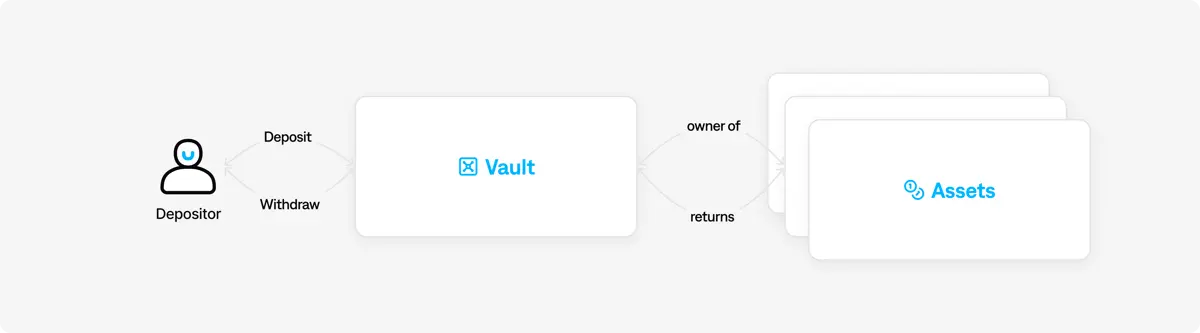
A vault is a smart contract that receives deposits of reference assets and allocates them to different DeFi strategies.
Depositors receive vault shares representing their ownership. As the value of the vault changes, the value of each user's share will also adjust accordingly.
The vault is priced in a reference asset, most commonly ETH-based assets (such as rETH).
For example, in the Rocket Pool rETH vault, other supported assets (ETH, WETH, stETH) are automatically converted to the vault's reference asset rETH through DEX routing upon deposit.
Role Distribution
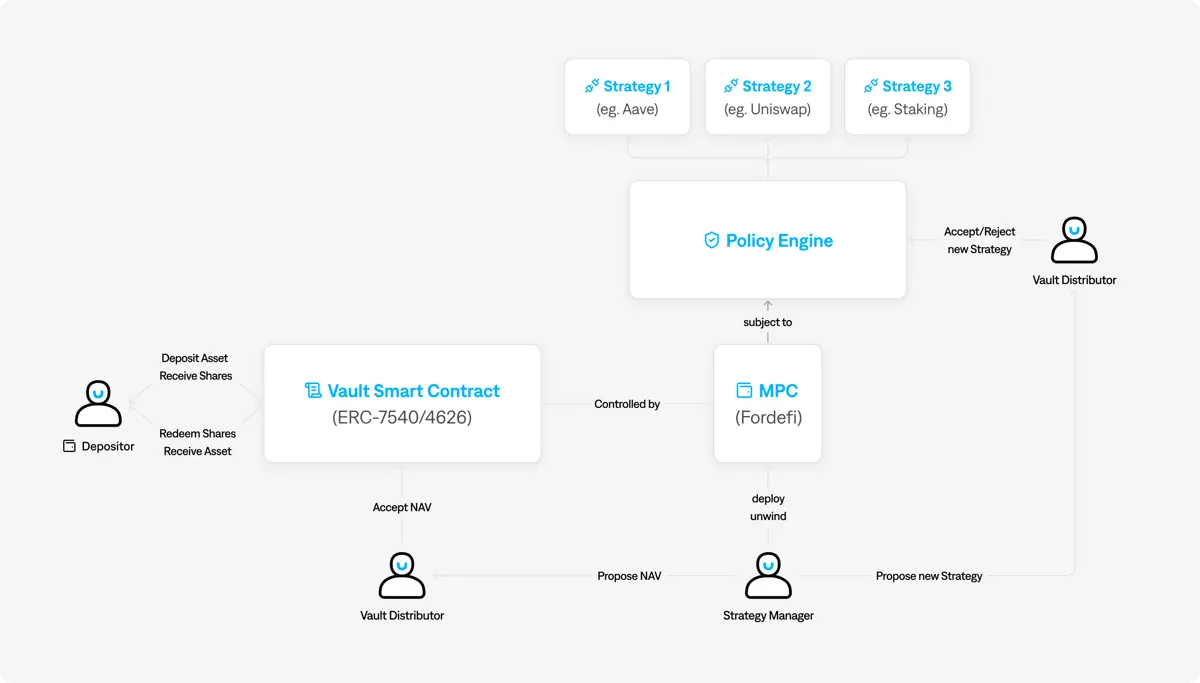
User / Depositor
Depositors deposit reference assets into the vault and receive receipt tokens (ERC-20) representing their ownership.
Receipt token rights:
View the allocation of vault assets
Monitor the value changes of their shares
Withdrawal process:
Users initiate withdrawal requests through the wallet holding the receipt tokens
Withdrawals show as "pending," with a processing period of about 24 hours (in accordance with the ERC-7540 asynchronous tokenization vault standard)
Ultimately receive the reference asset (for example, if stETH is deposited, it will be converted to rETH and deposited in the vault, and upon withdrawal, rETH will be received)
Service fee examples:
Service fee: 1%
Reward fee: 10%
Withdrawal period: 24h
Strategy Manager / Curator / Strategist
Responsible for proposing and executing investment strategies for vault assets, while also proposing NAV (Net Asset Value) updates.
Permission restrictions:
Can only deploy to whitelisted strategies
Can only operate approved protocols
All operations must comply with the MPC signature strategy, otherwise they will be automatically rejected
Daily responsibilities:
Deploy assets to whitelisted strategies
Rebalance between different strategies
Submit transactions and co-sign approvals with the Distributor
Daily propose updates to the vault token price (based on APR)
Strategy Manager for the rETH Vault: Tulipa Capital.
Distributor
Ensures that the vault's operations align with established goals (risk appetite, asset types, yield structure).
Collaborates with Partner Protocols to review strategy applications and acts as a co-signer:
Review strategy requests
Review daily NAV updates
Co-sign management and whitelisting proposals
Distributor for the rETH Vault: RockSolid.
Vault Management Platform
Provides underlying infrastructure to support standardized:
Deposits / Withdrawals
Accounting / NAV updates
Contract upgrades
Ensures that vault strategies can be deployed safely, transparently, and at scale.
Management platform for the rETH Vault: Lagoon.
MPC Signing Solution
Ensures that vault operations strictly adhere to policies and control rules.
Non-whitelisted operations will be automatically rejected.
Strategy asset deployments require multi-party computation (MPC) signatures, co-signed by the Distributor and Strategy Manager (Partner Protocols may optionally participate).
Signing solution for the rETH Vault: Fordefi.
Partner Protocol
External projects or asset issuers, usually the issuers or controllers of vault assets.
Plays an important role in formulating vault strategies.
Partner Protocol for the rETH Vault: Rocket Pool.
Security Council
Intervenes only in special circumstances (e.g., if the Distributor or Strategy Manager is unable to perform their duties or engages in malicious behavior, leading to an inability to reach a signature consensus).
Most members of the Security Council can intervene, replace relevant roles, or help stabilize the transition/closure of the vault.
Composed of experts in the cryptocurrency field with years of DeFi experience (identities kept confidential).
Tron Comments
RockSolid's advantage lies in its provision of a one-click, institution-level DeFi vault platform, allowing users to participate in yield strategies without managing private keys or complex operations; the platform ensures fund safety and transparent compliance in strategy execution through audited smart contracts, MPC multi-signature security mechanisms, and a professional management team, while returns automatically flow back to users, lowering the participation threshold.
Potential disadvantages include a high reliance on professional managers and custodial infrastructure, requiring users to trust the platform's strategy selection and execution; additionally, as a vault platform for ETH-native assets, its asset types are relatively concentrated, with limited cross-chain compatibility and diversified asset support; coupled with the volatility of the DeFi market and regulatory uncertainties, this may affect its long-term stability and scalability.
1.2. Interpretation of Total Financing of $14 Million, Solely Invested by WLFI ------ Falcon Finance, the Next-Generation Synthetic Dollar Protocol Combining Stability with Institution-Level Yields
Introduction
Falcon Finance is a synthetic dollar protocol that allows users to mint USDf ------ an over-collateralized stablecoin using various digital assets. Users can stake USDf as sUSDf to earn returns through institution-level trading strategies.
Falcon is built by a quant-focused engineering team and relies on transparent collateral infrastructure, aiming to connect on-chain liquidity with traditional
 Risk warning Risk warning



Popular articles





