








The Battle Between Tokenized Deposits and Stablecoins: The Future of Finance is Not Replacement, but Integration
 Core Viewpoint

 Banks create money, and stablecoins promote the flow of currency. We need both.
Article Author: Simon Taylor
Article Compiled by: Block unicorn
Banks create money, and stablecoins drive the flow of currency. We need both.
Proponents of tokenized deposits say, "Stablecoins are unregulated shadow banks. Once banks tokenize deposits, everyone will prefer to choose banks."
Some banks and central banks like this notion.
Proponents of stablecoins say, "Banks are dinosaurs. We don't need them on-chain at all. Stablecoins are the future of money."
Cryptocurrency natives particularly enjoy this narrative.
Both sides have missed the point.
Banks Provide Cheaper Credit to Their Biggest Clients
When you deposit $100, it turns into a $90 loan (or even more). This is how fractional reserve banking works. It has been the engine of economic growth for centuries.
Fortune 500 companies deposit $500 million at JPMorgan.
In return, they receive large credit lines at rates below market levels.
Deposits are the business model of banks, and large corporations are well aware of this.
Tokenized deposits bring this mechanism on-chain, but they only serve the bank's own customers. You are still under the bank's regulatory umbrella, still subject to the bank's operating hours, processes, and compliance requirements.
For businesses that need low-cost credit lines, tokenized deposits are a good option.
Stablecoins Are Like Cash
Circle and Tether hold 100% reserves, equivalent to $200 billion in bonds. They earn a 4-5% yield but do not pay you any fees.
In return, the funds you receive are not subject to any bank regulation. It is expected that by 2025, $9 trillion will be transferred cross-border via stablecoins. You can use them anytime and anywhere with an internet connection, without any permission, operating 24/7.
No need to ask a correspondent bank, no waiting for SWIFT clearance, and no waiting for "we will get back to you in 3-5 business days."
For companies that need to pay an Argentine supplier at 11 PM on a Saturday, stablecoins are a good choice.
The Future is Both
A company that wants to obtain good credit lines from banks may also want to use stablecoins as a channel to enter long-tail markets.
Imagine a scenario like this:
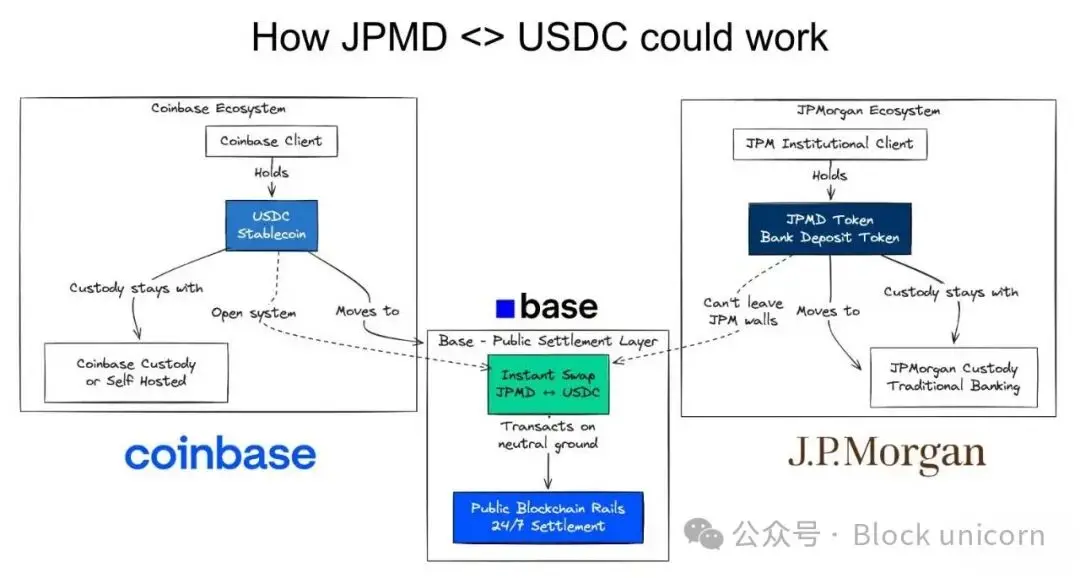
A Fortune 500 company holds tokenized deposits at JPMorgan.
In return, it receives favorable credit lines for its U.S. operations.
It needs to pay a more stablecoin-preferred supplier in Argentina.
So, it converts JPMD to USDC.
This is an example of the direction we are heading.
On-chain. Atomic.
Both are possible.
Use traditional channels where applicable.
Use stablecoins where they are not applicable.
This is not a question of either/or, but both/and.
Tokenized Deposits → Low-cost credit within the banking system
Stablecoins → Cash-like settlement outside the banking system
On-chain Conversion → Instant conversion, zero settlement risk
Both have their pros and cons.

They will coexist.
On-chain Payments > APIs for Payment Orchestration
Some large banks might say, "We don't need tokenized deposits; we have APIs," and in some cases, they are correct.
This is the advantage of on-chain finance.
Smart contracts can build logic across multiple enterprises and individuals. When a supplier's deposit arrives, smart contracts can automatically trigger inventory financing, working capital financing, and currency hedging. Whether banks or non-bank institutions, these operations can be completed automatically and instantly.
Deposit → Stablecoin → Pay Invoice → Downstream Payment Completed.
APIs are point-to-point, while smart contracts are many-to-many. This makes them very suitable for workflows that cross organizational boundaries. This is the power of on-chain finance.
This is a fundamentally different financial service architecture.
The Future Belongs to On-chain
Tokenized deposits solve the problem of low-cost credit. Deposits are locked. Banks lend against deposits. Their business model remains unchanged.
Stablecoins solve the problem of fund portability. Funds can flow anywhere without permission. Countries in the Global South can access dollars. Businesses can achieve rapid settlement.
Proponents of tokenized deposits only want regulated payment channels.
Proponents of stablecoins want to replace banks.
The future requires both.
Fortune 500 companies want large credit lines from banks, as well as instant global settlement. Emerging markets want local credit creation and dollar channels. DeFi wants composability and backing by real-world assets.
Debating who will win overlooks what is happening. The future of finance is on-chain. Both tokenized deposits and stablecoins are necessary infrastructure to achieve this goal.
Stop arguing about who will win. Start building interoperability.
Composable money.
 Risk warning
 Risk warning



Popular articles





