








The market keeps falling, when is the best time for TGE?
 Core Viewpoint

 The only thing that truly transcends cycles is the quality of the project itself.
Author: Zhou, ChainCatcher
As February comes to an end, the price of Bitcoin has nearly halved since its peak, and the altcoin market is in disarray, with the crypto market still shrouded in panic.
Countless projects are facing the same dilemma: should they launch tokens now or wait for a bull market?
A long-standing saying in the market is that TGE (Token Generation Event) is more likely to succeed in a bull market. However, real data and cases seem to show that there are numerous examples of poor projects collapsing to zero after being harvested in a bull market, while high-quality projects can emerge across cycles even in a bear market.
How important is the timing of TGE, really?
1. Is the Timing of Bull and Bear Markets Really Important?
Haseeb, managing partner at Dragonfly, recently posted on X platform that by using the Claude Code tool to analyze all token launch data from Binance, the research results indicate that there is no significant statistical difference in the performance of tokens launched during bull and bear markets.
The Mann-Whitney test p-value is 0.81, which means the performance difference between bull and bear market tokens is no different from noise; the timing of token launches is not that important.
He pointed out that since people tend to launch tokens in bull markets when capital is more abundant, there is a sample bias, so one cannot simply observe the proportion of bull market tokens among the top 100 tokens.
The study demonstrated the robustness of this conclusion by comparing the relative performance of about 200 token projects listed on Binance under bull, bear, and neutral market conditions.
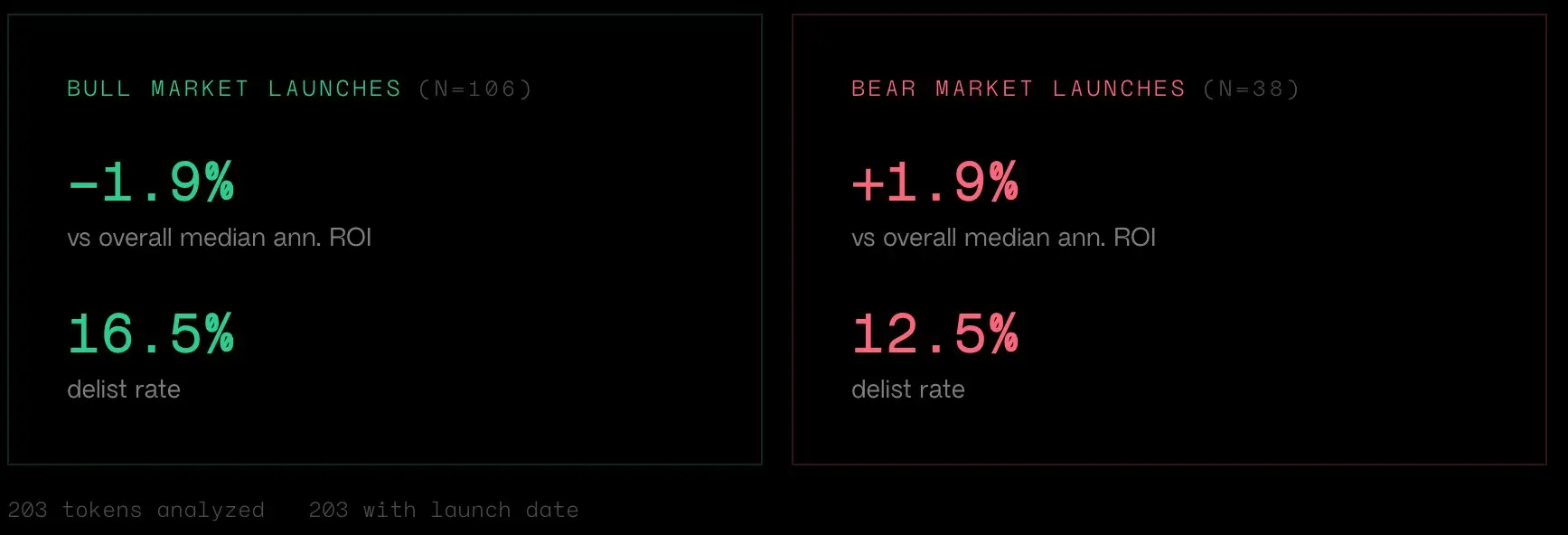
Additionally, he noted that while launching in a bear market has advantages such as less competition for talent, cheaper service providers, and lower pressure from exchanges, bull markets are more favorable for token sales; overall, these factors tend to offset each other.
Armani Ferrante, CEO of Backpack, added from another perspective that launching tokens in a bear market tends to result in fewer retail investors being harvested on a large scale.
Due to the lack of frenzied enthusiasm in the market, project teams are forced to confront real demand, and speculative funds find it difficult to easily inflate valuations.
Bull Market: Accelerator or Cover-Up?
The high liquidity and FOMO (Fear of Missing Out) in a bull market can indeed accelerate the growth of good projects.
Hyperliquid launched its HYPE token in the latter part of the bull market in November 2024, leveraging the real perpetual contract trading volume accumulated before TGE and a community-oriented genesis airdrop design. Its token price rose from an initial approximately $3.8 to several tens of dollars in 2025, maintaining a high market cap to this day.
Similarly, the Solana ecosystem DEX aggregator Jupiter launched its JUP token in early 2024, quickly establishing a foothold based on actual trading demand.
However, a bull market cannot save low-quality speculative projects.
At the end of the bull market from 2024 to 2025, a large number of purely narrative or meme projects were launched with great fanfare, only to crash shortly after a brief surge.
A typical example is Plasma, a high-valuation project in 2025, where the FDV (Fully Diluted Valuation) at TGE was often in the tens of billions, yet it lacked real usage support, leading to tokens generally dropping by 70-80% after launch, with high openings and low closings becoming almost standard.
According to statistics from crypto VC Delphi Digital, 97% of altcoins have been in a downtrend since January 2025, with an average decline of 78%. Among the 121 altcoins it tracked, only three tokens—HYPE, SYRUP, and BCH—have maintained an upward trend.
Overall, projects lacking real use cases and healthy tokenomics are unlikely to escape the fate of high openings and low closings, even if they catch the benefits of a bull market.
Bear Market: Filter or Meat Grinder?
The bear market is also a double-edged sword.
On one hand, high-quality projects like Solana launched just days after the COVID crash in March 2020, starting at a low valuation but leveraging underlying performance and continuously expanding use cases to become a Layer 1 leader in the subsequent bull market.
Uniswap launched in the later part of the bear market in September 2020, relying on real DeFi demand and community governance to ultimately achieve long-term value.
On the other hand, the bear market can amplify the problems of weak projects.
Coingecko data shows that as of mid-January 2026, 53.2% of cryptocurrencies on the GeckoTerminal platform have gone to zero, with a total of 11.6 million tokens collapsing in 2025, accounting for 86.3% of the total number of tokens that went to zero between 2021 and 2025. In the fourth quarter alone, 7.7 million tokens crashed, accounting for 34.9% of all recorded project failure cases.
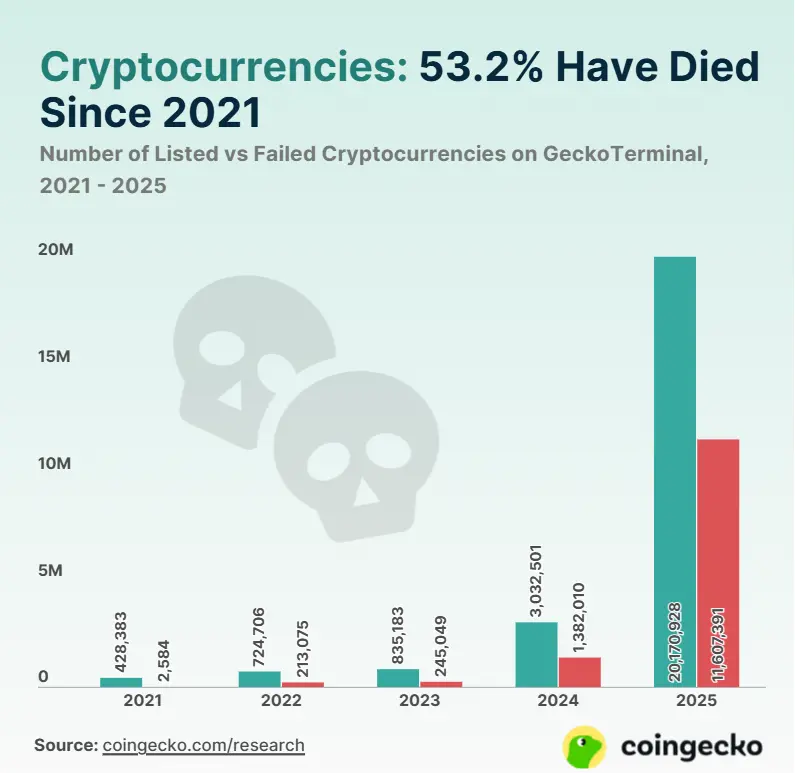
The low barriers to entry for issuance platforms, combined with the liquidity exhaustion and narrative fatigue in a bear market, have caused many low-quality projects to quickly lose trading activity.
It is evident that the timing of issuance is merely an amplifier, not a decisive factor.
A bull market can help good projects take off faster while temporarily covering up the problems of bad projects; a bear market makes it harder for good projects to launch but can filter out truly resilient teams.
Ultimately, project quality—real demand, sustainable token economics, and strong execution—remains the fundamental factor for traversing cycles.
2. Bear Market Forces the Evolution of Tokenomics
If timing is not key, then a more pressing question is: how is the bear market changing the underlying logic of token issuance?
Project Teams: Cost Advantages and New Paradigms
For project teams, the operational costs of TGE in a bear market are significantly reduced. Marketing, KOL collaborations, and CEX listing fees are often 30-70% cheaper, and competition pressure is much lower, making it easier to attract users and talent who genuinely recognize the long-term value of the project.
More profound changes come from innovations in token economics.
Armani Ferrante, CEO of Backpack Exchange, recently announced that its upcoming token will allow long-term stakers (at least one year) to exchange for 20% equity in the company at a fixed ratio. He candidly stated that many past token issuances were built on false promises of utility, with insiders receiving large allocations in advance, ultimately placing the selling pressure on retail investors.
This model of converting tokens into equity may become a new trend in the bear market. It transforms token holders into true shareholders of the company, sharing in actual growth rather than relying on hollow utility narratives; the mandatory lock-up for at least one year significantly reduces selling pressure and fundamentally avoids the risk of insiders dumping in traditional models.
It is worth noting that such models still face legal compliance challenges, as the hybrid structure of equity and tokens exists in a regulatory gray area in most jurisdictions, requiring project teams to carefully design legal frameworks.
However, the trend is clear, and similar practices are quietly spreading; for example, some projects are linking unlocking conditions to actual TVL (Total Value Locked), revenue, or product milestones, using executable smart contracts to replace verbal commitments.
In summary, the current market is forcing project teams to abandon the old model of relying on narratives to inflate valuations, shifting towards verifiable mechanisms like revenue sharing and equity conversion to anchor value. This may become standard in the next bull market.
Of course, a bear market also means that short-term price performance is likely to be flat or even decline, and insufficient liquidity can easily lead to price drops, increasing team morale issues and fundraising difficulties.
Beyond innovations in token economics, project teams still need to continue investing in product development and community maintenance.
Investors and VCs: Return Elasticity and Longer Due Diligence Cycles
For VCs and institutional investors, the valuations of TGE in a bear market are significantly compressed. Historical data shows that projects entering during a bear market have much higher return elasticity in the next bull market compared to those entering at high points in a bull market; however, the proportion of projects ultimately achieving positive returns is lower, as the bear market is also the period with the highest failure rates.
This has led to a noticeable tightening of institutional funds at this stage, with extended due diligence cycles, and a preference for concentrating resources on a few projects with real usage and healthy tokenomics rather than casting a wide net.
Retail Investors: Liquidity Traps and Longer Emotional Tests
For retail investors, the environment for TGE in a bear market is even more complex. The market lacks FOMO, reducing the chances of being harvested by overvalued projects; however, extremely low liquidity can cause price discovery mechanisms to fail, and small selling pressure can trigger severe volatility.
A recent example is Flying Tulip. This project had the endorsement of Andre Cronje (a well-known developer in the DeFi space, known for Yearn Finance and Fantom) and featured an innovative design claiming "never to break" through a 100% principal redemption mechanism, garnering significant attention at launch. However, it quickly fell below the public offering price after going live.
This exemplifies how, in a low liquidity market, even innovative mechanisms struggle against selling pressure.
Retail investors participating in TGE during a bear market often face longer periods of price fluctuations and emotional tests, requiring a higher level of judgment regarding the project's fundamentals.
Conclusion
Ultimately, the timing of TGE is far less important than the quality of the project.
What is more thought-provoking is that in the current bear market, characterized by liquidity exhaustion and increasing regulatory clarity, the concept of timing itself is being redefined. The previous model of quickly harvesting based on bull market FOMO and high FDV narratives has been repeatedly punished by the market.
When buying pressure disappears and selling pressure amplifies, the only things that can endure are real demand and verifiable token economics.
For ambitious project teams, this presents a strategic window of opportunity: lower costs, weaker competition, and concentrated attention can anchor valuations in healthier ways, filter communities, and refine products.
For investors and retail participants, the core question is no longer "when to TGE," but rather how to identify quality projects and maintain clarity and patience in a volatile market environment.

 Risk warning




Popular articles





