








The little deer live by the water and grass
 Core Viewpoint

 Mining companies have never been the most devout believers in Bitcoin. Under the pressures of halving compressing profits, financial reports showing revenue growth without profit increase, and coin prices falling below mining costs, the industry is collectively de-risking.
Author: Zhou, ChainCatcher
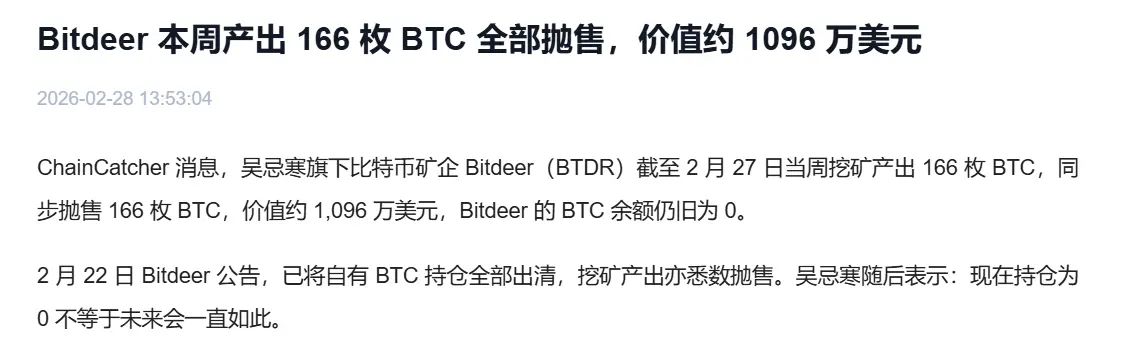
Bitdeer’s Bitcoin holdings have been reduced to zero.
As one of the leading mining companies, it held over 2,400 BTC at its peak in November last year, and has since continued to increase its selling pace, completing its liquidation by mid-February, and now maintains a rhythm of selling as much as it mines.
Notably, the company’s financial report shows that it achieved revenue of $224.8 million in the fourth quarter of 2025, a year-on-year increase of 226%; net profit reached $70.5 million; total hash rate reached 71.0 EH/s, a year-on-year increase of 229%, and mining efficiency significantly improved from 30.4 J/TH to 17.9 J/TH.
A company with a positive balance sheet and record-high hash rate chose to liquidate its Bitcoin reserves at this time. To understand this operation, one must first return to a fundamental fact that has long been obscured by the market.
1. Hoarding coins has always been a minority practice
Bitdeer was never a coin-hoarding institution driven by belief.
In its early years, the company adhered to the simplest mining logic—mine, sell, and convert to cash. BTC was not an asset for it, but a product.
It was only in the past two years, as MicroStrategy's hoarding model gained immense popularity in the capital markets, that the valuation logic for mining companies began to be reshaped, prompting Bitdeer to briefly switch to a hoarding narrative in line with industry trends.
This trend-following is not uncommon in the industry, but very few have truly persisted.
Analyst Tom Dunleavy from the blockchain research firm Messari released data showing that from January to November 2025, ten mainstream listed mining companies, including Core Scientific, Riot, Marathon, and Hut 8, mined approximately 40,700 BTC and sold about 40,300 BTC during the same period, with a sale rate close to 99%.
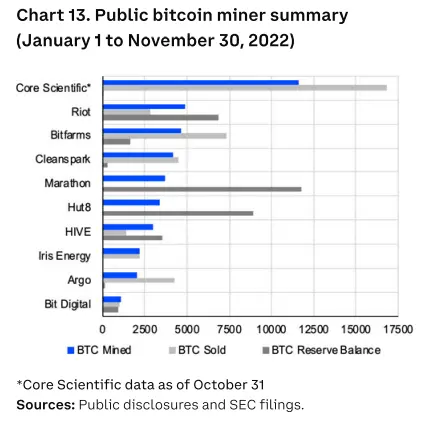 In other words, these companies have never truly hoarded coins.
This figure reveals the fundamental survival rule of the industry: the essence of mining companies is energy arbitrage; Bitcoin is merely an intermediary through which they convert cheap electricity into revenue, rather than a long-term holding on their balance sheets.
Recently, the market's belief in the hoarding narrative was partly due to the continuous rise in BTC prices, which obscured this reality—when assets are appreciating, whether to sell or not becomes a matter of posture; however, when prices fall below mining costs, selling coins shifts from a posture to a survival instinct.
Therefore, Bitdeer's liquidation this time can be seen less as a betrayal of belief and more as a return to its true nature. This is also not a signal of bearishness towards Bitcoin; Wu Jihan himself stated on social media that having zero holdings does not mean it will always be this way in the future.
However, this time, the coins sold were not for operational cash but for the startup capital for transformation. That brief period of hoarding was merely an interlude in the industry’s collective effort to tell a story to the capital markets.
2. Triple pressure: How cold is the winter for mining companies?
Understanding that hoarding coins is a minority practice allows for a clearer view of the current situation of mining companies. The industry is under the weight of three synchronously tightening dilemmas.
First is the cost pressure after the halving.
The halving in 2024 means that block rewards will be halved, directly cutting mining companies' unit output in half, while electricity costs, machine depreciation, and operational costs remain unchanged. Many mining machines' shutdown prices are already close to or exceed the current BTC price, meaning that turning on the machines results in losses, while shutting them down wastes assets.
Dunleavy also pointed out that miners' continuous selling of newly mined BTC constitutes structural downward pressure on prices. The lower the price, the more mining companies need to sell coins; the more coins they sell, the harder it becomes for prices to rebound, creating a self-reinforcing vicious cycle.
Second are the stark numbers in financial reports.
Looking at the annual reports of mining companies for 2025, almost without exception, they show a structure of rising revenue alongside rising losses.
MARA Holdings' annual revenue grew from $656 million to $907 million, but its net loss soared to $1.31 billion, compared to a profit of $541 million in the same period last year.
Hut 8's revenue increased from $162 million to $235 million, but its net loss shifted from a profit of $331 million to a loss of $248 million. TeraWulf's annual revenue grew from $140 million to $169 million, while its fourth-quarter loss per share expanded from $0.21 to $1.66.
The phenomenon of increasing revenue without increasing profit appears simultaneously in many leading companies, indicating that this is not a management issue, but a structural cyclical compression in the industry.
The fair value fluctuations of hoarded assets directly penetrate the profit and loss statement, making the balance sheet numbers particularly unsightly. Meanwhile, companies are still exchanging debt for transformation: Hut 8 launched a $1 billion ATM financing plan and signed a credit agreement with Coinbase for up to $400 million; Cipher Digital completed three financing rounds totaling up to $3.73 billion.
Finally, the macro environment has changed.
Trump raised global tariffs, geopolitical uncertainties continue to escalate, and risk assets are generally under pressure, with Bitcoin falling below $65,000.
Cryptocurrency analysis firm QCP pointed out that Bitcoin prices are significantly below the average mining cost, and prioritizing liquidity over hoarding coins is no longer a strategic choice but a reality constraint.
Bitdeer's liquidation and Cango's start to sell a small amount of BTC for operations, when viewed together, outline the industry's risk reduction profile.
3. To live or die: The gamble of transformation
In the context of synchronously tightening triple pressures, mining companies have only one way out: transformation, leveraging the infrastructure assets accumulated through Bitcoin mining to unlock a new source of revenue.
AI and high-performance computing have become the next card that the industry collectively bets on.
The logic is not hard to understand. Mining companies hold a large number of cheap electricity contracts and scalable data center land, which are precisely the most scarce resources for AI computing infrastructure. Switching from low-margin mining computing power to high-margin AI computing power leasing is, on paper, a profitable deal.
Bitdeer is fully promoting its self-developed mining machine Sealminer, AI cloud services, and high-performance computing business; Cipher has changed its brand from Mining to Digital, signaling a platform transformation; multiple companies are competing to secure long-term low-price electricity contracts to establish a structural moat on the energy cost front.
However, the reality of progress is far more conservative than the narrative.
Take TeraWulf, for example; the company’s revenue from HPC in the fourth quarter was only $9.7 million, accounting for less than 30% of total revenue of $35.8 million, and it saw a significant decline from the third quarter.
Acquiring customers for AI business, landing contracts, and ramping up production capacity all take time, while debt pressure and equity dilution are immediate realities.
The outcome of this transformation gamble depends on whether the new business can truly scale up before the debt matures.
Interestingly, during the same period when BTC fell nearly 17%, many mining company stocks rose against the trend. For instance, TeraWulf rose 31% during the month, Cipher increased by 8%, Hut 8 by 6%, and Core Scientific remained basically flat.
This decoupling reflects a revaluation in the capital markets—mining companies have long been one of the sectors with the highest short-selling ratios by hedge funds, and the upward momentum may partly stem from short covering.
This indicates that the market is beginning to view these companies as potential carriers of AI computing infrastructure rather than as amplifiers of Bitcoin price leverage.
In the future, their judgment criteria may no longer be how much BTC they hold, but who has secured the longest-term low-price electricity, whose data center assets have the most potential for AI transformation, and whose balance sheet can withstand the pains of transformation.
Conclusion
Mining companies have never been the most devout believers in Bitcoin; they are the most rational industry participants. When mining is profitable, they mine; when hoarding coins can support valuations, they choose to hoard; when selling coins can provide the bullets for transformation, they will sell without hesitation. This is the basic logic of business.
What is truly worth questioning is the next issue: when the story of AI/HPC transformation is fully priced by the capital markets, what can these companies offer to support the next round of valuations? If by then Bitcoin prices have rebounded, while the transformation business is still immature, will those mining companies that liquidated today start telling the hoarding story again?
Cycles repeat, narratives remain fresh. But in every winter, surviving is always more important than belief.
 Risk warning



Popular articles





