








Predicting the World Cup "Final Showdown": Over 150 projects are gearing up, with a total investment of nearly 6 billion dollars
 Core Viewpoint

 In the current situation where new projects are constantly emerging, it is necessary to be particularly vigilant against the risk of being "reversed."
Author: momo, ChainCatcher
Prediction markets are one of the most "money-absorbing" tracks in crypto recently, and they are a rare existence that has heated up against the trend in a bear market.
On March 27, Polymarket once again received a $600 million investment from ICE, the parent company of the New York Stock Exchange, bringing its total financing to as high as $2.879 billion; its competitor Kalshi is not far behind, with total financing of $2.515 billion and a valuation of $22 billion.
Although leading players have clearly outpaced others in terms of financing scale and trading activity, new entrants continue to emerge. Major exchanges, including Binance and Coinbase, have also begun to accelerate their layout through wallet integration and acquisitions. For example, Binance Wallet has just announced the launch of prediction market features and has integrated Predict.fun as a provider. Paradigm is also developing prediction market trading terminals aimed at professional traders and market makers.
With the World Cup approaching (about two months away), prediction markets are likely to welcome a new wave of traffic peaks.
This article will outline the latest landscape of prediction markets from the perspectives of financing and investment, and review some early representative projects and their differentiated paths.
Nearly $6 billion in financing, but 30% of projects have ceased operations
According to incomplete statistics from RootData, among the more than 230 prediction market projects recorded, over 50 projects have received public financing, with a total financing amount of $5.687 billion.
However, it is worth noting that among these more than 230 projects, only over 150 are currently operational, while more than 70 have ceased operations, resulting in an elimination rate of nearly one-third, reflecting that while the track has strong money-absorbing capabilities, project survival is not easy.
In addition, the capital distribution in this track is extremely concentrated. Polymarket and Kalshi together account for $5.394 billion, about 94.85% of the total financing amount in the track. This means that the remaining more than 50 projects share only about 5% of the financing amount, with capital highly concentrated in the hands of the "dual giants." Among them:
There are 7 projects with financing amounts of $10 million and above (excluding Polymarket and Kalshi), namely: Novig ($75 million), Opinion ($25 million), Space (public offering $20 million, community questions about soft rug), Limitless ($17 million), The Clearing Company ($15 million, already acquired); Noise ($14.1 million), Polynado ($10 million).
There are 3 projects with financing amounts between $5 million and $10 million, namely: AetheriumX ($8 million), 42 ($7.2 million), Augur ($5 million).
The vast majority of projects that have disclosed amounts have financing scales below $5 million, and the financing stages are highly concentrated in seed rounds and pre-seed rounds.
From the perspective of financing rhythm, the capital attention to prediction markets has significantly heated up since the second half of 2024, and is expected to further accelerate into an active period in 2025. In the first four months of 2026 alone, 16 financing events have occurred, almost maintaining a frequency of "one per week." Overall, on one hand, leading projects continue to receive large amounts of funding, while on the other hand, early projects are also beginning to receive intensive exploratory investments, showing a dual characteristic of "strengthening the head + tail diffusion."
At the same time, leading players are accelerating their layout in prediction markets through acquisitions. For example, Polymarket acquired the prediction market API company Dome, Coinbase acquired Kalshi and The Clearing Company, which was founded by former growth executives of Polymarket, and Gemini acquired an early-stage player in the track, Guesser.
How can early projects break through in a duopoly?
Apart from the two giants Polymarket and Kalshi, other early projects find it difficult to compete directly in terms of funding and scale, so they are looking for breakthroughs in segmented scenarios, trading mechanisms, and product positioning.
One obvious direction is verticalization. For example, Novig focuses solely on sports predictions, avoiding politics and entertainment, penetrating a single category.
Another direction is innovation in trading mechanisms. For instance, Noise and OmenX have chosen to directly introduce derivative leverage mechanisms into prediction markets; 42 packages each prediction result into small tokens similar to meme coins, allowing for buying and selling at any time on a bonding curve. This "prediction is trading" approach differs from traditional binary betting.
There is also a group of projects that choose not to be platforms, but to be tools. Polynado positions itself as the "Bloomberg terminal" for prediction markets, using AI to actively discover trends and generate markets; Kairos and TradeFox are cross-platform aggregation trading terminals that help users manage positions across multiple prediction markets in one place. They do not directly compete for Polymarket's users but attempt to become the underlying infrastructure for the entire track.
In addition, compliance and capital efficiency are also areas of differentiation. Novig uses a sweepstakes model (free coins + cash coins) to avoid being defined as gambling, while predict.fun allows users' prediction funds to generate additional returns during participation.
Another group of projects is working on traffic entry and distribution. Melee enhances user social sharing; Myriad embeds prediction functions directly into media pages like Twitter and YouTube through a browser plugin, allowing users to bet while browsing content. They do not attempt to make users actively "enter" a prediction market but instead bring predictions to users' attention.
The involvement of AI is also lowering the barriers to creating prediction markets. worm.wtf allows users to input prompts, and AI generates prediction markets with one click; Polynado similarly uses AI to automatically discover emerging trends and build markets in advance. This shifts the supply side of prediction markets from "manual topic selection" to "algorithm-driven."
Overall, leading players compete on funding and scale, while small and medium projects showcase their strengths in vertical scenarios, trading mechanisms, tool positioning, AI generation, and traffic distribution. Below is a brief overview of some early projects:
1. Novig
Novig is the prediction market project with the most financing besides Polymarket and Kalshi. Established in 2021, it just secured $75 million in financing led by Pantera Capital in February this year, with a post-investment valuation of $500 million.
Novig focuses solely on the sports track. It currently operates using a sweepstakes model to avoid being defined as "gambling." What does this mean?
It uses two types of virtual currencies:
Free Coins (Novig Coins): Users receive these for free to participate in various "games" or "predictions" on the platform. Since users do not purchase participation opportunities with real money, this does not constitute "gambling" legally.
Cash Coins (Novig Cash): Users need to purchase these with real money or earn them through participation in activities. Rewards won using this currency can be exchanged for real cash. This is similar to the virtual currency setup in games, where users typically purchase "virtual currency packages" to gain more "game opportunities" or better experiences. Legally, users are "purchasing virtual goods," not "betting."
Novig has officially applied to the CFTC (Commodity Futures Trading Commission) for a Designated Contract Market (DCM) license, aiming to operate legally in all 50 states of the U.S. as a regulated prediction market exchange, with a monthly trading volume of about $300 million.
On the team side, co-founders Jacob Fortinsky graduated from Harvard and have investment banking experience.
2. Opinion (OPN)
Opinion (formerly O.LAB) is a prediction market in the BNB Chain ecosystem, with YZi Labs participating in two rounds of investment. Opinion's three rounds of financing have exceeded $25 million, with institutions like Hack VC, Amber Group, Animoca Ventures, and Jump also participating. The token was launched in early March.
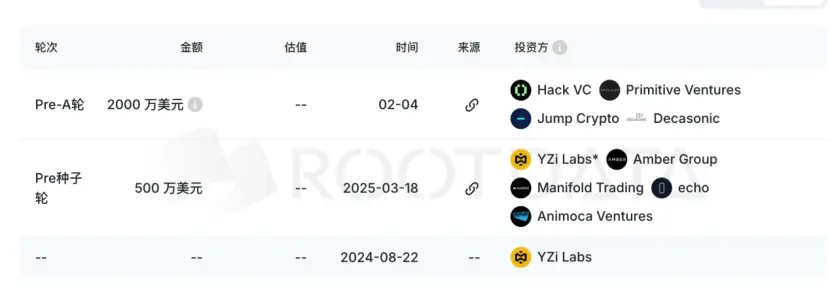
Opinion's characteristic is that it also incorporates AI concepts, mentioning that the platform uses AI Oracle to assist in creating markets and generating predictions.
However, during the TGE period, Opinion's financing, trading volume data, and airdrop were questioned by the market.
Recommended reading: “Is Opinion Really Worth Paying Attention To?”
3. Limitless (LMTS)
Limitless is a social protocol in the Base ecosystem. It has raised a total of $17 million, with participation from Coinbase Ventures, 1 confirmation, and other institutions. Limitless had its TGE in October 2025 but faced community skepticism due to issues like airdrops.
Limitless's prediction content allows for short-term price prediction trading on crypto assets, stocks, and more.
The founder & CEO/CTO has previously worked at Gitcoin and is a holder of the Optimism citizen badge. Its COO Roman Mogylnyi was a co-founder of the viral AI face-swapping application Reface.
4. Polynado
Polynado is positioned as AI-native prediction infrastructure. In December 2025, it completed a $10 million investment from LD Capital, Waterdrip Capital, and others.
It is not an independent prediction market platform but aims to build a "Bloomberg terminal-level" intelligence data layer for on-chain prediction markets represented by Polymarket, actively discovering emerging trends, automatically generating markets, and pre-building and trading these markets before they attract attention.
5. predict.fun
Binance Wallet has just announced the launch of prediction markets, with predict.fun as its main provider. In December 2025, predict.fun announced it received investment from YZi Labs.
The model of predict.fun allows users' prediction funds to generate additional returns during the prediction period, and in early March, it also acquired another prediction market, Probable.
The founder of predict.fun, dingaling, was previously the head of research at Binance, a co-founder of PancakeSwap, a well-known NFT whale, and also founded the token launch platform boop.fun. However, dingaling has previously faced community skepticism regarding his entrepreneurial ventures being trend-chasing, and there are rumors of disputes with Binance and CZ.
Recommended reading: “Reconciliation of Rivals? CZ and Former Employee Team Up to Launch Prediction Platform predict.fun”
6. Melee
Melee is a prediction market on Solana, positioned as "Viral Markets." It completed $3.5 million in pre-seed round financing, led by Variant, with participation from DBA and several angel investors, including Meltem Demirors, Chief Strategy Officer of CoinShares, Anatoly Yakovenko, co-founder of Solana Labs, and Web3 investor Santiago Roel Santos.
Melee emphasizes social and viral dissemination. It allows users to create fact or opinion markets (such as pop culture, sports) without permission, and the platform enhances user participation through social integration (such as one-click sharing on X/Discord).
Additionally, Melee has a unique feature that allows users to buy into the "overall market" (shares of all outcomes) without having to bet Yes/No or multiple options on specific results. This is equivalent to betting on the growth and popularity of the entire market, rather than specific right or wrong outcomes, suitable for users who are optimistic about topic popularity but uncertain about specific results.
Recommended reading: “Understanding the Newcomer Melee in Prediction Markets: Focused on Socialization and Deep Integration with Creator Economy”
7. The Clearing Company (Acquired by Coinbase)
The Clearing Company has been acquired by Coinbase and previously completed $15 million in seed round financing, led by USV, with well-known institutions like Coinbase Ventures participating.
Its founder, Toni Gemayel, was the growth director at Kalshi and Polymarket, aiming to combine the decentralization and openness with the credibility of regulatory compliance to create a new generation of prediction markets that can be accepted by retail investors and favored by regulators.
8. AetheriumX
AetheriumX is an early prediction market project that completed $8 million in strategic financing in January this year, with investments from CGV, GAINS Associates, DuckDAO, Genesis Capital, and others.
According to official information, its characteristic is that it allows users' funds to be dynamically routed to different DeFi protocols, RWA, or GameFi activities, improving capital efficiency.
9. Myriad
Myriad is incubated by DASTAN, the parent company of Decrypt and Rug Radio, and recently completed seed round financing with participation from MoonPay, Thomas Lee, and others.
Its characteristic is that it aims to embed prediction markets into news and social media pages like Twitter, YouTube, and Decrypt through a browser extension, allowing users to participate in predictions directly using stablecoins while browsing content.
Myriad has been integrated into Trust Wallet.
10. Noise
Noise is a prediction market in the Base ecosystem. It has raised over $14 million, with Paradigm as the lead investor in the seed round, and institutions or projects like GSR, Figment Capital, and Kaito also participating.
Noise's characteristic is that, unlike Polymarket, which focuses on binary betting on event outcomes, it allows users to conduct leveraged trading on bullish and bearish trends for a topic, trend, or brand, with the core idea of turning "internet attention" into a continuously tradable financial asset.
Noise opened its testnet in May last year and recently opened a waiting list for applications.
11. 42
42 was formerly known as Alkimiya and has now been renamed to 42. In 2021 and 2023, the team received investments from institutions such as Castle Island Ventures, 1kx, Coinbase Ventures, Dragonfly, and Circle Ventures.
42's characteristic is that it combines the "predictive event" and "meme launch platform" mechanisms, allowing each possible outcome of an event to be made into a small token similar to a meme coin.
You can buy and sell on the bonding curve at any time, just like trading meme coins. When the event actually concludes (for example, when election results come out or a game ends), the platform will settle based on the real results.
12. Kairos
Kairos is not an independent prediction market platform but a Web3 prediction market trading terminal, a unified execution and intelligence layer that aggregates data and trading functions from multiple prediction markets. Kairos raised $2.5 million in February this year, led by a16z.
13. OmenX
OmenX is a decentralized prediction market platform that supports leveraged trading, allowing users to trade on the outcomes of real-world events in crypto, sports, finance, and more by buying and selling long and short positions.
On March 30, OmenX announced it had secured several million dollars in financing from Paramita and M77 Ventures.
14. TradeFox
TradeFox (formerly factCheck) was incubated by AllianceDAO and initially focused on creating a news fact-checking version of Polymarket, allowing users to bet on the truth or falsehood of already occurred facts. However, it later transformed into a prediction market aggregator, focusing on integrating dispersed prediction markets into a seamless trading terminal, allowing users to conduct leveraged trading on real-world events (such as political elections, sports events, and crypto price fluctuations). The trading page is very similar to Hyperliquid. TradeFox has launched its mainnet.
15. worm.wtf
worm.wtf is a prediction market in the Solana ecosystem. It supports AIGC, allowing users to simply input prompts, and the platform can help users instantly generate prediction markets.
Conclusion
The growth of prediction markets is far from over. In the first quarter of 2026, the trading volume in the track reached $75 billion, a 70% increase from the previous quarter, and it is expected that prediction markets will further break out during the World Cup.
What is even more noteworthy is the accelerated adoption by traditional finance. JPMorgan's CEO has expressed consideration of providing prediction market services, and Wall Street brokers like Clear Street and Marex are actively integrating. These signals open up significant imaginative space for the future traffic, compliance, and commercialization of prediction markets.
In terms of market structure, it is expected that the highly concentrated situation of chips will be difficult to change in the short term. Whether in financing or trading volume, it is currently firmly concentrated on the two platforms, Polymarket and Kalshi, and their compliance layouts are also accelerating.
Given that nearly one-third of the more than 230 projects have ceased operations, the difficulty of successfully managing a prediction market is much higher than imagined. Dragonfly partner Haseeb Qureshi has predicted that 90% of prediction market products will be ignored by the end of the year. This is not alarmist; the moat built by leading players through liquidity, compliant distribution, and continuous subsidies makes it difficult for newcomers to break through solely by imitation.
However, in the medium to long term, new players are not without opportunities. Delphi Digital points out that the real breakthrough lies not in competing directly with Polymarket but in splitting the tech stack to serve different user types. For example, aggregation terminals and advanced analytical tools meet the needs of professional traders; social interfaces attempt to tap into a broader mass entertainment market. Additionally, the introduction of AI agents will quickly erase the arbitrage space in binary markets, driving funds to migrate to new mechanisms. Prediction markets are evolving into infrastructures for options, insurance, and governance, rather than just speculative tools.
For ordinary users, with new projects continuously emerging, there is a need to be particularly vigilant against the risk of being "reverse exploited." Opinion is a recent example: impressive financing, AI narrative, and backing from large institutions, but after the TGE, it faced data skepticism, airdrop shrinkage, and community backlash, and similar scripts are expected to repeat.
The track is far from being finalized, but for those new players shouting "overthrow Polymarket and Kalshi," it might be wise to let the bullets fly a little longer.

 Risk warning



Popular articles





