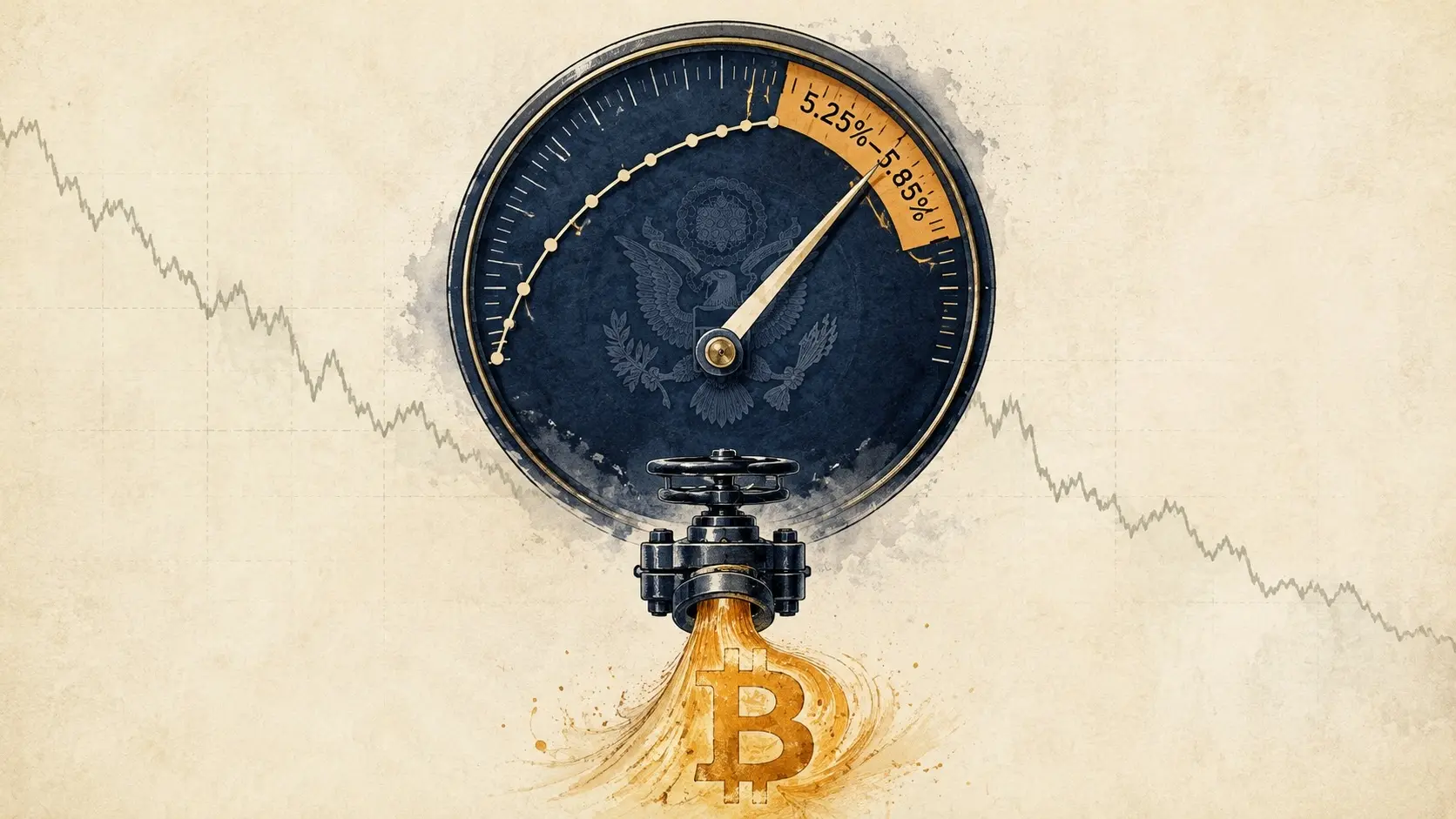
Strive CEO: The crypto bear market has ended, and the strongest bull market in Bitcoin's history may be coming
 Core Viewpoint

 The long-term weakness of the US dollar, the rising demand for scarce assets in the AI era, and the strengthening of the BTC/gold ratio are converging three forces, creating a favorable environment for Bitcoin that has never been seen before.
Author: Matt Cole, Strive CEO
Compiled by: Jiahua, ChainCatcher
The price trend of Bitcoin priced in gold is further reinforcing my judgment: the next Bitcoin cycle is likely to be the strongest one yet.
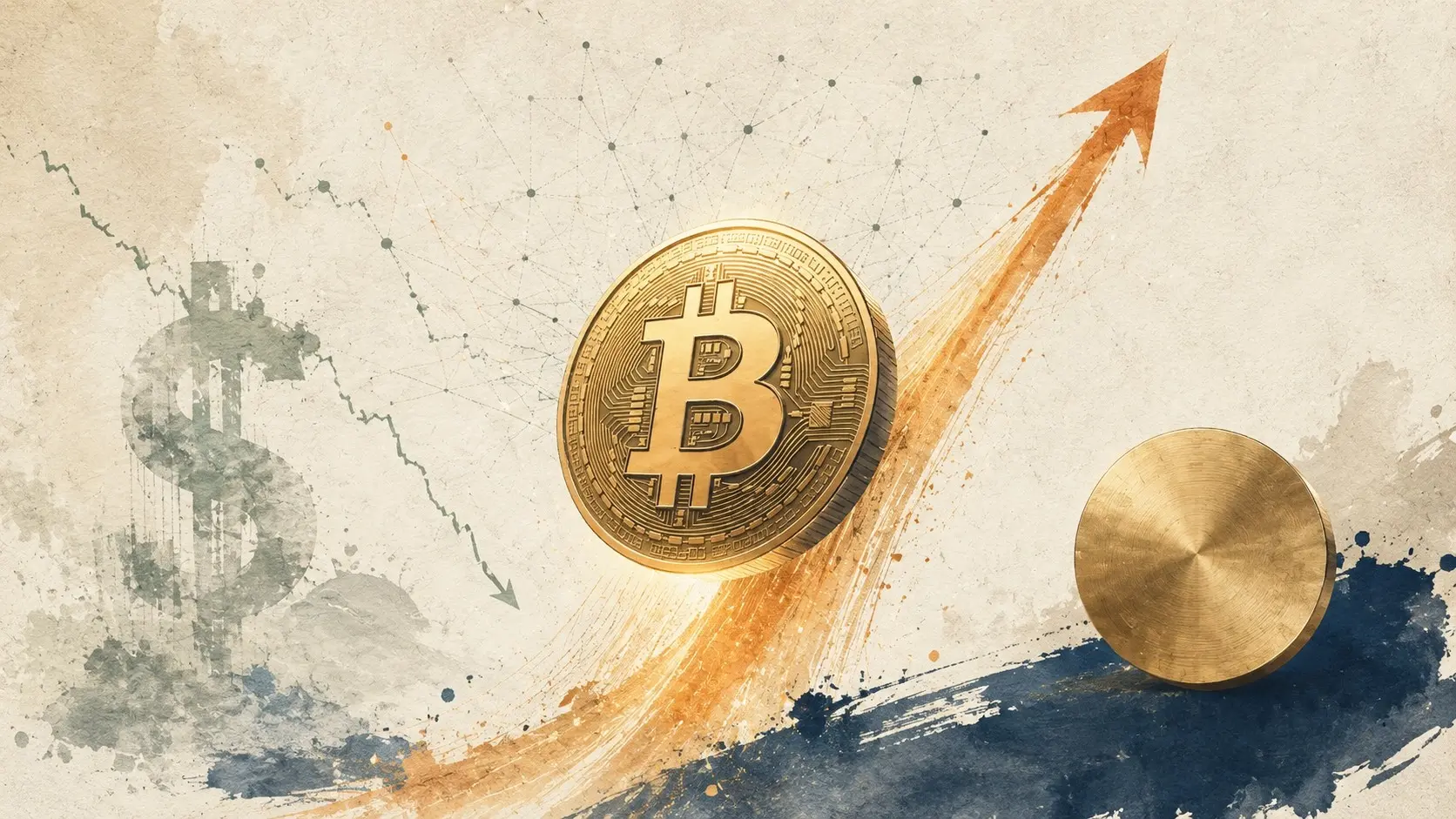
The logic of the dollar I mentioned earlier, along with the AI-driven increasing demand for scarcity in the "abundance era," is providing strong structural support for scarce assets. The BTC/gold ratio has also released another important signal: as more capital flows into scarce assets, Bitcoin may be re-establishing its leading position relative to gold, once again becoming the "fastest horse."
Dollar and AI
This judgment is primarily based on two structural forces driving capital toward scarce assets.
The first force comes from the dollar.
As I wrote earlier this week, I believe the dollar may be entering a long-term down cycle, and the long-term trend of the dollar index (DXY) supports this judgment.
Bitcoin has never experienced such a macro environment before. If the dollar truly enters a long-term weak cycle, it will provide Bitcoin with a tailwind that it has never seen in its history.
The second force comes from the renewed pursuit of scarcity in the AI era.
As intelligence becomes cheaper and more abundant, many things that were valuable due to scarcity in the past, such as knowledge, software capabilities, and the competitive barriers of many traditional businesses, are becoming easier to replicate.
This means that capital will increasingly value those scarce assets that cannot be easily replicated due to technological advancements.
Bitcoin, gold, and silver may all significantly benefit from this change. This is also a structural force that Bitcoin has never truly possessed before.
The combination of these two forces will drive more capital toward currency assets with scarcity attributes. Gold will benefit, and Bitcoin will benefit as well.
I have long firmly believed that as global monetary purchasing power continues to be diluted and capital re-pursues scarce assets, Bitcoin will ultimately become that "fastest horse."
The BTC/gold ratio is an important indicator to observe when Bitcoin re-establishes this leading position.
If the funds flowing into gold and Bitcoin are both increasing, and Bitcoin starts to outperform gold, then the opportunity brought by the combination of these two forces will be stronger than any single factor.
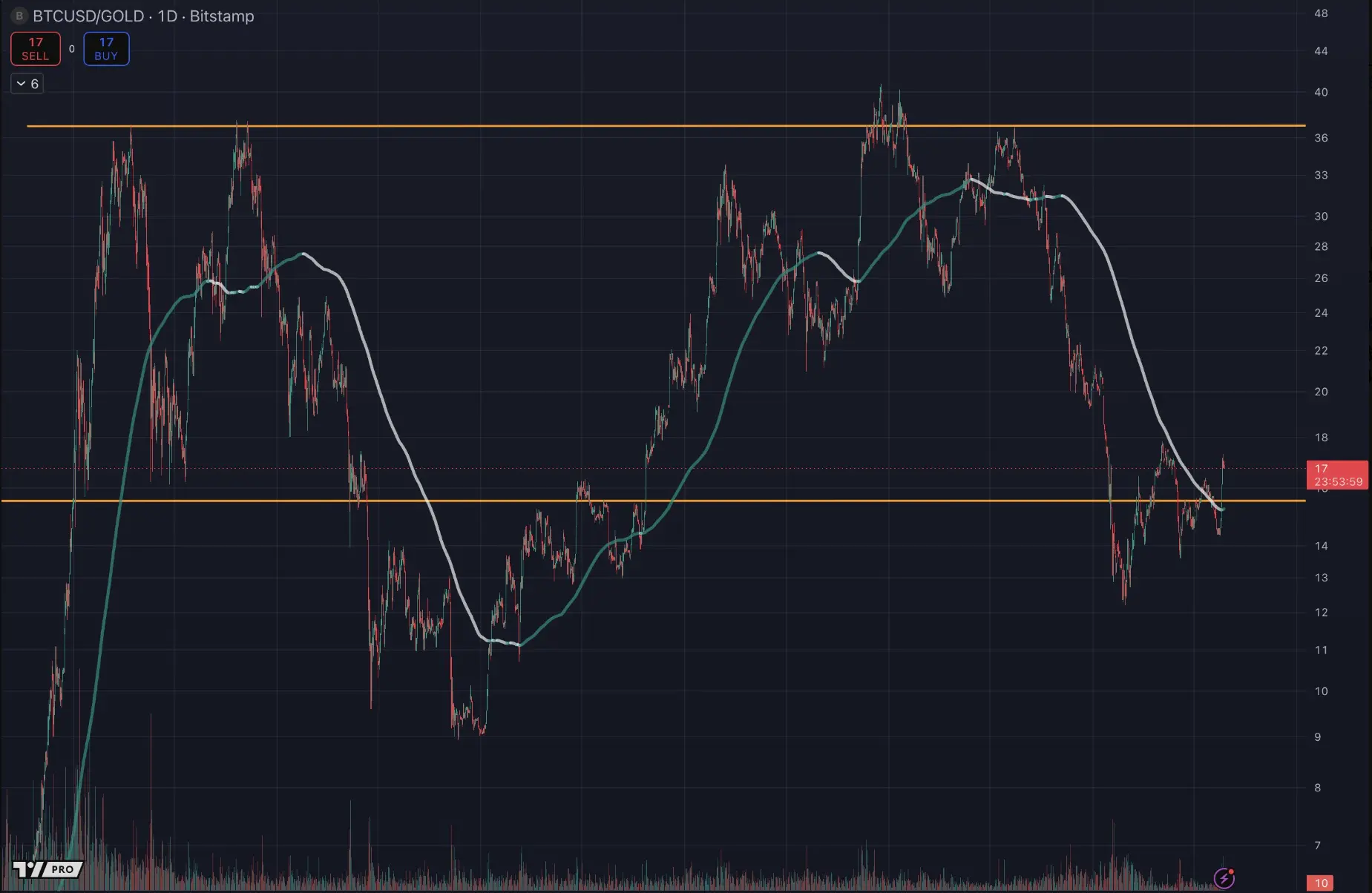
Over the past two years, the BTC/gold ratio has actually been a very effective leading indicator for observing Bitcoin's own trend.
In December 2024, Bitcoin peaked relative to gold; however, Bitcoin priced in dollars did not peak until October 2025, with a gap of nearly a year between the two.
During this period, Bitcoin's dollar price continued to reach new highs, but it could no longer set new highs relative to gold.
This is very important for Bitcoin, which is still in a growth phase as a currency asset.
The sustainability of a bull market largely depends on new funds and liquidity, as well as the positive feedback formed by this: more and more investors want to hold an asset, pushing it to continue strengthening, while stronger performance attracts more capital.
In hindsight, BTC/USD was still sending strong signals at that time, but BTC/gold had already shown that the foundation of this bull market was gradually weakening.
Ultimately, this fragility also reflected in the dollar price.
This may also explain why market sentiment is so pessimistic in this bear market, even though the pullback in dollar terms is not particularly severe by Bitcoin's historical standards.
Because in the previous bull market, Bitcoin never truly exhibited the relative leading advantage that the market expected.
Although Bitcoin set new highs in dollar terms, it consistently underperformed gold, and then entered a bear market under conditions where relative strength had already weakened.
If a bull market never fulfills the logic of "Bitcoin is the fastest horse," then even if the subsequent price pullback is not as severe as in previous cycles, the investor experience will still be very painful.
BTC / Gold
At the bottom phase, we can see similar signals, but the direction is completely opposite.
Bitcoin bottomed relative to gold in February 2026, but Bitcoin priced in dollars did not truly bottom until July 2026, with a gap of about five months between the two.
This is also why I have repeatedly discussed the BTC/gold ratio in various contexts in the first half of this year. Previously, the BTC/gold ratio indicated a market weakening earlier than BTC/USD; and when Bitcoin's dollar price was still weak, this ratio began to show signs of bottoming.
Therefore, it was also one of the important signals I used to judge whether the Bitcoin bear market might be closer to the end than what the dollar price trend indicated.
This bear market has one very different aspect compared to past bear markets: the financing environment has not tightened significantly like in previous bear markets, and the broader stock market remains strong, continuously setting historical highs.
In the past, Bitcoin bear markets were often accompanied by a significant weakening of the entire risk asset market. But this time, the weakness is more concentrated within Bitcoin and its related ecosystem. This makes the improvement in the BTC/gold ratio even more noteworthy.
What is particularly interesting this week is: now, Bitcoin has simultaneously broken through against both the dollar and gold, and this breakthrough is very strong.
A significant pullback occurring next would not surprise me, but it may also not happen at all.
If a substantial pullback does occur, I expect the market to buy aggressively.
At the same time, I am now very confident: the Bitcoin bear market has ended.
If the BTC/gold ratio is once again the indicator that releases signals earlier, then seeing BTC/USD and BTC/gold both moving upward now gives me more confidence about the future 12 to 18 months and makes me more optimistic about the larger opportunities that may arise in the coming years.
The weakening dollar and the continuous dilution of monetary purchasing power, combined with the AI-driven pursuit of lasting scarcity, will create an extremely favorable environment for scarce assets.
The relative performance among different scarce assets will determine where new capital and liquidity ultimately flow.
When Bitcoin becomes that "fastest horse," it has the opportunity to capture a larger proportion of new funds.
Stronger relative performance will bring deeper liquidity, and better liquidity will create more room for trading, financing, and other capital operations, further attracting capital in.
If these structural forces continue to expand the entire scarce asset market, while Bitcoin re-establishes its leading advantage over gold, then Bitcoin is actually occupying an increasingly larger share in a continuously expanding pool of funds.
It is this situation that makes me more bullish on Bitcoin now than at any other time.
Gold has thousands of years of monetary history behind it.
Bitcoin not only possesses absolute scarcity but also has global liquidity, portability, and a monetary network that can transmit and settle value anywhere in the world, year-round.
If the dollar enters a long-term weak cycle, AI drives capital to re-pursue lasting scarcity, and Bitcoin re-establishes its leading position relative to gold, then this will constitute an environment that Bitcoin has never truly possessed in its history.
Our Bitcoin Strategy
This framework has also profoundly influenced the way we build Strive.
When we consider risk, we are not just thinking about how to survive a severe Bitcoin downturn.
For Bitcoin, which we believe still has enormous upside potential as an emerging asset, we think the greater risk may actually be being too conservative.
Either not being bullish enough on Bitcoin, or being bullish but designing the company's capital structure in a way that does not allow common shareholders to fully participate when the rise truly comes.
This is also why we have consistently opposed the view that acquisitions, heavy investments, or focusing primarily on operating cash-generating businesses is the best way to maximize total returns relative to Bitcoin itself.
If your fundamental judgment is that Bitcoin will appreciate significantly in the future, then waiting to buy Bitcoin after future business generates cash flow means you will ultimately only be able to buy less Bitcoin at a higher price.
Having cash-generating businesses may seem more stable.
But if you believe that converting this portion of economic value into more Bitcoin now can bring higher expected total returns under the most likely scenarios, then the so-called more conservative cash flow strategy may ultimately lag in total returns.
Considering various possible outcomes, we believe that to maximize the expected total return of $ASST (Strive's stock code), we should increase our participation in Bitcoin's rise as much as possible within the range the company can responsibly bear, while maintaining strict capital discipline.
This includes: not using debt, not setting margin requirements, and not adopting any financing structure that could trigger forced liquidation.
On the surface, this structure seems very simple, and that is exactly what we intended.
But the real difficulty lies in considering both the downside and the upside clearly:
Downside, how much of a decline can this structure withstand?
And:
Upside, if Bitcoin ultimately rises as you judge, how much profit will be missed due to the structure being too conservative?
If our macro judgment ultimately materializes, then this structure will become very powerful.
First, the opportunities in the entire scarce asset market are expanding.
Second, Bitcoin may take an increasingly larger share from this growing pool of funds.
Finally, the structure of $ASST further amplifies the company's participation in Bitcoin's rise.
Thus, it will actually form a three-layer mutually reinforcing logic of rising:
Opportunity pool expands, Bitcoin occupies a larger share within it, and ASST common stock further amplifies this return elasticity.
This is why we care so much about designing the company's capital structure correctly.
The true logic of rising is not just "Bitcoin prices will rise."
But rather that Bitcoin becomes the fastest asset in a continuously expanding scarce asset market, while $ASST is designed to maximize this outcome within the range the company can responsibly bear.
This bear market has allowed us to test this design in a real market environment.
Especially when Bitcoin was approaching its weakest phase in this cycle, we continued to buy actively.
In the months leading up to this breakthrough, we were purchasing Bitcoin almost every week.
We designed this structure from the beginning to ensure it could remain stable in a challenging Bitcoin market environment while maintaining high Bitcoin return elasticity and having the ability to deploy capital when opportunities are most attractive.
Now, we have a real market record proving that this structure has indeed achieved this.
In conjunction with the BTC/gold ratio, there is another aspect of this bear market that I find very interesting.
Bitcoin bottomed relative to gold in February, about five months earlier than it bottomed relative to the dollar in July.
And ASST also bottomed in February, well before the entire Bitcoin-related stock sector hit its low around July.
I do not believe this timing overlap is merely coincidental.
In both cases, the market seems to have first released turning signals on those assets most sensitive to liquidity improvement and risk appetite recovery.
The BTC/gold ratio began to indicate that the asset I believe will run the fastest in an environment of diluted monetary purchasing power is regaining strength.
At the same time, ASST, as an asset with higher return elasticity relative to the same Bitcoin logic, also began to strengthen.
As market confidence in Bitcoin recovers and risk appetite rises, capital starts to flow into more volatile assets with higher upside elasticity, and our capital structure, Bitcoin amplification capability, and liquidity design all give $ASST the opportunity to become one of the targets for new capital flows.
The close timing of these two turning points is also why I believe this correspondence is so noteworthy.
Designing a structure on paper is one thing; actually experiencing a market downturn while observing the performance of the balance sheet and common stock is another.
I believe we can create and maintain high Bitcoin return elasticity while relying on a sufficiently solid capital structure and liquidity to sustain this capability across different market environments.
Ultimately, this will help the company achieve a higher valuation premium relative to its Bitcoin holdings.
This bear market is the period in which we build this "performance engine."
Now, our common and preferred stocks already have considerable liquidity; the company's capital structure has no debt or margin requirements; and the company is also prepared for what I believe is the emerging next phase of the Bitcoin market environment.
The weak dollar and the continuous dilution of monetary purchasing power, the abundance era driven by AI, and the BTC/gold ratio are actually telling us three different but complementary things.
The first factor expands the overall opportunities for scarce monetary assets.
The second factor increases the value premium enjoyed by those scarce assets that cannot be easily replicated.
And the BTC/gold ratio helps us judge: among all the scarce monetary assets competing for the same pool of capital, how much market share Bitcoin is capable of capturing.
Individually, any one of these changes is a positive factor.
But if they continue to develop in the direction we judge, then Bitcoin will enter its historically most favorable macro environment and relative performance combination.
And this also means that the potential upside space for Bitcoin in the coming years may reach a level we have never truly seen before.
 Risk warning