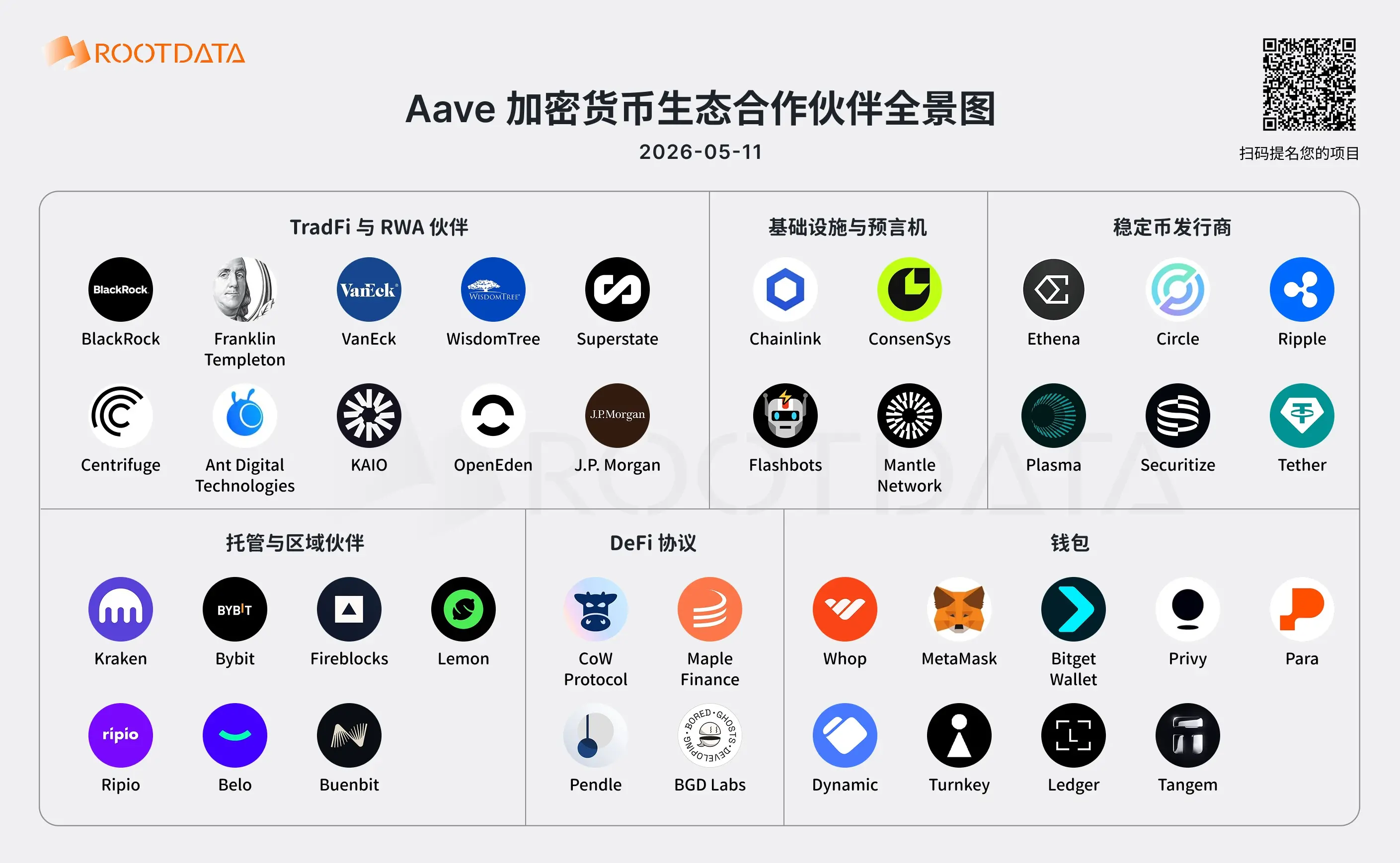
Illustration of Aave's 40 Web3 Business Partners: Defining the On-Chain Dollar Interest Rate Market
The Web3 asset data platform RootData has outlined 40 partners of Aave, covering multiple layers such as TradFi/RWA, stablecoins, infrastructure, wallets, DeFi protocols, exchanges, and custody. From its early focus on the lending efficiency of crypto assets to competing for on-chain dollar liquidity after the launch of GHO, Aave seems to be defining an interest rate system for on-chain dollars.
At the TradFi and RWA layer, institutions like BlackRock, Franklin Templeton, VanEck, and JPMorgan are prominently featured, along with RWA platforms such as Centrifuge, OpenEden, and Securitize, indicating that Aave is no longer satisfied with lending native crypto assets but is attempting to meet the financing needs of real-world assets on-chain.
At the stablecoin layer, partners like Circle, Tether, Ethena, Ripple, and Plasma suggest that Aave is competing for the on-chain "dollar liquidity" entry point. Whoever controls stablecoin deposits is closer to on-chain interest rate pricing power.
At the infrastructure layer, partners like Chainlink, ConsenSys, Flashbots, and Mantle provide Aave with price oracles, MEV optimization, and multi-chain expansion capabilities.
At the user distribution layer, wallet partners like MetaMask, Ledger, Bitget Wallet, Privy, and Turnkey are lowering the entry barriers for users; meanwhile, institutional channels like Kraken, Bybit, and Fireblocks further amplify the capital entry points.
DeFi protocols such as Pendle, Maple Finance, and CoW Swap extend Aave's liquidity into fixed income, institutional lending, and trading scenarios. The recent rsETH/Kelp risk event caused Aave's TVL to drop from a peak of $44 billion to $15 billion, once again testing the risk management capabilities of this established DeFi protocol. Related collection: Aave Web3 Partner Network Collection (continuously updated)
Cryptocurrency projects actively showcasing their partner networks have become a key way to enhance transparency and market trust. It is reported that RootData welcomes Web3 projects to claim their information and continues to track and open more project business relationship disclosure channels. The platform has released multiple editions of crypto project ecosystem maps, nominating Web3 ecosystem partners for upstream clients like Visa, Mastercard, and Coinbase.
If you wish to nominate your project in future ecosystem maps, please fill out the [RootData 2026 Industry Ecosystem Mapping] form to supplement your important clients and partners.