Scan to download
BTC $63,417.97 +2.64%
ETH $1,684.90 +4.33%
BNB $599.95 +2.07%
XRP $1.13 +2.74%
SOL $66.48 +3.85%
TRX $0.3270 -0.18%
DOGE $0.0863 +3.31%
ADA $0.1665 +2.97%
BCH $206.14 -6.85%
LINK $7.94 +3.76%
HYPE $61.85 +6.97%
AAVE $64.05 +2.92%
SUI $0.7583 +3.59%
XLM $0.2009 -1.18%
ZEC $420.54 +5.33%
BTC $63,417.97 +2.64%
ETH $1,684.90 +4.33%
BNB $599.95 +2.07%
XRP $1.13 +2.74%
SOL $66.48 +3.85%
TRX $0.3270 -0.18%
DOGE $0.0863 +3.31%
ADA $0.1665 +2.97%
BCH $206.14 -6.85%
LINK $7.94 +3.76%
HYPE $61.85 +6.97%
AAVE $64.05 +2.92%
SUI $0.7583 +3.59%
XLM $0.2009 -1.18%
ZEC $420.54 +5.33%

barriers

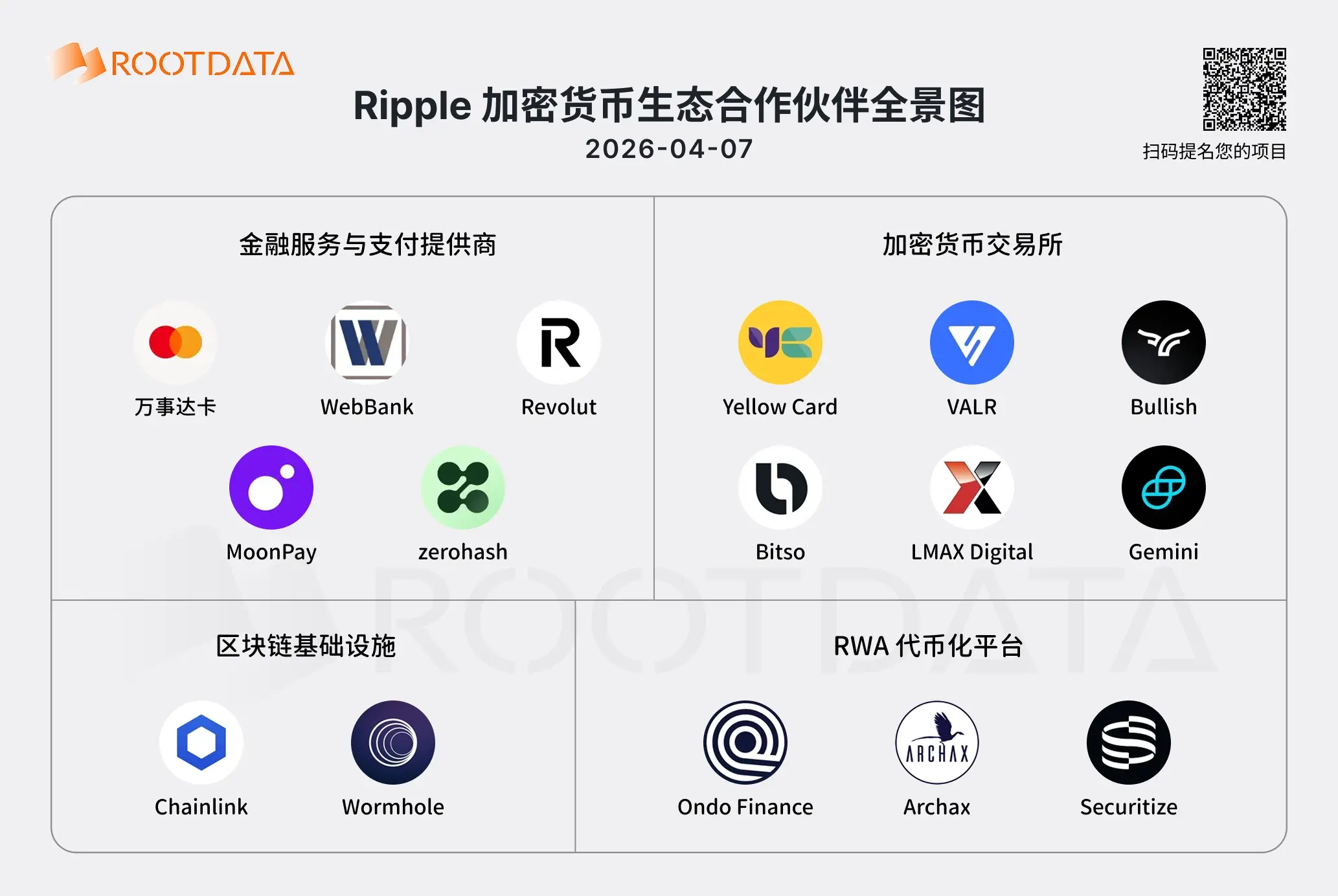
Illustration of Ripple's 16 Web3 business partners: Actual ODL transaction volume is transforming into competitive barriers

The Web3 asset data platform RootData has outlined Ripple's Web3 business partners, whose crypto supply chain covers key aspects such as RWA tokenization, RLUSD stablecoin distribution, cross-chain infrastructure, and ODL payments (Note: On-Demand Liquidity is a cross-border payment solution based on the XRP cryptocurrency): * In the RWA tokenization and infrastructure segment, Ripple has introduced service providers such as Securitize, Ondo Finance, Wormhole, and Chainlink to enhance on-chain asset tokenization and cross-chain interoperability, ensuring system stability and DeFi composability; * In terms of RLUSD stablecoin distribution and trading liquidity, support is provided through compliant platforms like Gemini, Moonpay, Bullish, Revolut, and ZeroHash; * In the area of cross-border payments and the actual implementation of ODL, heavyweight traditional institutional channels such as SBI Holdings (Japan), Tranglo (Southeast Asia), and Novatti (Australia) may account for over 50% of XRP's actual application trading volume. Structurally, Ripple's Web3 layout emphasizes actual adoption and efficiency: on one hand, its Web3 partners focus on innovative applications such as RWA tokenization, RLUSD stablecoin distribution, and cross-chain infrastructure; on the other hand, its traditional partners clearly lean towards heavyweight institutions that can drive real ODL trading volume and compliant implementation. Related compilation: [Ripple Web3 Partner Network Compilation (Continuously Updated)](https://cn.rootdata.com/Archives/detail/Ripple%20Crypto%20Business%20Partner?k=NDY1NTY0) Crypto projects actively showcasing their partner networks have become a key way to enhance transparency and market trust. It is reported that RootData welcomes Web3 project parties to [claim data](https://www.rootdata.com/Projects/submit?ft=claimApply) and continues to track and open more project business relationship disclosure channels. The platform has continuously released multiple editions of crypto project ecosystem maps, nominating Web3 ecosystem partners for upstream clients such as Visa, Stripe, and Coinbase. **If you wish to nominate your project in future ecosystem maps, please fill out the [RootData 2026 Industry Ecosystem Mapping](https://forms.gle/tWArmXcpSfZJkh1r8) form to supplement your important clients and partners.**
Illustration of Ripple's 16 Web3 business partners: Actual ODL transaction volume is transforming into competitive barriers

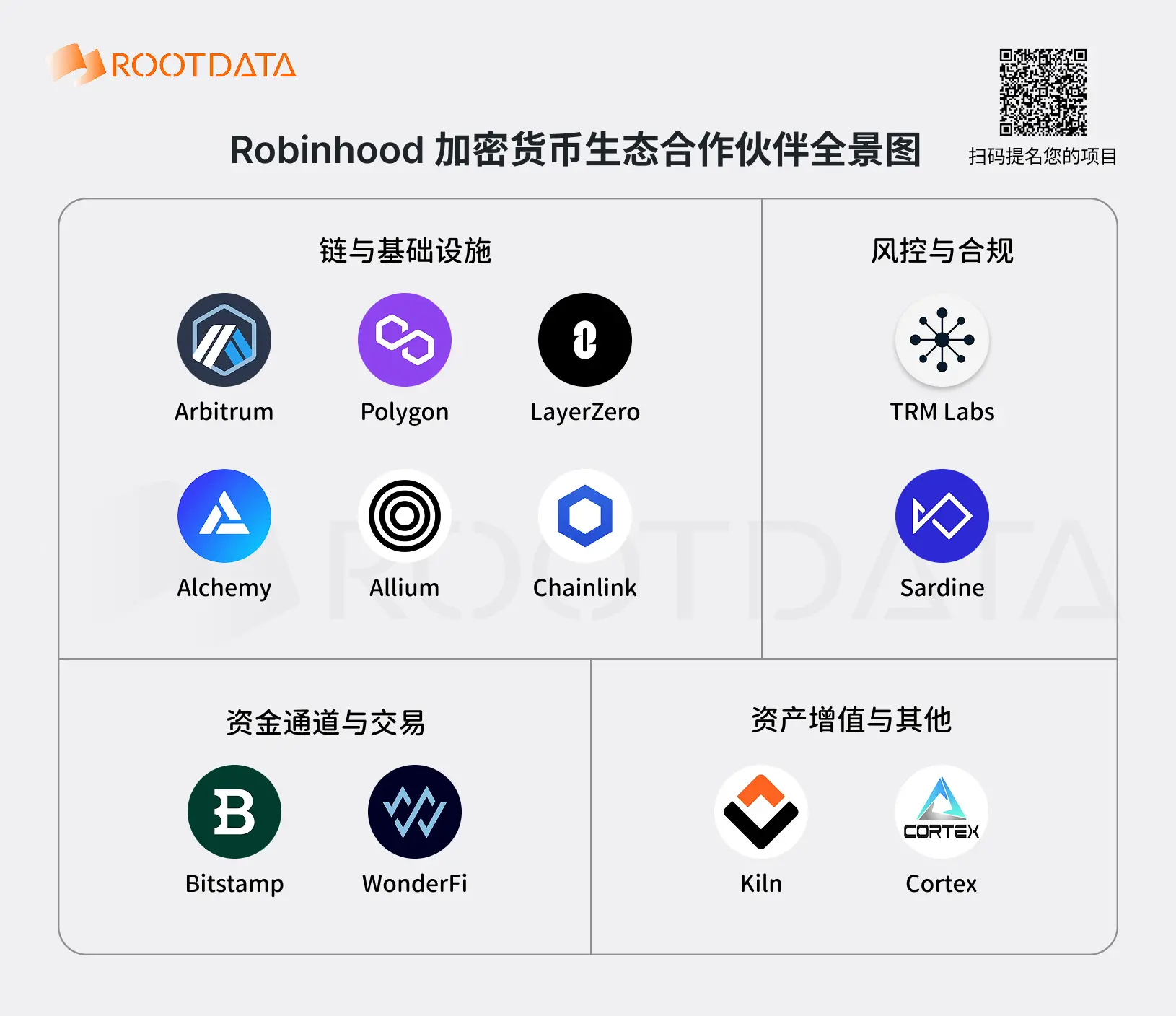
Illustration of Robinhood's 12 Web3 business partners: Compliance capabilities are transforming into competitive barriers

The Web3 asset data platform RootData has outlined Robinhood's Web3 partners, whose crypto supply chain covers key aspects such as data services, risk control compliance, and trading liquidity. Compliance capabilities are shifting from a "cost item" to a "competitive barrier." Structurally, Robinhood's crypto layout emphasizes **compliance first and robust expansion**: on one hand, it holds multiple financial and crypto-related licenses in the U.S. and several other regions, giving it a first-mover advantage in advancing its business within the regulatory framework; on the other hand, its partner selection clearly favors **suppliers with strong compliance capabilities and mature institutional-level services**. In the risk control and compliance aspects, Robinhood has introduced service providers like TRM Labs and Sardine to enhance on-chain transaction monitoring and anti-fraud capabilities; at the infrastructure level, it ensures system stability and data reliability through established networks and service providers such as Arbitrum, Polygon, Alchemy, and Chainlink; in terms of trading and liquidity, it supports platforms like Bitstamp and WonderFi that have compliance operating experience. Related compilation: 【[Robinhood Crypto Partner Network Compilation (Continuously Updated)](https://cn.rootdata.com/Archives/detail/Robinhood%20Crypto%20Business%20Partner?k=NDY0MjQ4)】 Crypto projects actively showcasing their partner networks have become a key way to enhance transparency and market trust. It is reported that RootData welcomes Web3 project parties to [claim data](https://www.rootdata.com/Projects/submit?ft=claimApply) and continues to track and open more project business relationship disclosure channels. The platform has continuously released multiple editions of the crypto project ecosystem map, nominating Web3 ecosystem partners for upstream clients such as Visa, Stripe, and Coinbase. **If you wish to nominate your project in future ecosystem maps, please fill out the 【[RootData 2026 Industry Ecosystem Mapping](https://forms.gle/tWArmXcpSfZJkh1r8)】 form to supplement your important clients and partners.**
Illustration of Robinhood's 12 Web3 business partners: Compliance capabilities are transforming into competitive barriers

Anthropic has been reported to launch a "migration prompt" tool, directly targeting OpenAI's memory barriers

Anthropic is accused of launching a prompt tool for "exporting ChatGPT memory data," helping users transfer historical memory information to its model Claude, which has drawn industry attention.According to public content, the tool allows users to export their memory data from OpenAI's ChatGPT by copying and pasting specific prompts, and then import it into Claude. Related discussions suggest that this move is seen as directly weakening the user stickiness and switching costs that ChatGPT relies on through its "memory function."Market views consider the memory mechanism as an important moat for large model products— the longer users engage, the deeper the model understands their preferences, context, and historical conversations, thereby increasing the migration costs. If third-party tools can facilitate easy data migration, it may change the current user lock-in logic of AI products.Meanwhile, reports also mentioned that Anthropic was previously restricted from use by relevant systems of the U.S. Department of Defense, but the company's popularity and attention have quickly surged, topping some application rankings.Currently, the specific compliance of the aforementioned tool and the platform's response have not been clarified. The industry generally believes that competition among large models has extended from performance comparisons to ecological and data sovereignty aspects, with user data portability potentially becoming a key variable in the next stage.
app_icon
ChainCatcher Building the Web3 world with innovations.