








Bitcoin confirms the removal of OP_Return byte limit: Is Bitcoin facing on-chain governance rifts again?
 Core Viewpoint

 The debate about OP_Return has lasted nearly six months. Will it trigger a hard fork similar to that of 2017?
Author: Chloe, ChainCatcher
Yesterday (22), the Bitcoin Core development team officially confirmed that it will remove the 80-byte limit on the OP_Return opcode in version 30.0. Bitcoin developer and advocate Jimmy Song strongly criticized Bitcoin Core for this move, calling it fundamentally a "fiat mindset."
The development team ignores the voices from the Bitcoin community and node operators
OPReturn is a special output format in Bitcoin transactions that allows a small amount of data to be written to the blockchain, primarily used for storing small pieces of information on the Bitcoin blockchain without affecting its functionality. However, unlike regular transaction outputs, OPReturn outputs cannot be spent and do not add to the burden of the unspent transaction outputs (UTXOs) set.
It can be said that OP_Return allows Bitcoin to be used not only as a currency but also as a tool for data storage and verification, while also providing a foundation for the development of other assets and applications, such as during the Ordinals inscription craze in early 2024.
OP_Return was proposed by the Bitcoin developer community in 2014, originally designed to allow transactions to safely carry "a small amount of data" written into the blockchain, with a typical limit of 40 bytes, which was later increased to 80 bytes in v0.11. The original intention of this feature was to give users the opportunity to leave a brief message on the Bitcoin chain (such as proof of ownership, digital file hashes, copyright statements, evidence of artwork, etc.), while avoiding "non-monetary uses" from occupying UTXO space, thus keeping the ledger clean.
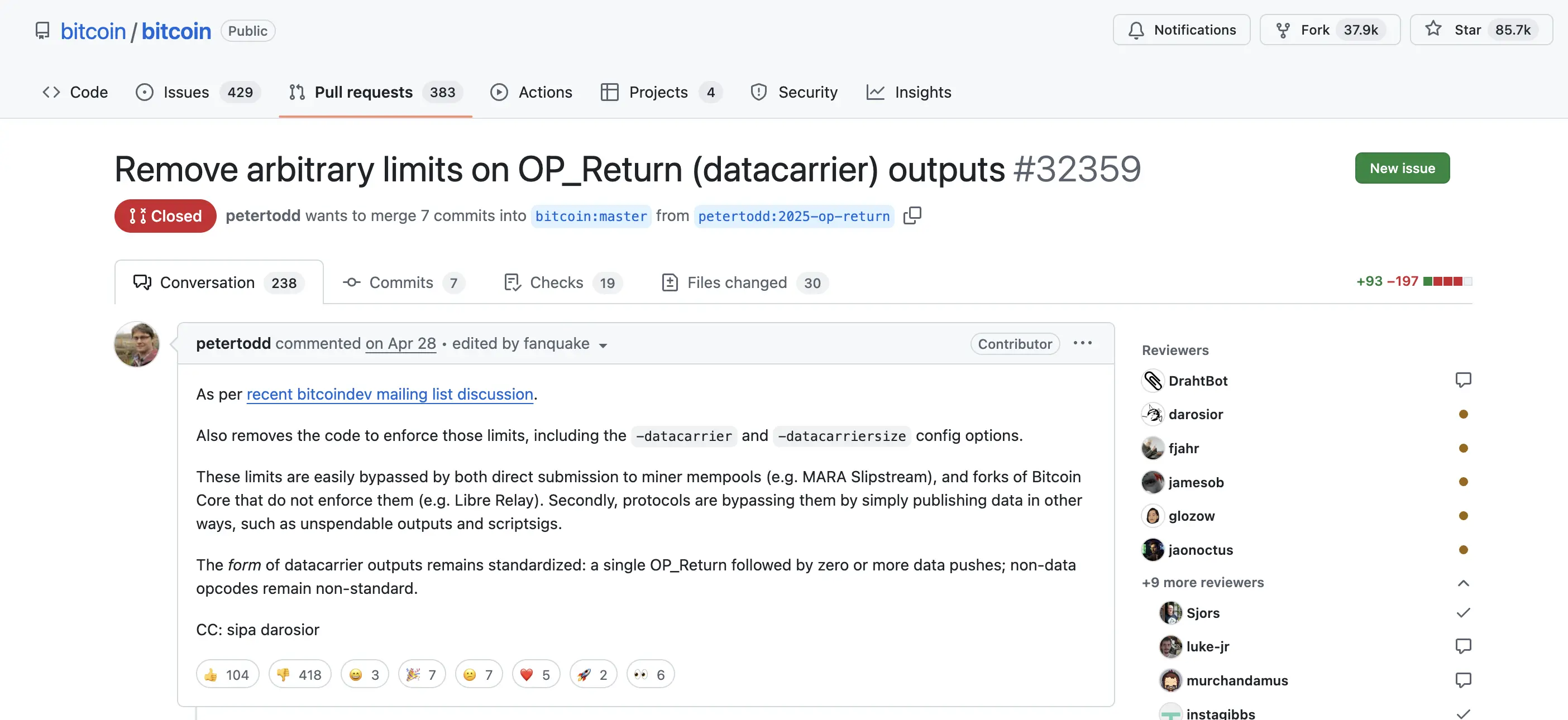
The decision to remove the OPReturn opcode has led Jimmy Song to accuse Core developers of evading users' concerns about the removal of the OPReturn limit (currently 80 bytes) and ignoring the strong opposition from the Bitcoin community and node operators.
Many opponents worry that if non-financial data floods in, the blockchain size will accelerate its expansion, raising hardware costs and undermining the foundation of "anyone can run a node."
Song stated, "The argument that it's difficult to define garbage information, and therefore no distinction is made in software design, is a waste of time 'political' sophistry; the non-monetary uses of Bitcoin are garbage information."
The debate over OPReturn has lasted nearly six months, inevitably reminding the market of the Bitcoin block size debate from 2015 to 2017, which ultimately led to a hard fork of the Bitcoin protocol and the birth of Bitcoin Cash (BCH). This has led some members of the Bitcoin community to speculate whether the OPReturn dispute will also trigger a similar split.
The community's long inability to reach consensus in 2017 ultimately led to a hard fork
From 2015 to 2017, the Bitcoin community was embroiled in fierce debates over the block size limit (1MB), splitting into the "big block" camp and the "small block" camp. The former sought to modify the original Bitcoin protocol to increase block capacity to handle more transactions, arguing that cheaper and faster transactions would make Bitcoin more scalable.
The latter wanted to maintain the 1 MB size limit (which Satoshi Nakamoto originally set for each block and never publicly explained why the 1MB block size limit was added), prioritizing the fundamental principles of Bitcoin's security and decentralization. They believed that increasing the block size would raise the cost for ordinary users to run Bitcoin nodes, leading enterprises to host nodes in data centers, thereby harming the network's decentralization.
After a long-standing inability to reach consensus, this ultimately led to a hard fork. On August 1, 2017, the camp supporting block expansion created a new chain, Bitcoin Cash, raising the block limit to 8MB, which was later further expanded to 32MB. BTC (Bitcoin) maintained the original 1MB block limit, shifting towards a role as "digital gold" and a store of value; BCH focused on "payment applications" and fast, low-cost everyday transactions.
This established two major paths: BTC as digital gold (high security, store of value) and BCH as a circulating currency (fast, low cost), directly influencing subsequent Bitcoin governance, protocol disputes, and other fork discussions.
Mass exodus of nodes towards Bitcoin Knots
Currently, many node operators are turning to Bitcoin Knots, which maintains existing data limits. According to Coin Dance data, the proportion of nodes using Bitcoin Knots surged from about 1% in 2024 to 20%, showing vertical growth in just nine months. Knots allows node operators to enforce strict data size limits, and supporters believe this is necessary to maintain the decentralization of the Bitcoin protocol.
Since the establishment of the decentralized protocol in 2009, the Bitcoin ledger has generated approximately 680 GB of data, thanks to Bitcoin's simple architecture and strict data limits. Bitcoin's lower data storage requirements allow anyone to synchronize approximately 680 GB of complete chain data with just about $300 in retail hardware, greatly achieving democratized participation and maximum decentralization.
This time, node operators are taking action against the decision, leading to a historic wave of migration towards Bitcoin Knots.
Meanwhile, developers supporting the removal of the OPReturn limit argue that the existing 80-byte limit is merely an artificially set threshold, and there are already various ways to circumvent it, such as utilizing the Taproot and Ordinals technologies in Bitcoin protocol upgrades to split data and embed it in different parts of transactions, breaking through the single OPReturn size limit. If the data carrying capacity can be increased, it could stimulate more innovative applications, thus supporting the sustainable development of the network.
The debate over the OP_Return limit highlights the Bitcoin community's challenge in balancing on-chain data storage space with decentralization principles. As technology evolves and use cases diversify, the 80-byte limit can no longer effectively reflect real-world needs. Removing this limit means that the Bitcoin ecosystem will enter a more open and inclusive phase, helping to foster more innovative applications and providing new revenue incentives for miners.
However, this also brings risks of network expansion and decentralization pressure, forcing the community to re-examine how to find a balance between expansion and protecting core values.
 Risk warning
 Risk warning




Popular articles





