








Insider trading may be the most valuable part of predicting the market
 Core Viewpoint

 Prediction markets are not stock markets; they are essentially a radar of human collective intelligence. To keep this radar accurate, it is necessary to allow for the friction costs brought about by information arbitrage to a certain extent.
Author: Chloe, ChainCatcher
Recently, Venezuelan leader Maduro was arrested. Before mainstream media released the news, a Polymarket account established in late December quietly exited with a 1242% return. This event has prompted U.S. Congressman Ritchie Torres to introduce the "2026 Financial Prediction Market Public Integrity Act," attempting to bring traditional financial "insider trading" regulations into the crypto market.
This article will focus on the Maduro incident as a core case to delve into the controversial topic of "insider trading" in prediction markets, re-examining whether we need an absolutely equal casino or an accurate truth engine in decentralized prediction platforms.
Polymarket's "Prophet" Moment: Accurately Predicting Maduro's Downfall
In January 2026, Venezuelan leader Maduro was confirmed to have been arrested. While global mainstream media were still verifying sources, data from the decentralized prediction market Polymarket had already provided the answer.
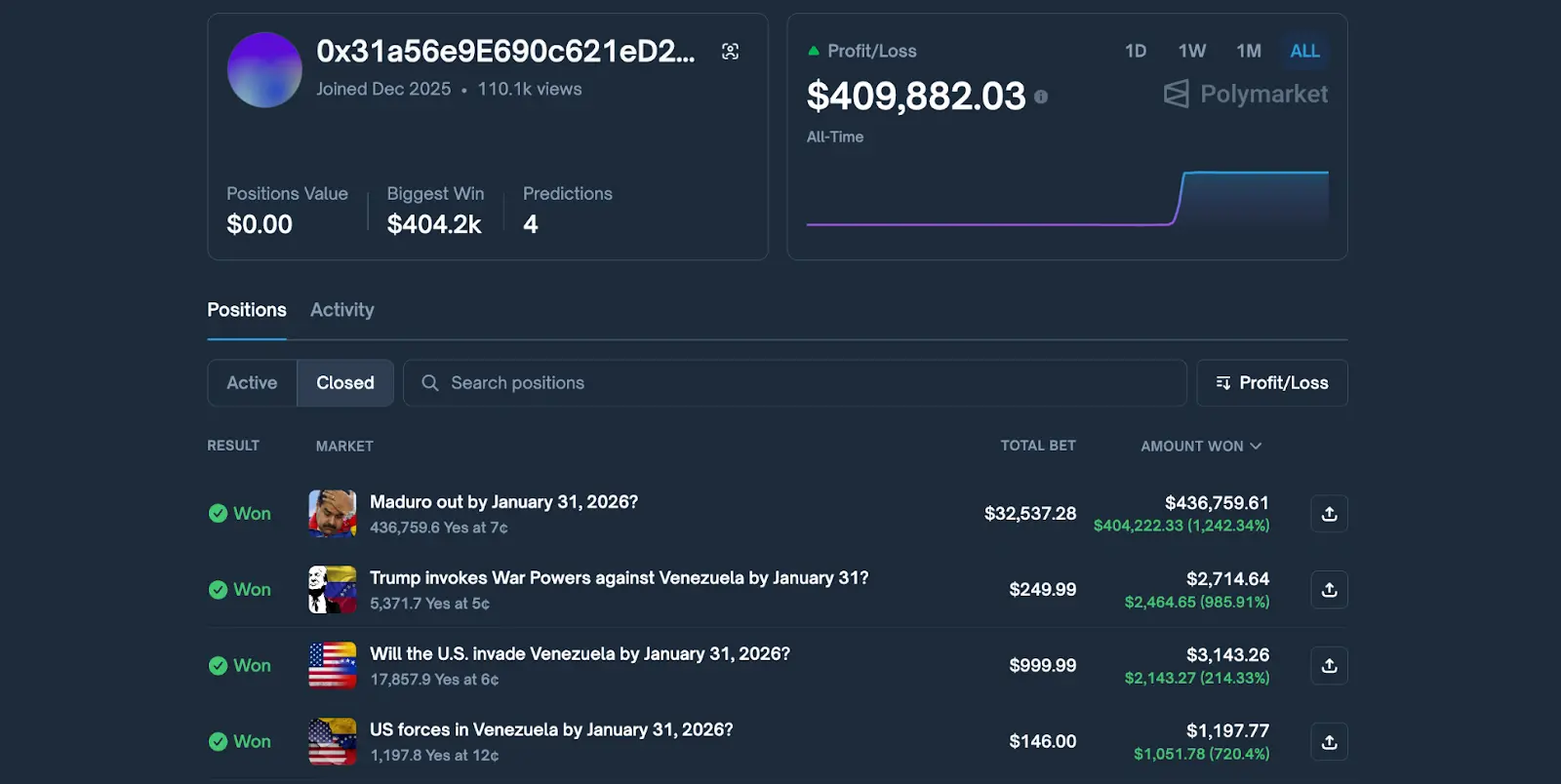
An account created on Polymarket in late December 2025 seemed to have a god-like perspective, accurately predicting the occurrence of the event. This account made four predictions during a period of market silence, all related to whether the U.S. would intervene in Venezuela, with the largest bet being $32,537 on "Maduro will step down before January 31." At that time, the market's expected probability for such extreme events was only in the single digits, and the account scooped up contracts at a very low price of 7 cents.
With the news of Trump's confirmation of military action breaking early Saturday morning, these contracts instantly soared to a settlement price close to $1. The account made over $400,000 in profit in less than 24 hours, with a return rate of 1242%. This was not an ordinary speculation but a precise strike.
A Mysterious Prophet or Insider Trading?
This massive profit with a god-like perspective quickly became the focus of the community. As discussions heated up, accusations of insider trading followed:
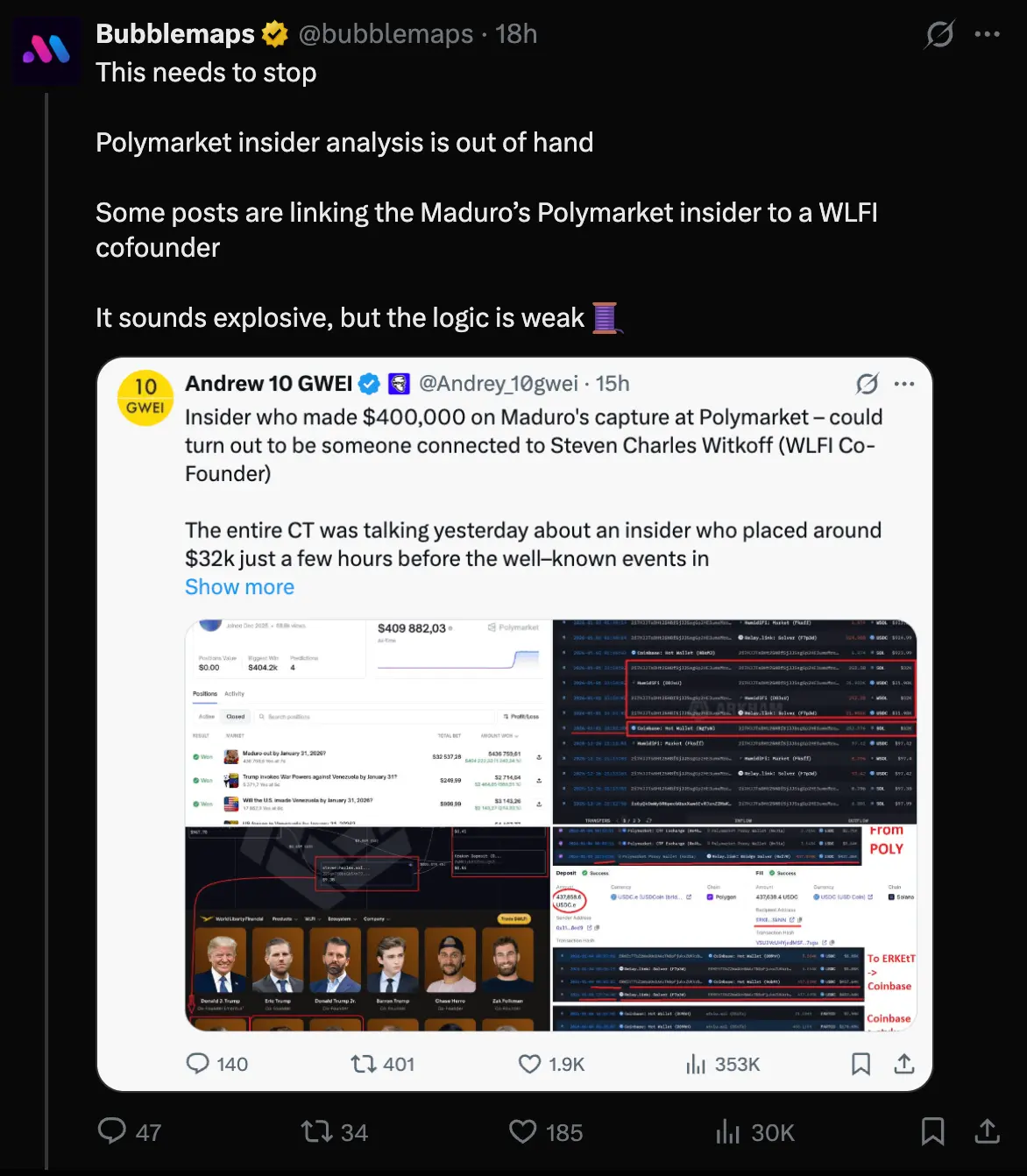
On-chain analyst Andrew 10 GWEI pointed out that the fund flow of this account showed a high degree of similarity: 252.39 SOL withdrawn from Coinbase on January 1 matched closely in amount and timing (23 hours apart) with 252.91 SOL deposited into another wallet the previous day, suggesting a possible intermediary chain break through the exchange. More controversially, the associated wallet registered domains like StCharles.sol and had significant transactions with the address of Steven Charles Witkoff, a co-founder of the suspected World Liberty Finance (WLFI). Given WLFI's close ties to the Trump family, this raised strong suspicions: was this insider trading utilizing information from within the White House?
The on-chain analysis platform BubbleMaps subsequently expressed a different viewpoint. They argued that the inference of "similar timing and amount" was too superficial and pointed out that there were at least 20 wallets on-chain that fit this pattern. Furthermore, Andrew's argument lacked direct evidence of on-chain fund movement, thus there was no reliable evidence linking the Polymarket account to WLFI.
Congressman Proposes Integrity Bill: Aims to Regulate Insider Trading in Prediction Markets
This incident also led to U.S. Congressman Ritchie Torres proposing the "2026 Financial Prediction Market Public Integrity Act," which aims to prohibit federally elected officials, politically appointed officials, and executive branch employees from trading in prediction markets related to government policies using "material non-public information" obtained through their official positions.
However, this bill faces a dual gap in reality. First is the lengthy and variable legislative path; under the complex power dynamics of U.S. politics, such bills often undergo prolonged hearings and interest negotiations, easily becoming texts that reflect political statements more than substantive impact.
Second is the enforcement blind spot in a decentralized environment, where on-chain fund flows can easily be obscured by various privacy protocols or complex intermediary mechanisms. Although the bill symbolizes the traditional financial values beginning to formally intervene in prediction markets, attempting to protect retail investors from information harvesting and maintain fair participation rights in the market, we must consider: will this regulatory logic directly applied to decentralized prediction markets create conflicts due to differing core values, potentially leading to market dysfunction?
The Core Value of Prediction Markets and the Paradox of Insider Trading
Returning to first principles, what is the purpose of prediction markets? Is it to provide everyone with a fair opportunity to profit, or to achieve the most accurate predictive results?
Traditional finance prohibits insider trading to protect retail investors' confidence and prevent capital markets from becoming a cash machine for the powerful. However, in prediction markets, their core value may lie in "truth discovery."
Prediction markets are machines that aggregate fragmented information into price signals. If a market about "whether Maduro will step down" prohibits informed individuals from participating, then the price reflection of that market will forever be "guesses from outsiders," rather than "real probabilities," which would undermine the accuracy of prediction markets.
In the Maduro incident, suppose the profit-maker was not an insider but a top information analyst. By tracking abnormal radio signals at the Venezuelan border, private jet takeoffs and landings, and even the U.S. Department of Defense's public procurement lists, they could piece together a model that predicted military action. Such behavior may be controversial in traditional regulatory views, but under the logic of prediction markets, it is a highly valuable "information pricing behavior."
One of the missions of prediction markets is to break information monopolies. When various parties interpret vague and delayed government diplomatic language, the price fluctuations in prediction markets are already sending out warnings of the truth to the world. Therefore, rather than calling this insider trading, it is more accurate to say that it rewards those who bring hidden information to light through trading, thus providing the public with immediate risk guidance.
Prediction Markets Are Tools Born to Pursue Truth, Not Fair Trading Places
The emergence of the "2026 Financial Prediction Market Public Integrity Act" may reflect a cognitive bias of regulators towards decentralized prediction platforms. If we pursue a "completely fair" prediction market, we will ultimately end up with a "completely ineffective" prediction market.
The Maduro incident profoundly reveals the true value of prediction markets: it allows hidden truths to be transformed into signals on-chain that everyone can examine through the traces of fund flows. The transparency of blockchain breaks the black box; even if we cannot immediately identify the behind-the-scenes players, when mysterious accounts build positions and probabilities fluctuate dramatically, the market is actually sending signals. This can attract smart money to follow quickly, rapidly leveling the originally unequal information gap, thus transforming "insider" into "public probability."
Prediction markets are not stock markets; they are essentially a radar of human collective wisdom. To keep this radar accurate, it is necessary to allow for the frictional costs that come with information arbitrage to some extent. Therefore, rather than attempting to block signals with prohibitions, we should consider whether to position prediction markets as tools born to pursue truth, rather than as fair trading places.
 Risk warning
 Risk warning



Popular articles





